Five-Fold Peak Traffic: Elastic Optimization for AI Customer Service Systems

At mega-sale midnight, customer service requests instantly hit five times the daily volume: responses slow, requests time out, model invocation costs climb steeply. Users are at their most anxious (paid, no order, no delivery) exactly when the system is most fragile — the stress test AI customer service systems face every year. Frantically adding machines at the last minute is both expensive and too late.
This is the tenth post in an experience-sharing series for AI customer service product managers and developers, drawn from hands-on practice as an AI product manager at a Southeast Asian cross-border e-commerce platform. In this post I want to share how to optimize the system across concurrency control, request queues, caching, model routing, degradation strategies, and elastic scaling when a mega-sale suddenly grows customer service requests 5x and latency, request timeouts, and model invocation costs climb.
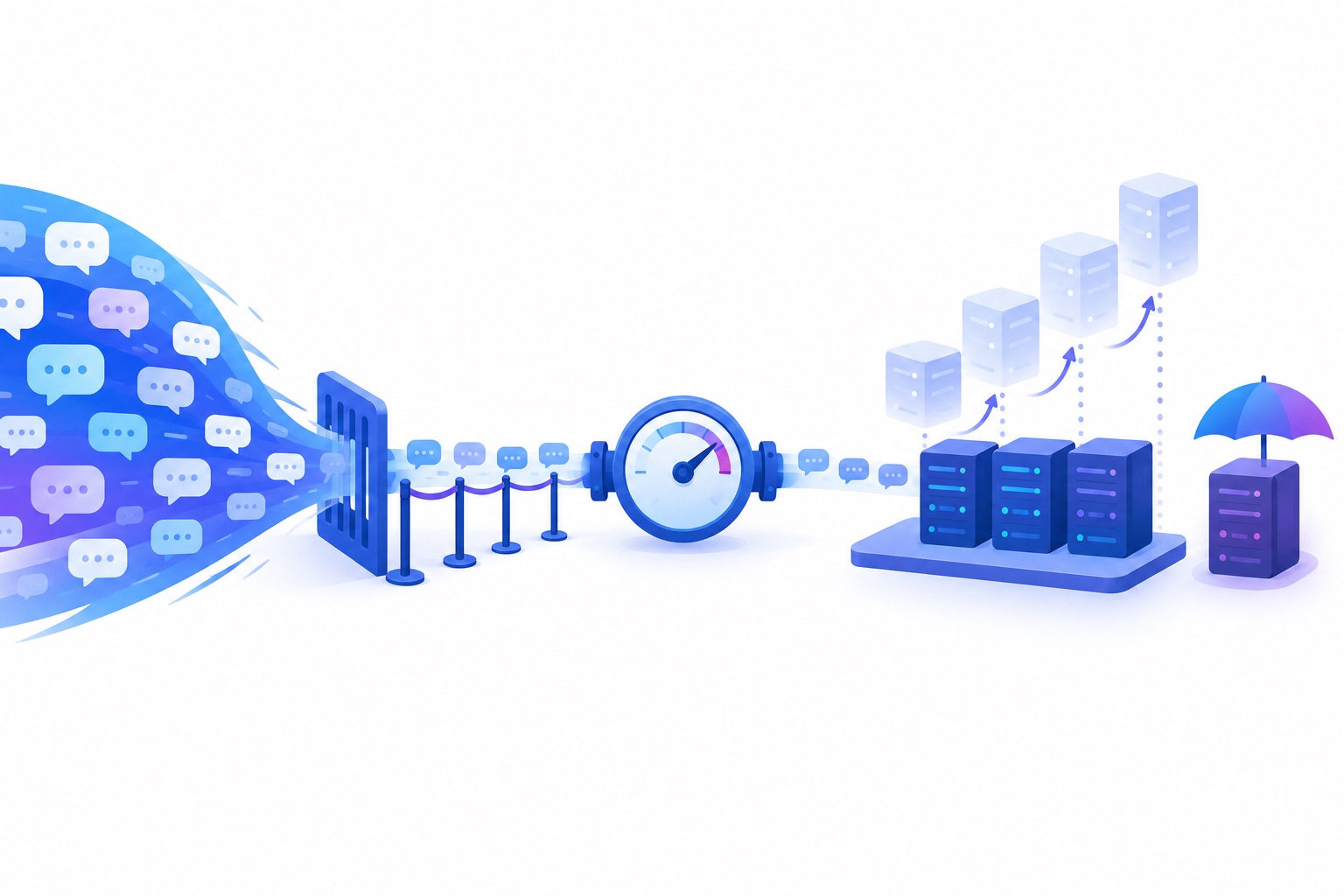
Three Key Points in Peak-Traffic Optimization
- High-concurrency system design: rate limiting, queues, caching, and scaling forming a coherent playbook.
- Cost-experience trade-offs: every point of inference cost is amplified five times during peak — the line between saving money and protecting experience must be drawn deliberately.
- Degradation and fault-tolerance planning: the system will overload; fallback tiers must be designed and rehearsed in advance.
The Overall Design
1. Concurrency control and request queues: protect downstream first
- Rate limit at the gateway (per user, per endpoint) with token bucket / leaky bucket to control downstream pressure;
- Route excess requests into a peak-shaving queue with a maximum wait time; on timeout, quickly return a "we're experiencing high volume" reassurance plus self-service entry — a self-service path at 3 seconds beats timing out after 30 seconds of waiting;
- Priority queueing: payment and refund issues first, general inquiries later.
2. Caching: never recompute what you can reuse
- Multi-level caching: normalize high-frequency FAQ queries (rewrite colloquial phrasing into standard questions) before caching answers, dramatically raising hit rates; short-TTL reuse of retrieval results; reuse of in-session context and intermediate results to cut repeated retrieval and calls;
- Pre-warm the highest-demand knowledge before the sale: logistics policies, return rules, mega-sale mechanics.
3. Model routing: tiered large and small models
- Tiered invocation: simple intent recognition and standardized FAQs go to small models or rule engines; only complex questions route to the large model. During the sale, actively lower the traffic ratio routed to the large model;
- Streaming output reduces first-token latency — perceived speed improves immediately.
4. Degradation: a ladder, not a switch
- Tier 1: reduce retrieval top-K and shorten context;
- Tier 2: switch to a smaller model;
- Tier 3: serve high-frequency questions with fixed responses + self-service links;
- Tier 4: guide users to human agents / community, keeping critical scenarios alive.
Also define non-degradable scenarios: money, complaints, and security — these can queue, but quality must hold.
5. Elastic scaling: plan before the storm
- Horizontally scale stateless services plus elastic GPU inference scheduling;
- Load-test before the sale to establish capacity headroom, with scaling runbooks and on-call alerting — nobody should be guessing "should we add machines?" at midnight.
How This Maps to Weiyu
The Weiyu open-source customer service system (GitHub: https://github.com/bytedesk/bytedesk , website: https://www.weiyuai.cn ) has a tech stack well suited to high-concurrency support: the backend supports Redis caching and message-queue peak shaving, with traffic scheduling at the channel access layer; knowledge base and FAQ capabilities absorb high-frequency standard questions, reducing LLM calls; AI and human agents mix flexibly, letting teams adjust the human-AI ratio dynamically during sales, with the queue-to-human path ready when AI overloads; conversation statistics feed back per-channel load and resolution in real time, informing scaling decisions. The open-source architecture also makes it easy to add rate limiting and degradation policies on your own infrastructure.
Key Takeaways
- Rate limiting + queue-based peak shaving is the first line of defense; cap queue waits and hand users self-service fast on timeout.
- Layered caching: FAQ answer caching after query normalization offers the best ROI; pre-warm before the sale.
- Tiered model routing; actively lower the large-model traffic share during peaks.
- Make degradation a ladder while red-lining money, complaints, and security scenarios.
- Load tests + scaling runbooks + on-call alerts — with plans in place, you can actually sleep during the mega-sale.