Tool Calling for Business Operations: Making AI Support Safe at Taking Actions

A chatty AI support bot that misspeaks earns a user complaint; an operational AI support bot that executes a wrong refund loses real money. Once the bot gains the ability to cancel orders, change addresses, and file returns, the first design principle shifts from "fluent answers" to "reliable operations".
This post is part of an experience-sharing series on "AI customer service product and engineering practice", drawn from hands-on practice at a global fast-fashion cross-border e-commerce platform. In this post I want to share how to design the tool-calling mechanism behind scenarios like canceling orders, changing addresses, applying for returns, and checking refunds, so that permission checks, timeouts, duplicate requests, abnormal states, and execution failures are all handled and business operations stay accurate and reliable.
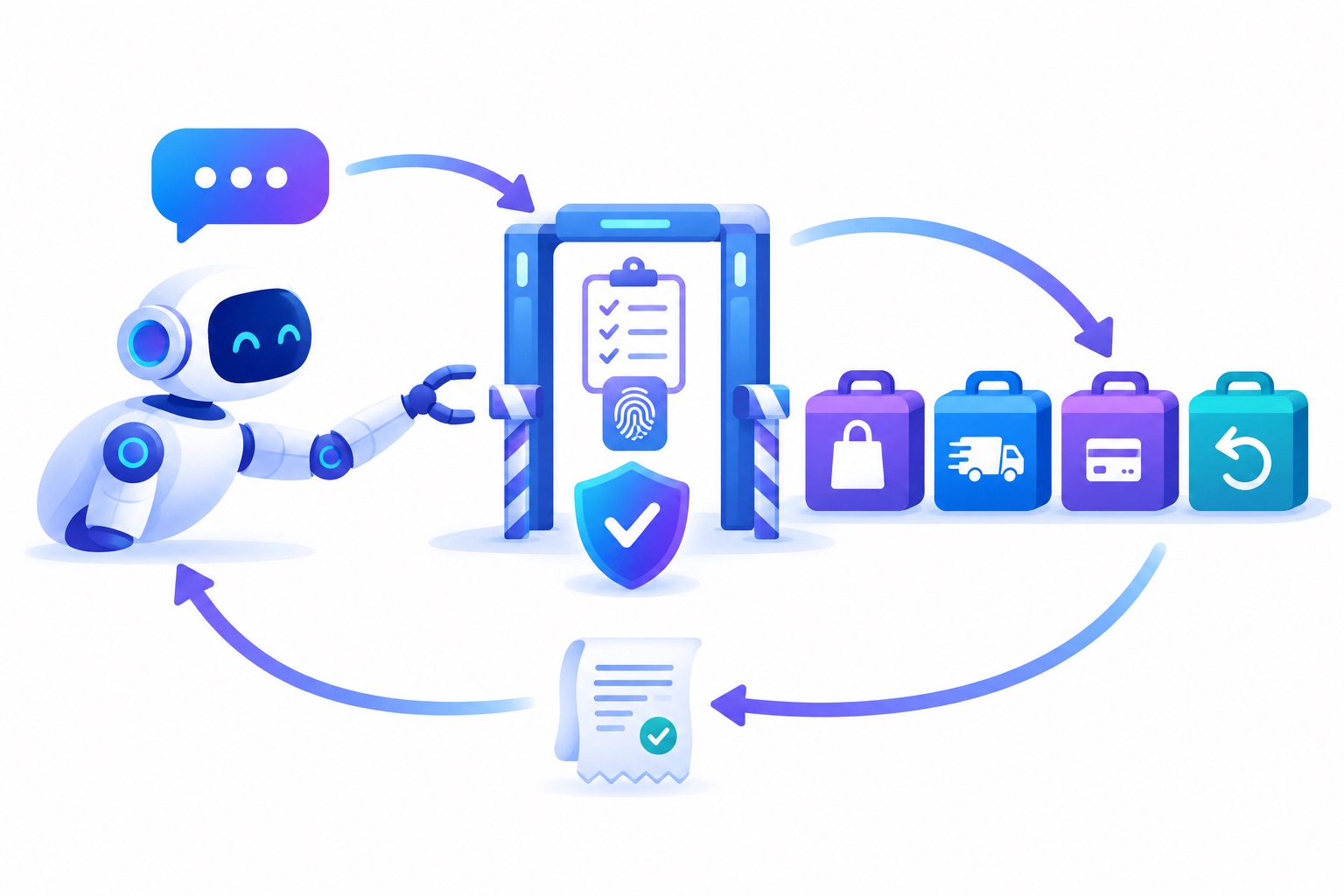
Four Key Points in Tool Calling Design
- Standardize every tool: registration, parameter validation, and result handling follow one explicit contract.
- Gate sensitive operations: permission checks, identity verification, and double confirmation come before anything that mutates state.
- Build for distributed failure: idempotency, timeout retries, state machine validation, and compensation form the reliability quartet.
- Always leave an exit: fallback and escalation paths exist for every failure mode.
The Overall Design
My governing principle: the LLM only understands and decides; the business system's real state determines the final outcome.
Step 1: Tool registration and standardization
- Wrap each business capability as a standard tool: tool name, description, input schema, output schema, and error codes—all specified explicitly.
- The LLM only selects tools and assembles parameters based on intent; actual execution happens in the system layer, and the model never touches business APIs directly.
- Front-load parameter validation: input format, required fields, and business legality (the order belongs to this user) are validated before the call—invalid requests never reach the business system.
Step 2: Permission and identity checks
- Complete identity verification when the session starts (login state; SMS/email second factor when necessary).
- Authorize before operating: verify user-order ownership; high-risk operations (refunds, cancellations) require explicit double confirmation—execute only after the user clearly replies "confirm".
- Tiered permissions: queries are low-threshold, operations are high-threshold, and money-movement operations only guide users to official pages or route to humans.
Step 3: Reliability design—four mechanisms
- Idempotency: every operation carries a unique request ID; duplicates return the first result, preventing duplicate refunds at the root.
- Timeout and retry: set timeouts; retryable interfaces use exponential backoff; non-retryable ones (like an already-submitted cancellation) query status first instead of blindly resending.
- State machine validation: pre-check business state before calling—a shipped order cannot be canceled—and explain the reason to the user instead of throwing an error.
- Failure handling: on failure, give clear wording and alternatives, log the failure; operations needing compensation (cancellation succeeded but notification failed) go through an async compensation queue.
Step 4: Result confirmation and fallback
- After execution, read back the business state to confirm the real outcome before reporting to the user—a successful API call is not a successful business operation.
- Continuous failures or abnormal states auto-escalate to humans with complete call records so agents can investigate immediately.
- Full-chain audit logs: who triggered what operation in which session, and the outcome—fully traceable.
With this mechanism, efficiency is preserved while financial and data risks stay controlled—the model can make mistakes, but the mistakes never reach the business system.
Practice in Bytedesk
The AI Agent in the open-source Bytedesk customer service system (GitHub, website https://www.weiyuai.cn ) supports function calling, letting capabilities like order lookup and tracking be registered as standard tools for the model to invoke; human agents can handle sensitive operations requiring double confirmation within the conversation, forming a "machine understands, human confirms" collaboration; the ticket system carries complex business workflows; and full message and operation records support post-hoc auditing.
Key Takeaways
- Core principle: the model understands and decides; business outcomes follow the system's real state.
- Register tools in a standard way with front-loaded validation—invalid requests never reach the business system.
- High-risk operations need the triple safeguard: identity verification + ownership check + double confirmation.
- Reliability quartet: idempotency, tiered retries, state pre-checks, async compensation.
- Read back state after execution; auto-escalate on failure; keep full-chain audit logs.