Designing the Routing Mechanism Between AI and Human Customer Service

The two extremes that hurt user experience often coexist in one team: a bot that cannot answer but stubbornly refuses to transfer until the user types "human agent" three times; and thresholds so loose that floods of simple questions pour into human queues, keeping agent costs high. The essence of routing design is finding a dynamic balance between cost and experience.
This post is part of an experience-sharing series on "AI customer service product and engineering practice", drawn from hands-on practice at a global fast-fashion cross-border e-commerce platform. In this post I want to share a deployable routing mechanism between AI and human customer service: the signals that feed the routing decision, the criteria for the three outcomes—bot handles autonomously, keep clarifying, transfer to human—how the human inherits the complete user request, conversation history, and business records after transfer, and how thresholds keep being tuned with data after launch.
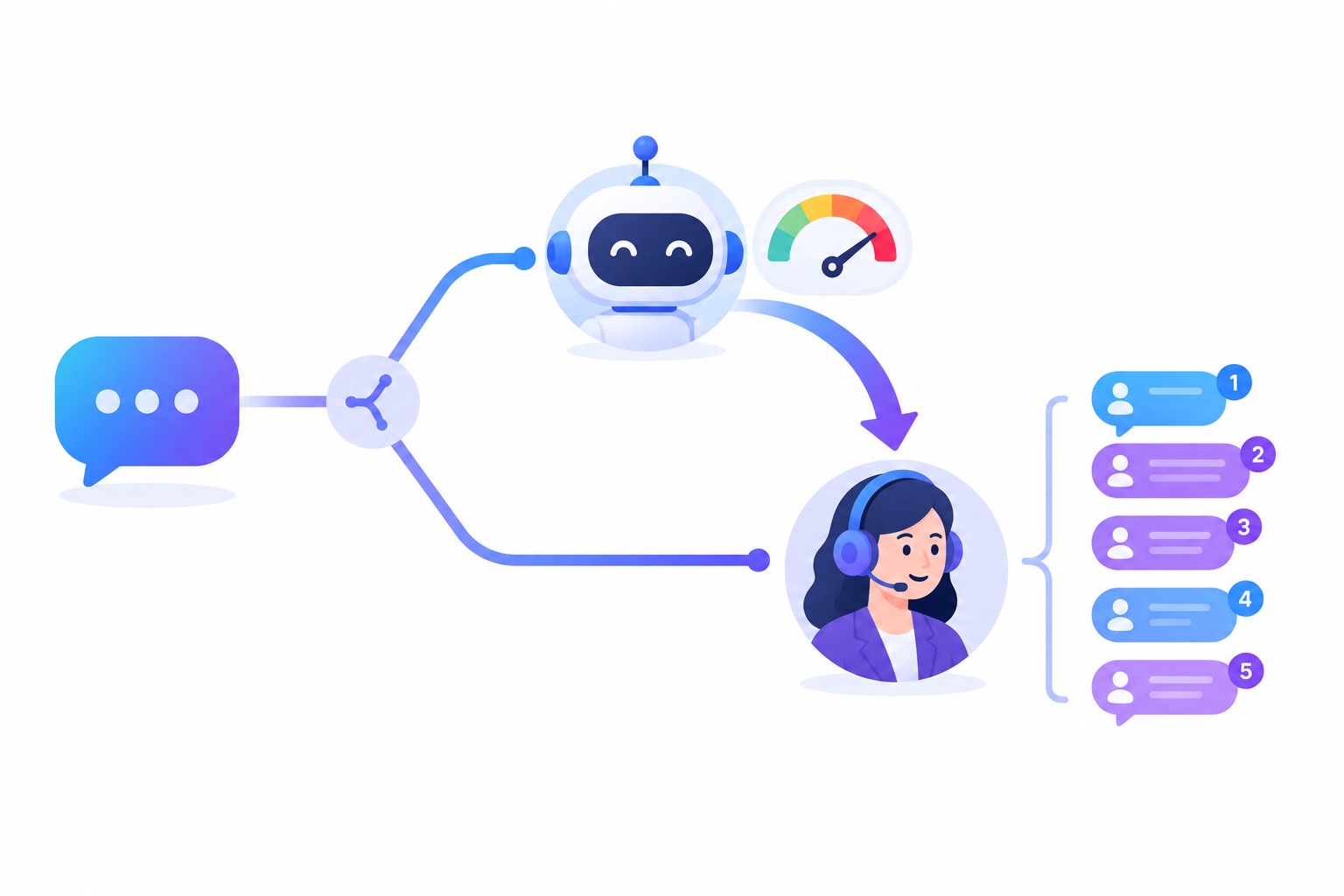
Four Key Points in Routing Design
- Routing must be multi-dimensional: confidence alone is not enough—issue type and user value belong in the decision too.
- Criteria must be quantified: transfer rules are executable and configurable, never "it depends".
- Handover must be complete: context inheritance and ticket system integration decide whether users repeat themselves.
- Balance cost and experience: weighing transfer rate against resolution rate runs through the whole design.
Overall Routing Design
I would design across three parts: decision criteria, handover, and the optimization loop.
Step 1: Routing decisions—four signal families combined
- Bot-side signals: intent confidence, knowledge hit score, clarification turn count, user sentiment (negative-word detection), repeat contacts.
- Business-side signals: issue type (money-movement and safety issues force human), abnormal order states, complaint involvement.
- User-side signals: user value tier, membership level, explicit human request—when the user says "human agent", respect it; do not stall with scripts.
- Operations-side signals: current human queue status; dynamically adjust thresholds at peak times.
Step 2: Criteria for three outcomes
- Bot handles autonomously: high-confidence intent + knowledge hit + standard-flow scenarios (order status, tracking, policy questions).
- Keep clarifying: intent is clear but information incomplete; ask slot-filling questions 1-2 times; if still unclear beyond the cap, transfer—never interrogate endlessly.
- Transfer to human: low confidence, knowledge miss, agitated user, financial disputes, safety complaints, explicit requests, repeat contacts on the same issue.
Step 3: Context inheritance on handover—the key to experience
- Generate a structured conversation summary at transfer: core request, recognized intents and entities, executed operations, and replies the bot already gave.
- Pass the full conversation history along; the agent sees everything in one screen.
- Show business records (API results, ticket status) so the agent can continue operating immediately—the user never repeats themselves.
- Manage the transfer script: tell the user "transferring you to an agent; all previous conversation has been shared" to reduce waiting anxiety.
Step 4: The optimization loop—let agent labels feed back into routing
- After handling, agents label whether "the bot could have solved this" or "genuinely beyond the bot", feeding threshold tuning.
- Monitor transfer rate and post-transfer first-contact resolution to avoid both failure modes: "should transfer but didn't" hurts experience, "transfers everything" burns cost.
- If many cases are labeled "bot could have solved", thresholds are too loose; if transfer rates are high but all are genuinely hard, bot capability needs strengthening.
Practice in Bytedesk
The open-source Bytedesk customer service system (GitHub, website https://www.weiyuai.cn ) natively supports bot-first reception and auto-transfer rules based on keywords or non-response; agents see the full message history after transfer; the ticket system carries post-transfer business workflows; and conversation statistics provide transfer-rate metrics for continuous threshold tuning.
Key Takeaways
- Combine bot-side, business-side, user-side, and operations-side signals; always honor explicit human requests.
- Three outcomes with clear criteria: answer at high confidence, clarify with a turn cap, transfer at low confidence.
- Handover core: structured summary + full history + business records in one screen, no repeated descriptions.
- Let agent labels feed routing strategy; watch transfer rate and post-transfer first-contact resolution.
- "Should transfer but didn't" hurts experience; "transfers everything" burns cost—routing is a dynamic balance, not a one-time config.