The Intelligent Service Optimization Loop: Prioritizing Knowledge Base, Prompts, and Models When Resources Are Scarce

The platform has accumulated mountains of consultation records, bot failure cases, and human-agent data — and then what? For most teams the ending is: data sits in the warehouse, algorithm and R&D resources are forever scarce, and optimization runs on gut feeling — whoever shouts loudest gets built first. Intelligent service optimization should not be a firefighting crew; it should be a continuously running machine that sorts by value and validates by benefit.
This post is part of an experience-sharing series for AI customer service product managers and developers, drawn from hands-on practice as an intelligent service product manager at a large general e-commerce platform. In this post I want to share how to build the data analysis and optimization loop with large volumes of consultation records, bot failure cases, and human service data but limited algorithm and R&D resources — identifying high-value problems, setting priorities across knowledge base, prompts, models, Agent workflows, and product interactions, and validating the actual business benefit of each optimization.
The crux is priority decisions under resource constraints (ROI thinking) and the design of a data-driven loop — when the budget is finite, ordering itself is the strategy.
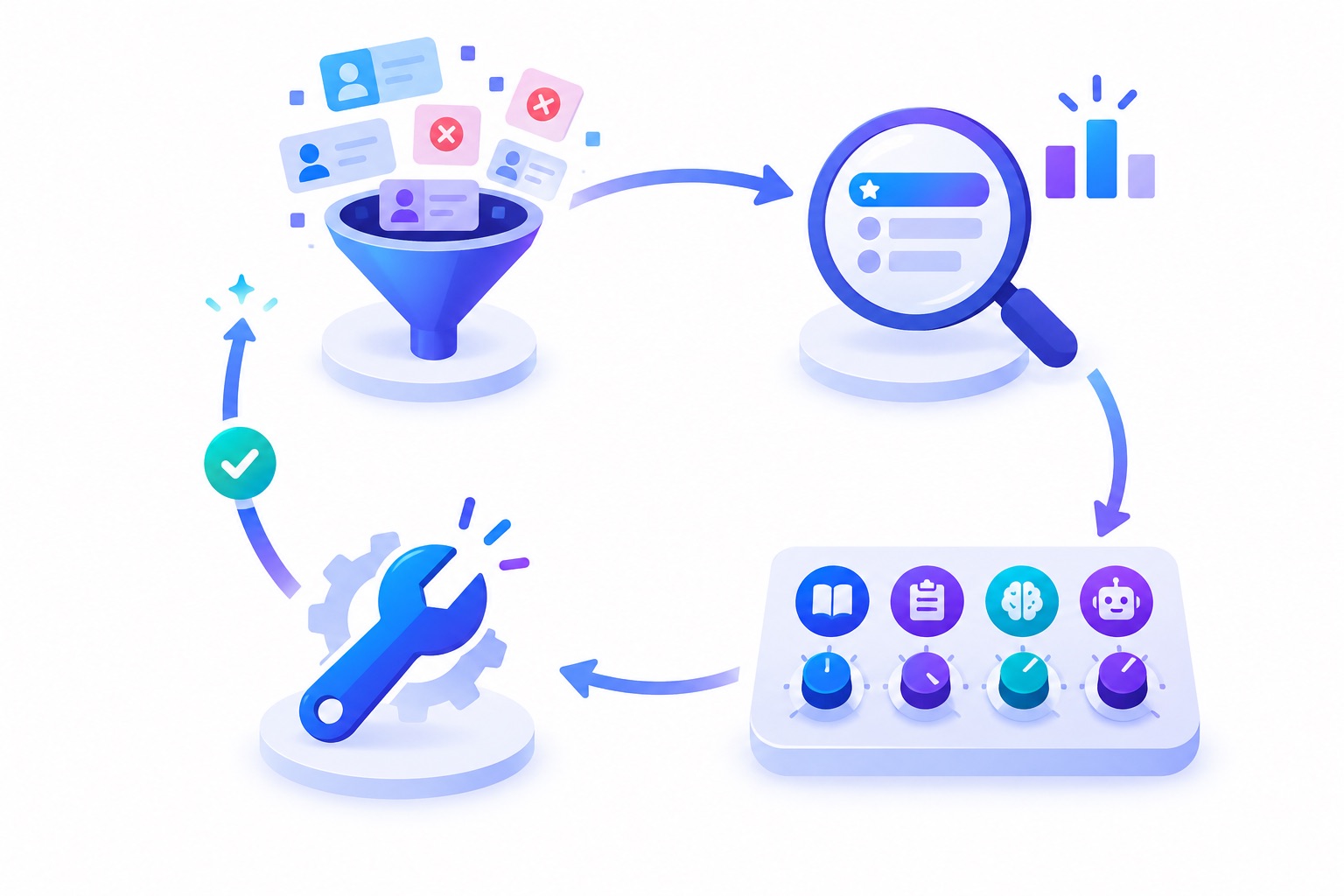
Two Key Points in the Optimization Loop
- Priority decisions under resource constraints: ranking by ROI instead of being led by business-side volume or technical enthusiasm.
- Landing design of the data-driven loop: from data foundation, problem identification, and lever selection to benefit validation — a mechanism that keeps running.
The Overall Design
Step 1: Build the data foundation
- Unify session data standards: session tagging (scenario, intent, resolved/unresolved, transfer reason, user feedback) plus Bad Case attribution (missing knowledge / retrieval failure / generation error / tool failure / process blockage).
- No big investment required: start with manual sampling for attribution plus rule-based auto-tagging, turning existing data into analyzable structured assets. The essence of the data foundation is "letting failure cases speak", not building a data platform.
Step 2: Identify high-value problems
Rank by "traffic × value × solvability" across three dimensions:
- Traffic: session volume and repeat-contact volume per problem category;
- Value: monetary impact (refund disputes), satisfaction impact (complaint concentration), cost impact (transfer volume);
- Solvability: can current resources solve it cheaply — adding knowledge is far easier than swapping models, which is easier than rebuilding workflows.
Output a high-value problem list: for example, "logistics-exception questions in one category account for 15% of failed sessions and a batch of knowledge fixes them" should outrank "a full model upgrade". The same benefit can differ in cost by an order of magnitude.
Step 3: Rank the optimization levers (from cheap to expensive)
- Knowledge base additions/repairs: cheapest and fastest; cover high-frequency gaps first;
- Prompt optimization: quick iteration for generation-quality problems;
- Product interaction optimization: guiding copy, quick entries, card design;
- Agent workflow adjustments: for task-completion bottlenecks;
- Model upgrade/fine-tuning: the largest investment — save it until the first four are exhausted.
This ordering is not a technical judgment but a cost-effectiveness judgment: exhaust the cheap levers before touching the expensive ones.
Step 4: The benefit-validation loop
- Each optimization defines expected benefit metrics (scenario resolution rate, transfer rate, cost) and is validated via small-traffic A/B or before/after comparison;
- Build an "optimization ledger": record each item's investment, launch date, validation method, and actual benefit — reusable ROI experience. The ledger becomes your intuition calibrator the next time you prioritize;
- Regular reviews: watch metric trends by scenario, spot new high-value problems, and roll into the next round. The point of a loop is that once it spins, it never stops.
Two insights worth keeping
The trade-off view under constraints: "exhaust the cheap levers (knowledge, prompts) before considering the expensive one (models)" — this engineering cost-effectiveness mindset is what business stakeholders value most. Team trust is built on a track record of "every investment paid off", not on "we use the latest model" headlines.
The optimization ledger makes every decision traceable: how much invested, how much returned, how validated — the direct expression of a PM's closed-loop management, and your confidence a year later when asked "why this priority order".
How This Maps to Bytedesk
Bytedesk, the open-source AI customer service system (GitHub, site), provides ready-made building blocks for this loop: session statistics dashboards cover reception volume, transfer rate, and satisfaction with time trends; quality inspection supports failed-session sampling and attribution; the knowledge base supports fast additions and hot updates — the prime landing spot for "the cheapest lever"; FAQ and quick replies adjust guiding copy instantly; multi-model access makes "swapping models" a configuration-level operation rather than an engineering project; and the VOC module collects user feedback for value assessment. The optimization ledger is a team management practice, maintainable from Bytedesk's statistics exports.
Key Takeaways
- Start with the data foundation: session tagging + Bad Case attribution via manual sampling and rules — no platform build required.
- Rank high-value problems on traffic × value × solvability; output a list, not a feeling.
- Order levers from cheap to expensive: knowledge → prompts → interaction → workflow → model.
- Define expected benefit and A/B validate every optimization; accumulate ROI experience in a ledger.
- The loop's value is continuous operation: review → new problems → the next round, never stopping.