Redesigning the E-Commerce Customer Service Journey: Splitting Work Between Bot Self-Service, Quick Actions, and Humans

A shopper notices on the order detail page that their parcel has not moved for three days. Their first message to customer service is usually "why is my package stuck?" The two most common bad experiences at this moment: the bot first asks them to pick a problem category and type in the order number, or the bot misses the point for several rounds until the user gives up hunting for the "human agent" entry. When the help journey is poorly designed, even the strongest model gets burned on pointless interactions.
This post is part of an experience-sharing series for AI customer service product managers and developers, drawn from hands-on practice as an intelligent service product manager at a large general e-commerce platform. In this post I want to share how to redesign the user help journey across pre-sales consultation, order lookup, logistics exceptions, and refunds/returns, and how to decide the interaction strategy between bot self-service, quick actions, and human service based on user intent, business state, and problem complexity.
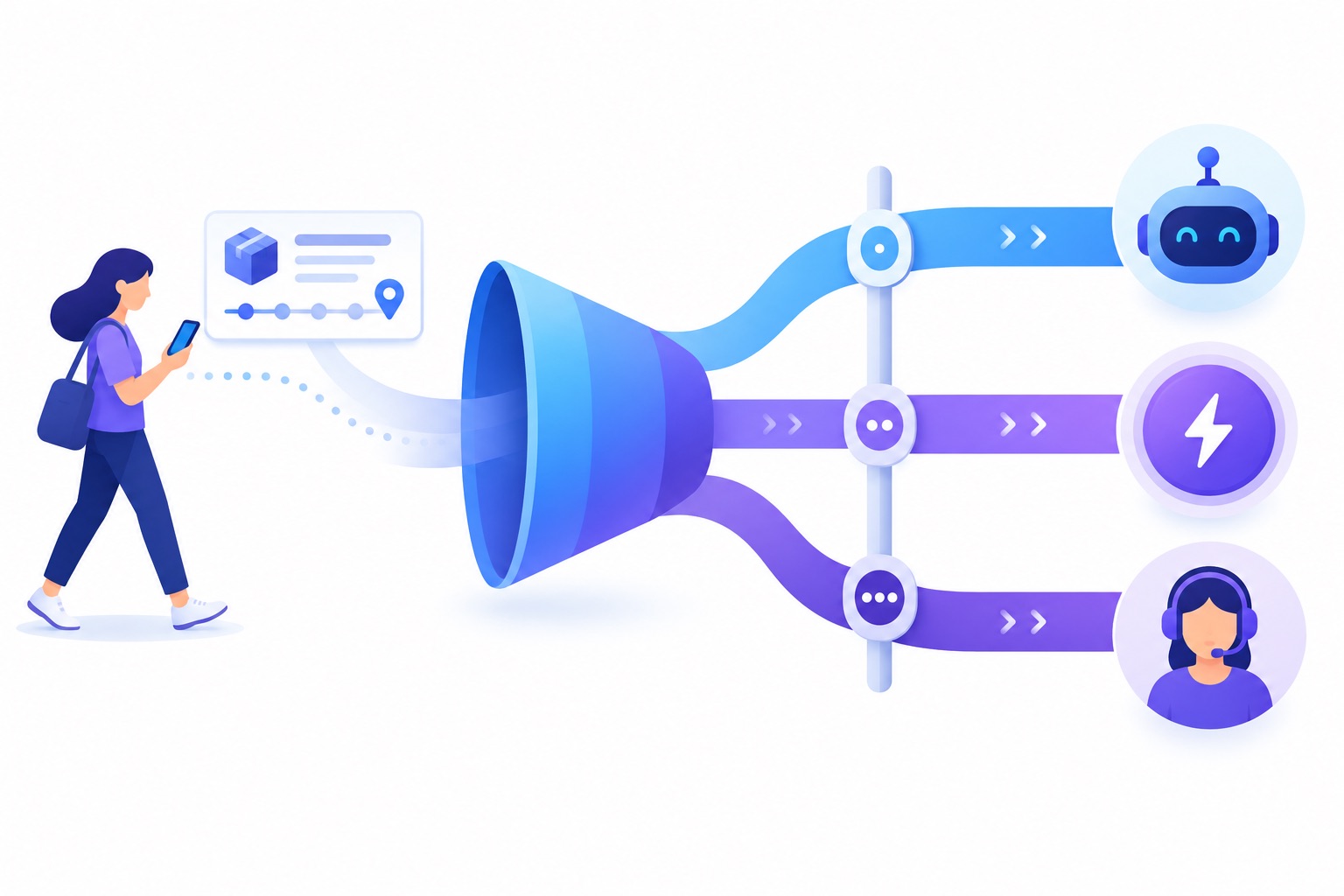
It matters because this is not about "how the bot answers" but "how the user's problem gets solved fastest". Pre-sales, in-order, and after-sales needs are completely different, so one uniform Q&A logic inevitably fails someone.
Six Key Points in Redesigning the Help Journey
- Business understanding: how user needs differ across pre-sales, in-order, and after-sales scenarios.
- Experience design: spotting interaction cost, repeated description, and waiting time in the help journey and cutting unnecessary steps.
- Intelligent interaction: intent recognition, multi-turn dialogue, context management, and task decomposition applied to concrete service scenarios.
- Human-bot collaboration: dividing responsibilities between bot, quick actions, and human agents without sacrificing experience for automation rate.
- Technical boundaries: where LLMs, RAG, business APIs, rule engines, and Agents each fit in customer service.
- Data-driven thinking: metrics such as intelligent resolution rate, first-contact resolution, human transfer rate, and repeat-contact rate, kept in use for continuous optimization.
The Overall Design
I would structure the design in six steps: define the goal, decompose scenarios, design the triage mechanism, lay out the technical architecture, build the metrics system, and sequence the experiments.
Step 1: Define the business goal and redefine the help journey
The goal is not to reduce the number of human agents, but to design around whether the user's problem gets solved quickly and accurately. I watch three questions: can the user find the right service entry quickly? Can the bot accurately understand what the user actually wants? Can the user finish the consultation or transaction in the fewest steps?
For example, if a user spots a logistics exception on the order detail page, offer logistics lookup, delivery urging, and after-sales entry right there, instead of sending them into a chat window to re-describe the order. The core idea: let service entries follow the user's business context, not force users to hunt for them.
Step 2: Decompose the journey by business scenario
- Pre-sales consultation: product information, specs, stock, pricing, promotions, and product comparison — served by the product knowledge base, information retrieval, and recommendations that support purchase decisions.
- Order lookup: order status, payment status, shipping progress — call the order system for real-time data and render it as an order card so users never retype anything.
- Logistics exceptions: stuck shipments, delivery delays, address problems — combine logistics milestones, estimated delivery time, and exception status, then offer quick actions such as urging delivery or contacting the carrier.
- Refunds and returns: refund eligibility, after-sales policy, return process, refund progress — judge eligibility from order data plus platform rules, support multi-turn guidance, and hand complex disputes to humans.
The key point: scenarios must not share one fixed Q&A flow; the service strategy should adjust dynamically to real business state.
Step 3: Build the triage mechanism between bot, quick actions, and humans
This is the heart of the design. I look at five dimensions:
- Is the user's intent clear?
- Is the bot's understanding confidence high enough?
- Does the current order or product's business state allow the action?
- Does the action touch money, transactions, or other high-risk behavior?
- Is the user visibly upset, repeatedly contacting, or in a complex dispute?
Then three service modes:
- Bot self-service: rule-clear, low-risk, standardized answers — product spec questions, return policy explanations, common logistics questions.
- Quick actions: clear goals, satisfied business conditions, executable via APIs — order lookup, delivery urging, refund application; anything touching a real transaction requires user confirmation.
- Human service: complex disputes, special orders, rule conflicts, cases the model cannot understand, and users explicitly requesting a human.
Also design a dynamic human-transfer mechanism — never let users retry endlessly against a bot that cannot help. Do not set a fixed turn-count threshold; branch by scenario: the user explicitly asks for a human, provide the entry immediately; complex transaction disputes, prioritize humans; intent still unconfirmed after multiple turns, trigger the fallback; low model confidence that clarification cannot fix, transfer; the bot fails tool calls repeatedly, stop retrying and transfer. On transfer, sync the full conversation, order information, and actions already taken so service stays continuous.
Step 4: Design the underlying technical architecture
Seven core modules: intent recognition (business type and real need), entity extraction (product, order, time, amount), context management (multi-turn history so users never repeat themselves), knowledge retrieval (RAG over platform rules, product knowledge, after-sales policy), business tool calls (orders, logistics, refunds), dialogue orchestration (ask, execute, or transfer next), and human fallback (seamless handoff with full context).
One boundary deserves emphasis: the LLM handles language understanding, intent reasoning, and dialogue; order status, refund eligibility, and real transactions must be governed by real business systems and deterministic rules. The model must never fabricate business outcomes.
Step 5: Build the metrics system
Three directions: user experience (resolution rate, first-contact resolution, satisfaction, average time to resolve), bot capability (intent accuracy, knowledge hit rate, tool-call success rate, multi-turn task completion), business efficiency (self-service resolution rate, human transfer rate, repeat-contact rate, cost per contact).
Note carefully: the user going silent after a bot answer does not mean the problem is solved. Distinguish bot answer rate, self-service resolution rate, and true resolution rate; verify with business outcomes, user feedback, and whether the same issue recurs within 24–72 hours. If a user asks about logistics and the bot returns tracking info while the parcel still has not arrived, that is not resolution.
Step 6: Optimize continuously through experiments
- Phase 1: high volume, clear rules, low risk — product questions, order lookup, logistics lookup.
- Phase 2: extend to refunds and returns that need multi-turn interaction and real transactions.
- Phase 3: explore complex after-sales, multi-intent understanding, and proactive service.
Validate every change with A/B tests on resolution rate, repeat-contact rate, satisfaction, and cost — avoid pushing the human transfer rate down while problems stay unsolved.
How This Maps to Bytedesk
These ideas map to capabilities already in Bytedesk, the open-source AI customer service system (GitHub, site): multi-channel access lets service entries follow business scenarios; skill-group routing plus the FAQ/knowledge base covers standardized self-service; quick replies and tickets support guided "transactional" tasks; the AI Agent can call business tools to query order status; human-bot collaboration supports dynamic human transfer based on confidence and user sentiment with full conversation context synced; and session statistics and quality inspection dashboards track resolution and transfer rates to keep the journey data-driven.
Key Takeaways
- The help journey exists to solve problems, not to inflate bot reception volume; entries should follow business context.
- Design differently for pre-sales, orders, logistics, and after-sales — no single Q&A flow fits all.
- Triage on five dimensions: intent clarity, model confidence, business state, action risk, user sentiment.
- The LLM understands and converses; deterministic rules judge; business APIs execute — keep the boundaries clean.
- Guard against inflated resolution rates: verify with business outcomes, feedback, and repeat contacts.