The Ultimate Form of AI Customer Service and Building Its Core Competitiveness

Whenever the conversation turns to "what is the ultimate form of AI customer service," the answers most clearly expose the boundaries of a product manager's vision—do you see customer service as a "cost-reduction tool," or as an evolving business? Open-ended questions like this have no standard answer, which is exactly why they are worth thinking through carefully.
This is the eighth and concluding article in an experience-sharing series, "AI Customer Service Product and Engineering Practice," drawn from hands-on practice as an AI customer service product manager at a global short-video social platform. In this post I want to share my take on the ultimate form of AI customer service, and how core competitiveness should be built for an AI customer service operation under such a global platform in the LLM era.
Four Key Points in Thinking About the Ultimate Form
- Layered product vision: give a staged view of evolution rather than empty talk of "omnipotence." Vision talk is ruined by leap-to-the-finish descriptions.
- Structured thinking: anchor the viewpoint with a clear framework (evolution stages + layered moats)—open-ended topics reward organization even more.
- Understanding of competitive essence: see through the premise that "model capabilities will eventually converge" in the LLM era, and thus locate competitiveness outside the model itself.
- Grounding in real business: vague claims that "data matters" are unconvincing; speak to the scarcity of data in concrete scenarios.
My Take
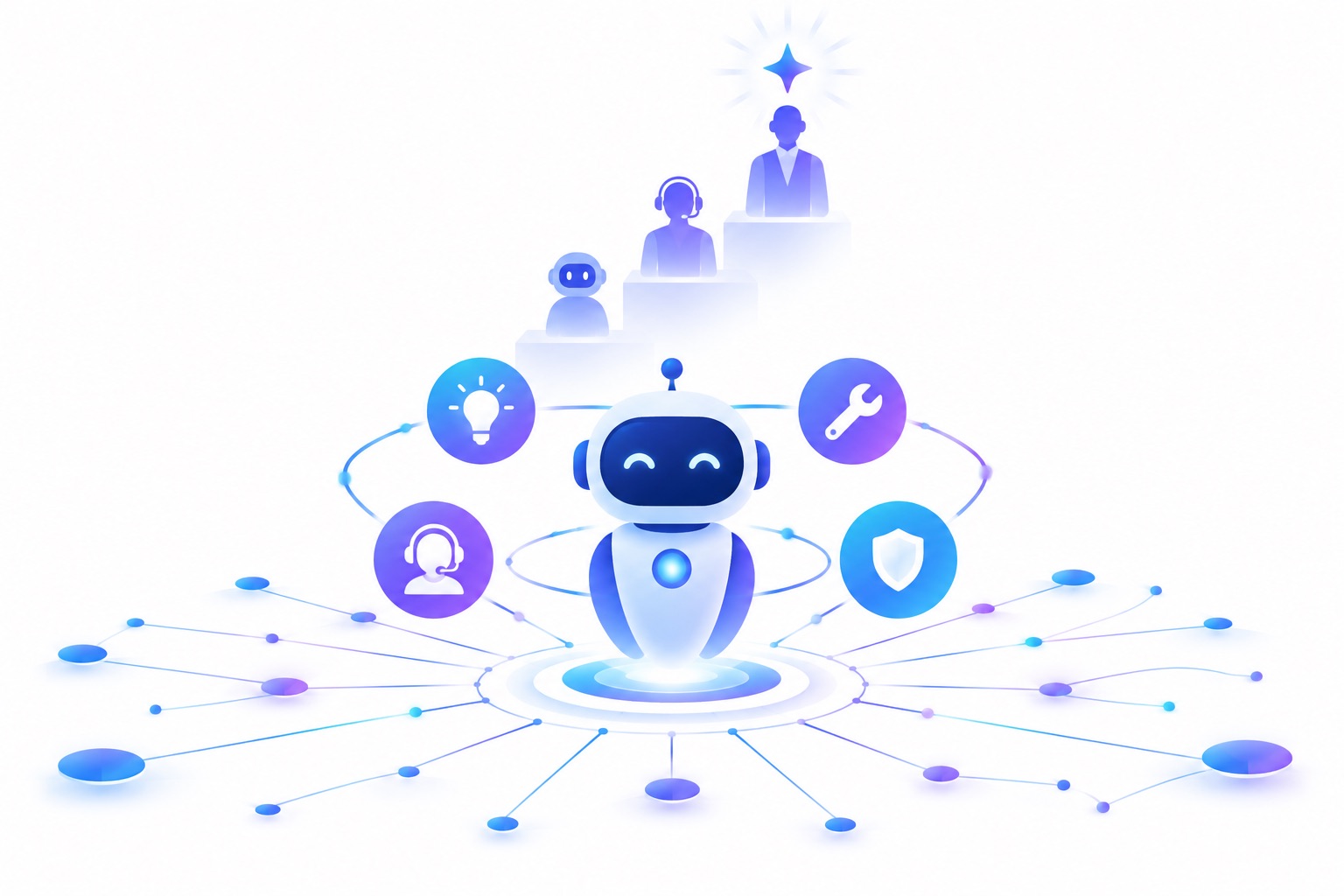
1. The Ultimate Form: A Three-Stage Evolution, Not a Single Leap
Today (reactive): the user has a problem; customer service responds. The core is efficiency; the metric is resolution rate. This is where most AI customer service stands today.
Mid-term (anticipatory): customer service embeds from the chat window into the full business chain—predicting problems from user behavior and intervening before they occur. Typical example: the system detects a logistics anomaly and, instead of waiting for the complaint, proactively pushes "Your parcel is delayed; we've added a $5 voucher as compensation." At this point customer service shifts from a cost center into infrastructure for experience and retention—problems are solved before the user even perceives them.
Endgame (service as product): customer service is no longer an auxiliary feature but part of the product's value itself—service data feeds product design, service capability opens to merchants and ecosystem partners, and "great service" becomes one reason users choose the platform. The ultimate form in one sentence: imperceptible service where "problems never happen."
2. Where Core Competitiveness Lies in the LLM Era
State the premise first: in the LLM era, model capabilities will eventually converge—everyone can call foundation models of similar quality, so the window for "my model is better" keeps shrinking. Core competitiveness lies not in the model but in three layers of non-replicability:
Layer 1: the data flywheel. Real service conversation data that is global, multilingual, and multicultural is the scarcest asset. The key mechanism is making every session produce annotation value—user clicks, downvotes, and handoff reasons all settle into training signals, forming the positive loop of "service → data → model → better service." Competitors cannot quickly replicate this scenario diversity: the problem distribution in a mixed e-commerce, content, and social-traffic scenario is entirely different from any single-scenario product.
Layer 2: localization depth. Region-specific knowledge bases, cultural rule engines, agent networks, and local policy compliance—this is heavy operational "unglamorous work," and precisely where the moat lies. After LLMs level the technical floor, the contest is over who better understands the difference between an Indonesian user and a German user.
Layer 3: ecosystem-level entry. Customer service should not be a standalone feature but deeply integrated with transaction, content, and logistics systems—the service agent can directly call the commerce and fulfillment systems to close the loop (check order, compensate, reship). This system-level integration is something no "wrapper chatbot product" can match.
Underneath all three layers is the same phrase: exclusivity of global scenarios. Data, operations, and ecosystem are all fed by real scenarios—and that is precisely the hardest part for followers to catch up on.
How This Maps to Bytedesk
This endgame thinking closely aligns with the design philosophy of the open-source AI customer service system Bytedesk (GitHub, website): multi-channel access corresponds to the entry-point layout of "embedding service into the full chain"; AI Agent with tool calling lets customer service actually operate business systems, pointing to the closed-loop capability of "service as product"; the knowledge base with RAG is the content carrier of localization depth; human-AI collaboration acknowledges the irreplaceable value of humans in long-tail scenarios; and tickets with session statistics provide the outlet for the data flywheel to accumulate. For most companies, the moat need not be "exclusive global scenarios"—connecting your own business scenario data with the service chain can likewise build a flywheel of your own.
Key Takeaways
- The ultimate form is a three-stage evolution: reactive → anticipatory → service as product, ending in imperceptible service where problems never happen.
- The competitive premise of the LLM era: model capabilities will converge; moats must be built outside the model.
- Three layers of non-replicability: data flywheel × localization depth × ecosystem-level entry, underpinned by scenario exclusivity.
- Customer service evolves from cost center to infrastructure for experience and retention, and ultimately into product value itself.
- The lesson for ordinary companies: no need to chase global scenarios—connecting your own business data with the service chain is the minimal viable moat.