Competitor Analysis and Opportunity Evaluation: Verify the Gap Before Building

Seeing a competitor's bot look up delivery status in one sentence and proactively change the address, many teams instinctively react with "let's build that too". But a competitor's capability grows on their user mix, category structure, and technical debt—copying it wholesale may not fit. The value of competitor analysis is not "what to copy", but verifying whether the gap is real and whether it matters to your users.
This post is part of an experience-sharing series on "AI customer service product and engineering practice", drawn from hands-on practice at a global fast-fashion cross-border e-commerce platform. In this post I want to share how to build a competitor analysis and opportunity evaluation system when a competitor holds clear advantages in automation, interaction experience, or service efficiency: combining user feedback, business data, technical feasibility, and ROI to set priorities, and driving product, engineering, data, and support teams to validate together.
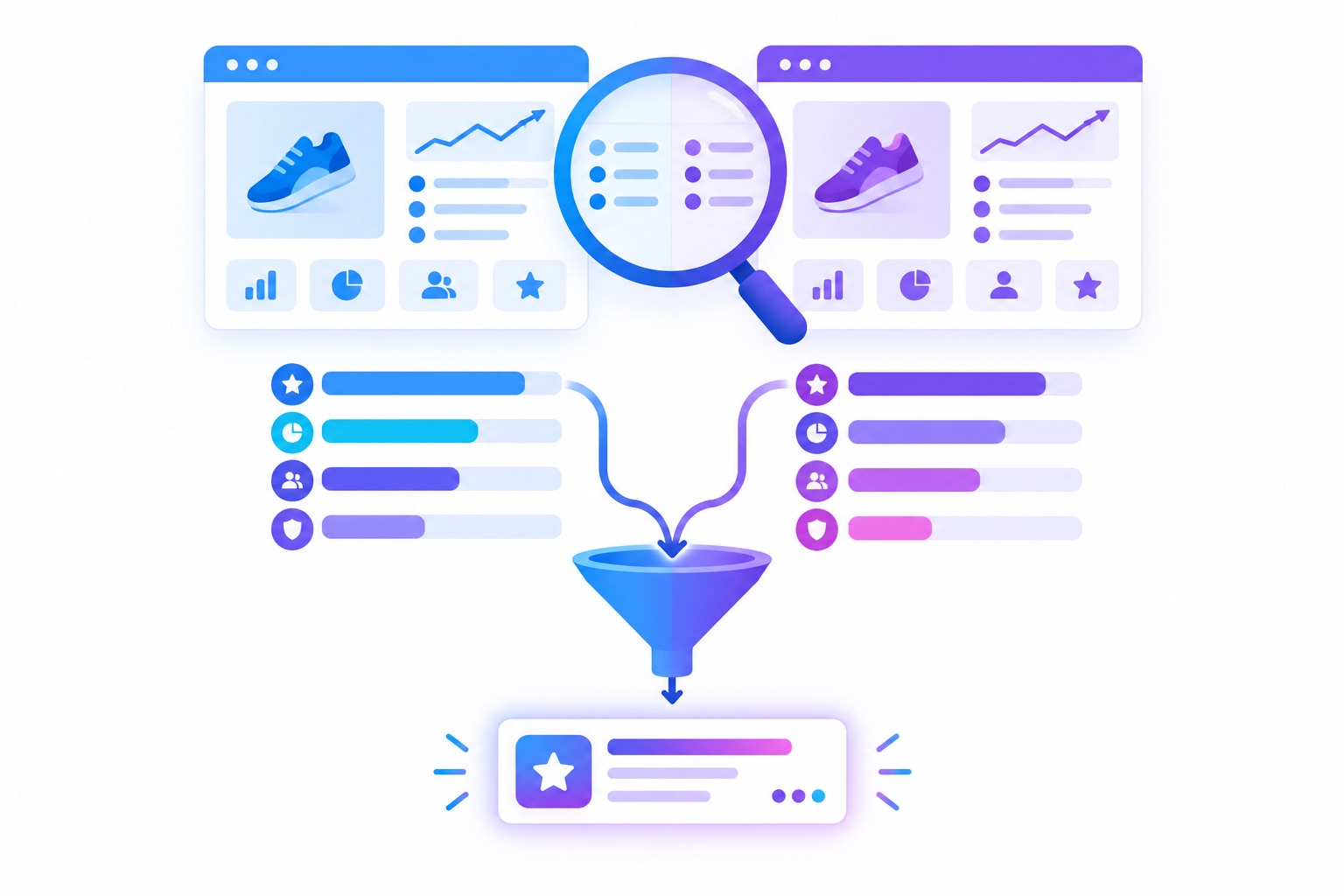
Four Key Points in Competitor Analysis
- Decompose, don't imitate: competitor capabilities are broken down structurally rather than copied at the surface.
- Score before committing: value, feasibility, and ROI form the composite evaluation.
- Judge with your own data: "is it worth building" is a data question, not a sentiment.
- Organize four-team validation: product-engineering-data-support each own part of the landing.
The Overall Design
On discovering a competitor's edge, I would not jump straight into a copycat project. I would follow "verify the gap → evaluate the value → validate in small steps".
Step 1: Build a structured competitor analysis system
- Standing monitoring: regularly experience the competitor's support as a real user across high-frequency scenarios—logistics, returns, payments—recording three dimensions: automation capability (which scenarios the bot closes end-to-end), interaction experience (multi-turn understanding, clarification strategies, UI), and service efficiency (response time, transfer speed, resolution time).
- Cross-verification: use social media reviews, app store comments, and industry reports to confirm whether the advantage is real perception or marketing.
- Output a benchmark table: score your side vs. the competitor scenario by scenario, locating the widest gaps.
Step 2: Validate the opportunity with your own data—the critical step
Map the competitor's advantage onto your own data:
- Their bot resolution is higher? Drill into which scenarios contribute the gap—if their logistics resolution is high and logistics is exactly your lowest-resolution, highest-volume scenario, that is a high-value opportunity; if the gap concentrates where your volume is tiny, lower the priority.
- Voice-of-Customer corroboration: check whether your users complain about the same weakness (VoC analysis).
- Avoid blind benchmarking: their user mix, categories, and market structure differ from yours; their answer is not automatically yours.
Step 3: Opportunity evaluation and priority—four-dimension scoring
- User value: affected consultation volume × experience improvement magnitude.
- Business value: expected contribution to resolution rate, cost, conversion.
- Technical feasibility: can the current architecture and models support it, or does it need a rebuild?
- ROI: development and operating cost vs. expected benefit.
Decision rule: high user value + high feasibility → build now; high value + low feasibility → phased plan; low value → watch.
Step 4: Drive landing and validation
- Form a task force: product leads the solution, engineering assesses the architectural work, the data team pre-defines success metrics and the A/B plan, and support contributes frontline scenario knowledge and human-perspective feedback—four parties, clear roles.
- Cadence: small-traffic pilot → data validation → full rollout.
- Define success criteria upfront: for example, "resolution rate in target scenarios up X points"—let experiment data speak; roll out on success, review and adjust on failure.
- Standing mechanism: quarterly competitor monitoring, forming a "discover → evaluate → pilot → validate → roll out" loop rather than a one-off exercise.
Practice in Bytedesk
The open-source Bytedesk customer service system (GitHub, website https://www.weiyuai.cn ) is itself an open reference for benchmarking: its bot reception, knowledge base and RAG, AI Agent tool calling, ticket workflows, and conversation statistics/quality inspection are all publicly inspectable. Teams doing capability comparisons can verify the real effect of an open implementation directly, reducing the risk of being misled by marketing; private deployment also frees small-traffic pilots from vendor constraints.
Key Takeaways
- Competitor analysis needs structural decomposition plus cross-verification to confirm real capability vs. marketing.
- The critical step: map the competitor's edge onto your own data to verify the gap lands in your high-volume scenarios.
- Prioritize with four scores: user value, business value, technical feasibility, ROI.
- Form a four-party task force, define success criteria upfront, pilot small before rolling out.
- Make competitor monitoring a quarterly loop: discover—evaluate—pilot—validate—roll out.