The Online Quality Evaluation Loop: From Conversation Sampling to Monitoring Alerts

92 points offline, flooded with negative reviews online—the most common puzzle for AI support teams. The cause is rarely mysterious: the evaluation set was built from high-frequency questions three months ago, while live traffic has drifted with new campaigns and categories. Offline evaluation tests "past questions"; live users ask "present questions"—once the two diverge, a high score means nothing.
This post is part of an experience-sharing series on "AI customer service product and engineering practice", drawn from hands-on practice at a global fast-fashion cross-border e-commerce platform. In this post I want to share how to build the complete quality loop for the good-offline-bad-online situation—real conversation collection, sample labeling, problem classification, offline evaluation, and online monitoring—so wrong answers, stale knowledge, and erroneous operations keep surfacing and getting fixed.
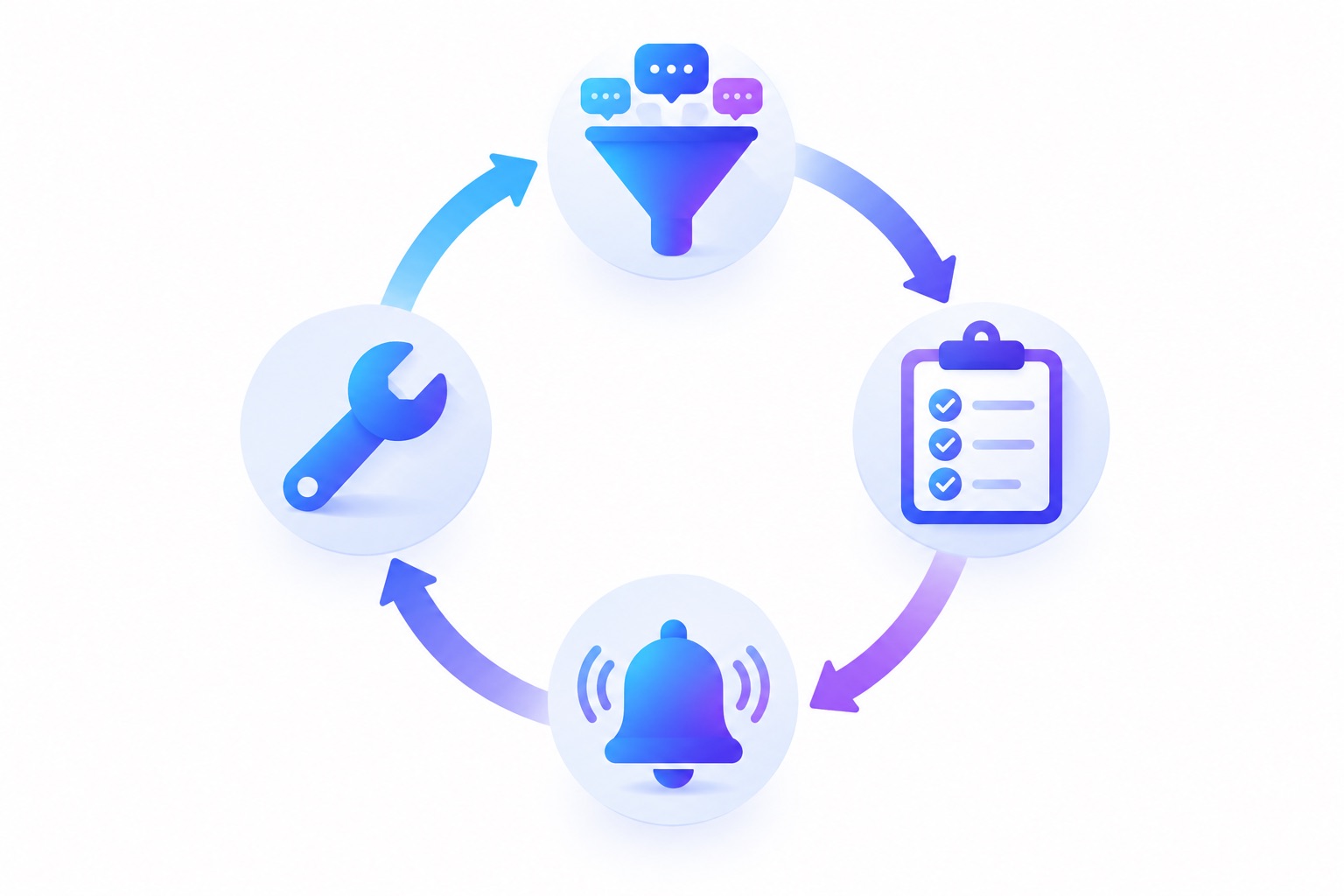
Four Key Points in the Quality Loop
- Attribute the offline-online gap: evaluation-set distribution drifting from real traffic distribution is the root cause to fix first.
- Design the loop end to end: collect → label → classify → evaluate → monitor runs as one chain.
- Invest in labeling: guidelines, quality checks, and efficiency decide the loop's throughput.
- Monitor in real time: online quality needs real-time observability, not periodic spot checks.
The Overall Design
Good offline but poor online is essentially the evaluation set diverging from real traffic. The loop's core is letting live data continuously feed the evaluation.
Step 1: Diagnose why offline evaluation failed
- Stale distribution: the set is mostly historical high-frequency questions, while traffic has shifted with new features and campaigns.
- Too easy: lacking hard cases—ambiguous phrasing, mixed intents, code-switching.
- Incomplete dimensions: testing QA accuracy only, not tool-call correctness or knowledge freshness.
Step 2: Collect real conversations
- Structured full logging: user input, recognized intent, knowledge hit, tool calls, and final outcome (resolved/transferred/abandoned).
- Stratified sampling into the labeling pool: prioritize negative-feedback, low-confidence, transferred, and repeat-contact conversations—the most valuable badcase sources. Explicit user feedback (thumbs-down, bad ratings) enters at the highest priority.
Step 3: Labeling and problem classification
- Label on four dimensions: answer correctness, knowledge freshness, operation correctness, experience score.
- Three-level classification: error type (wrong answer/stale knowledge/wrong operation/expression issue) → stage (intent/knowledge/tool/generation) → specific root cause.
- Labeling quality control: dual-annotator sampling, consistency checks, arbitration for disputed samples.
- Results flow back: hard cases enter the evaluation set; badcases enter the optimization queue.
Step 4: Continuously update the evaluation set—the key to curing offline distortion
- Rebalance the evaluation set to match live traffic distribution, adding newly discovered hard cases monthly.
- Distinguish a regression set (core historical scenarios, to prevent breaking them) from a new-scenario set (validating new capabilities). The set should always approximate what real users ask now.
Step 5: Online monitoring
- Real-time watch: low-confidence rate, thumbs-down rate, transfer rate, repeat-contact rate, with automatic anomaly alerts.
- Knowledge freshness monitoring: check the knowledge version cited by answers; auto-alert on expired knowledge.
- Sampling review: daily manual review of sampled conversations, with risk-tiered sampling ratios.
- The full loop: online anomaly → sample and label → locate root cause → fix → regression evaluation → launch → monitor to confirm.
One-sentence summary: offline evaluation is the gate, online monitoring is the radar—link them with the same labeling and classification standards, and quality keeps converging.
Practice in Bytedesk
In the open-source Bytedesk customer service system (GitHub, website https://www.weiyuai.cn ), full conversation records support collection and retrospection; the quality inspection module supports manual sampling and labeling; knowledge base hits are traceable from conversations; conversation statistics provide transfer rate, satisfaction, and other monitoring metrics. Together these capabilities form the engineering foundation of the "collect → label → evaluate → monitor" loop.
Key Takeaways
- The root cause of good-offline-bad-online is evaluation set diverging from real traffic—diagnose before acting.
- Collect badcases in strata: thumbs-down, low-confidence, transferred, and repeat-contact conversations first.
- Label on four dimensions and locate root causes with three-level classification.
- Rebalance the evaluation set to live distribution, separating regression and new-scenario sets.
- Offline evaluation is the gate, online monitoring is the radar—one standard to close the loop.