Data Permissions, Privacy Protection, and Compliance in AI Customer Service

A customer service system is one of the most sensitive-data-dense places in a company: orders, payments, addresses, and refund records flow through conversations. With LLMs, this information also enters prompts, logs, and even third-party model contexts. The cost of one leak can far exceed all the savings the support system ever delivered.
This post is part of an experience-sharing series on "AI customer service product and engineering practice", drawn from hands-on practice at a global fast-fashion cross-border e-commerce platform. In this post I want to share how to design data permissions, sensitive-information protection, log management, and model output review for AI customer service handling user orders, payment information, addresses, refund records, and personal data, while meeting the compliance requirements of different countries and regions.
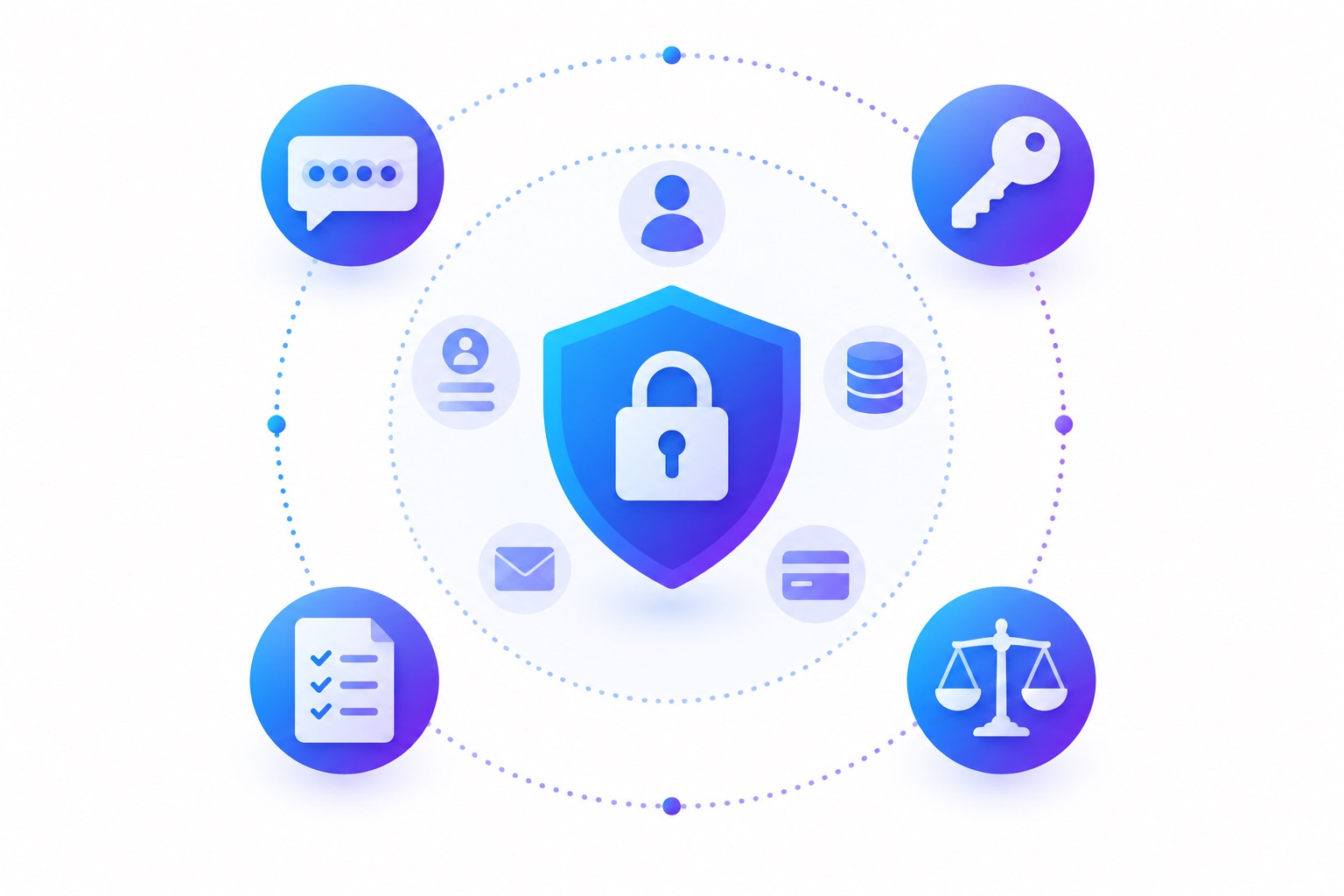
Four Key Points in Data Protection and Compliance
- Architect security in: permission models, masking, and encryption come before features.
- Know the regulations: the core requirements of GDPR, CCPA, and their peers shape the design.
- Control model output: sensitive information must never leak into replies.
- Log for audit, retain minimally: traceability and minimal retention close the loop.
The Overall Design
The governing principle is data minimization and permission convergence. I would design four mechanisms plus regional compliance adaptation.
Step 1: Data permission design
- Least privilege: the support system requests permissions by role and scenario; bot tool calls are authorized by intent—checking logistics grants no access to payment details.
- Data classification: four levels—public/internal/sensitive/highly sensitive. Card numbers, full addresses, and ID numbers are highly sensitive; the bot cannot see them by default, only masked views.
- Identity binding: users can only query their own data; every tool call enforces ownership checks to eliminate horizontal privilege escalation.
Step 2: Sensitive information protection
- Display-layer masking: show only the last four digits of card numbers and partially masked addresses; guide users to official secure pages for full information.
- Encryption in transit and at rest: encrypt sensitive fields at storage; TLS for the whole session.
- Input-side protection: users may voluntarily send card numbers or passwords in chat—the system must recognize such content, prompt deletion, and never write plaintext to logs. This is the most commonly missed point.
Step 3: Log management
- Tiered log storage: separate conversation logs, API logs, and model input/output logs; sensitive fields must be masked before logging.
- Retention by regulation and market: shorter retention for EU markets, automatic cleanup at expiry.
- Full-chain audit: who accessed what data and when is traceable, with real-time alerts on abnormal access.
Step 4: Model output review
- Source control: inject masked data into the model context—the model never touches raw sensitive information, which is more reliable than post-hoc filtering.
- Output filtering: replies pass a sensitive-information detection engine (rules plus model, dual layer); raw card numbers and internal data must never appear in replies.
- High-risk reply control: replies involving refund amounts or legal liability go through templates or human confirmation.
Step 5: Regional compliance adaptation
- GDPR (EU): explicit notice of data usage, support for the right to erasure (deletion request flow), data minimization, and lawful cross-border transfer (data localization or standard contractual clauses).
- CCPA (California): support user data access and deletion requests.
- Other markets: configure data residency and retention policies per country.
- Key design: turn compliance requirements into a configurable policy center—new markets onboard by changing configuration, not code.
Security and compliance are not patches applied after launch; they are part of the architecture.
Practice in Bytedesk
The open-source Bytedesk customer service system (GitHub, website https://www.weiyuai.cn ) supports private deployment, keeping sensitive data inside the corporate network; the role-based permission system scopes agent data access by workgroup and role; conversation and operation logs support audit traceability. Combined with an enterprise's own encryption and masking policies, the "minimize data, converge permissions" principle can be implemented. Self-hosting matters especially for markets with strict data-residency requirements like the EU.
Key Takeaways
- Governing principle: data minimization plus permission convergence; bots are authorized by intent.
- Classify data; highly sensitive fields are invisible to bots by default and always masked in display.
- Recognize user-sent card numbers and passwords: prompt deletion and never log plaintext.
- Dual defense for model output: masked data injected at the source plus sensitive-content filtering on output.
- Make compliance a configurable policy center—new markets change config, not code.