From FAQ Q&A to Task-Oriented AI Agent: A Five-Stage Pipeline and Execution Boundary Design

"What is the refund policy?"—an FAQ bot answers this well. "Process my refund"—an FAQ bot can only reply "please contact a human agent." The difference between these two sentences is the watershed between knowledge-QA customer service and a task-oriented Agent: one answers questions, the other completes tasks.
This is the third article in an experience-sharing series on "AI customer service product and engineering practice," drawn from hands-on practice as an AI Product Manager focused on IM intelligent customer service at a local-life services platform. In this post I want to share how to design the complete product pipeline—intent recognition, context understanding, task planning, tool calling, and result verification—and define the Agent's autonomous execution boundary, when upgrading smart customer service from traditional FAQ Q&A to an AI Agent that autonomously handles order queries, delivery exceptions, and refund applications.
This upgrade matters because nearly every customer service team has been making it since 2024—and the common thread of failures is: they swapped the model but designed no pipeline and no boundary. An Agent is not "a chatbot that can call APIs"; it is an execution pipeline with verification and risk control.
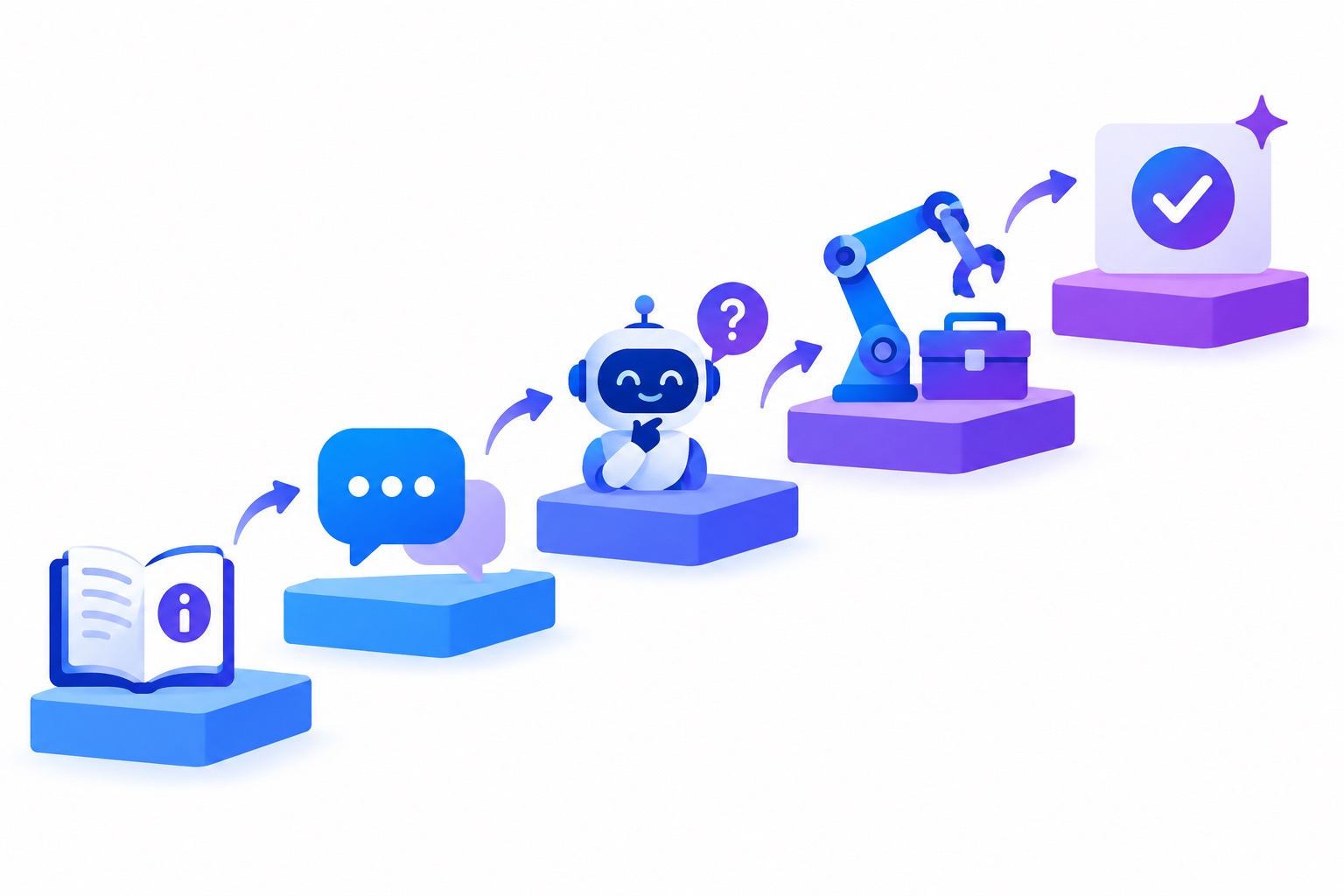
Three Key Points in the FAQ-to-Agent Upgrade
- Understand the essential difference between FAQ Q&A and a task-oriented Agent: answering questions vs. completing tasks—the responsibility boundary is completely different.
- Design the full pipeline of "intent recognition → task planning → tool calling → result verification"; missing any stage invites incidents.
- Keep risk-tiering and execution boundary awareness—this is what separates a task Agent from a demo.
Overall Approach
Step 1: Clarify the Upgrade Path
FAQ only does knowledge retrieval and answer matching; a task-oriented Agent must understand intent, maintain task state, call business tools, and own the outcome. The core shift is from "giving answers" to "getting things done."
But the upgrade is not a replacement—it is a layered coexistence of "FAQ as backstop + Agent as executor": policy questions keep going through retrieval Q&A, transactional requests go through the Agent flow, each with its own lane.
Step 2: Design the Five-Stage Pipeline
1. Intent recognition. Perform multi-intent recognition and intent rewriting, disambiguate with order context, and proactively clarify when confidence is low instead of guessing. When a user says "there's a problem with this order"—missing item, late delivery, or damaged goods—needs order state plus a follow-up question to resolve.
2. Context understanding. Maintain a session-level task state machine: what the current task is, which slots are confirmed, what information is missing. Support multi-turn follow-ups and preserve state when the user switches topics and returns.
3. Task planning. Decompose the user's goal into execution steps: query order → check conditions → execute action → report result, dynamically adjusting the path on intermediate results—if the order turns out to be delivered, the refund flow takes the "after-sales appeal" branch, not "intercept delivery."
4. Tool calling. Call business APIs through a unified tool gateway: parameter schema validation, permission checks, timeout and retry control all happen at the gateway layer, and sensitive operations go through confirmation. Business API changes no longer directly affect Agent logic.
5. Result verification. Apply business-rule checks and consistency checks to tool results; on failure, do not reply to the user—escalate to a human or retry. The Agent must never assume the tool returned a sensible result—nulls, error codes, and data contradicting the user's description must all be intercepted.
Step 3: Define the Autonomous Execution Boundary
Handle by risk tier:
- Low risk (queries, rule explanations): Agent executes fully automatically.
- Medium risk (address change, submitting a refund request): requires explicit user confirmation before execution.
- High risk (large refunds, batch operations, rider/merchant compensation): Agent only pre-screens and collects information; humans decide.
- Backstop: consecutive failures, angry users, or safety/PR concerns force human handoff.
This captures automation efficiency while containing financial-loss and PR risk.
What to Watch After Launch
Track three metric families: task completion rate, erroneous execution rate, and human handoff rate. Especially attribute every "executed but not accepted by the user" bad case one by one—whether the failure lies in intent recognition, task planning, or the tool layer leads to completely different fixes.
Practice in Weiyu
Weiyu, the open-source AI customer service system (GitHub, website), practices this layered approach: the knowledge base with RAG retrieval serves as the "FAQ backstop" layer; the AI Agent module supports intent recognition and multi-turn dialogue and connects to business systems via tool calling; human-AI collaboration lets any session transfer to a human agent with context carried over; the ticket module handles tasks that need cross-team routing. Skill-group routing decides which sessions go to AI and which go straight to humans—a configuration-driven implementation of the "execution boundary."
Takeaways
- The essence of the FAQ-to-Agent upgrade is moving from "giving answers" to "getting things done"; responsibility grows, so the pipeline must be complete.
- Five stages: intent recognition, context understanding, task planning, tool calling, result verification—any missing stage is an incident waiting to happen.
- Boundaries tier by risk: low risk automatic, medium risk user-confirmed, high risk pre-screen and hand off.
- The upgrade is layered coexistence, not replacement—FAQ keeps handling policy questions.
- "Executed but not accepted" bad cases are the most valuable iteration material.