Architecture of a Large-Scale Conversational AI System: Balancing Latency, Stability, and Cost

An AI customer service bot that shines in a demo faces three interrogations the moment it hits production: will it survive the traffic spike of a mega sale; will the whole service collapse when the LLM API wobbles; and can the inference cost per conversation be measured and reduced. These map to three goals — speed, stability, and cost — that cannot all be maximized at once. Architecture design is fundamentally about ranking them and trading off layer by layer.
This post is part of an experience-sharing series for AI customer service product managers and developers, drawn from hands-on practice as an intelligent service product manager at a large general e-commerce platform. In this post I want to share how to design a large-scale online conversational AI system covering user input, intent recognition, knowledge retrieval, context management, model inference, tool calls, and human takeover — while balancing response speed, stability, and call cost under high concurrency.
This is hardcore system design: not any single component, but the ability to assemble all components into a machine that survives production.
Two Key Points in Conversational AI Architecture
- End-to-end architecture design: the full chain from access to fallback, with each layer's responsibility and boundary made explicit.
- Performance/stability/cost trade-offs under high concurrency: engineering tools like tiering, caching, degradation, and circuit breaking — not just model quality talk.
The Overall Design
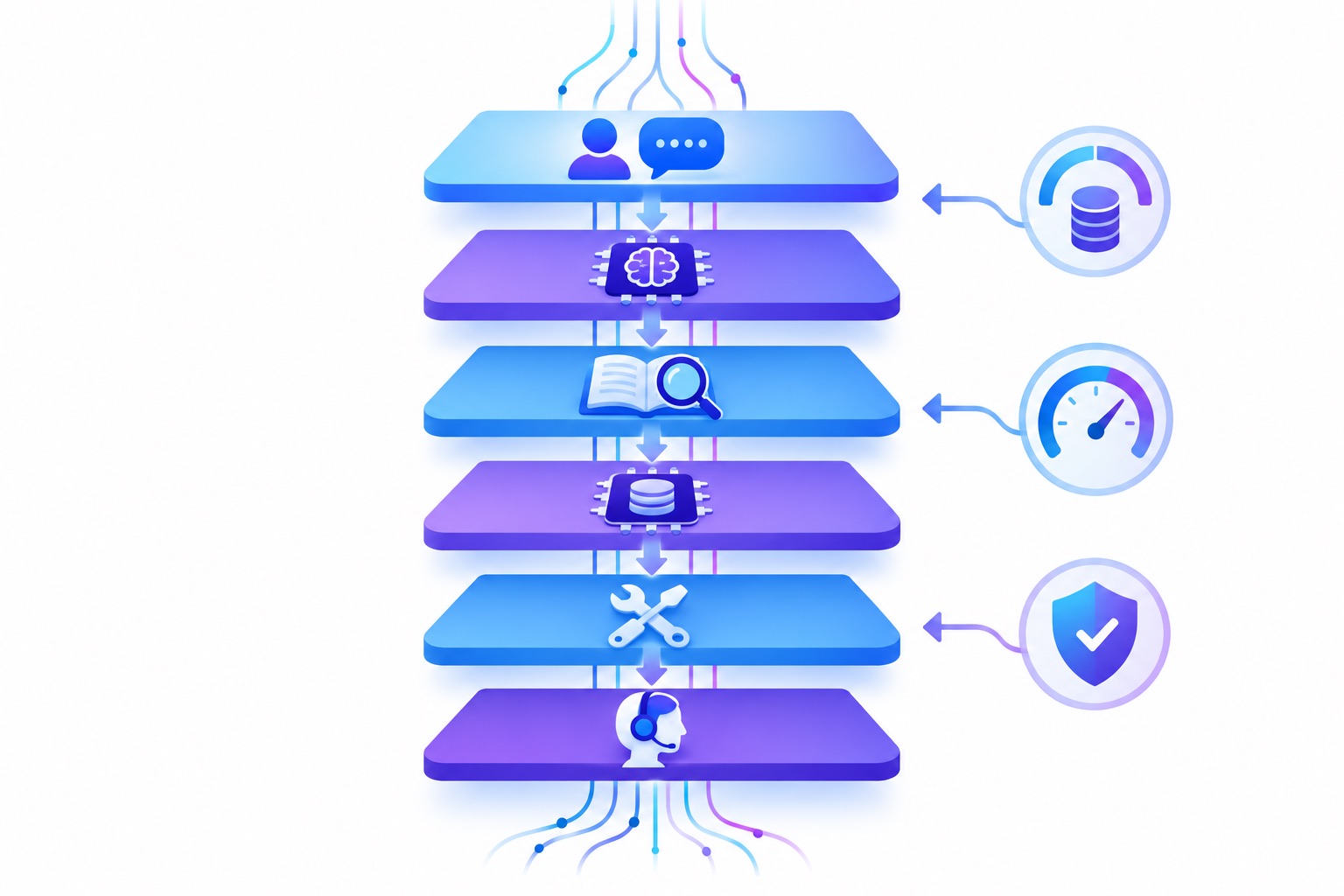
Overall architecture: six layers
- Access layer: a unified gateway for all client entries, handling session routing, authentication, rate limiting, and degradation switches — the first gate for all traffic.
- Understanding layer: intent recognition + entity extraction + sensitive-word/risk pre-filtering; under high load, high-frequency intents get fast-tracked by small models or caches, and only complex input reaches the LLM — never let a flagship model handle "check my order".
- Retrieval layer: RAG services (vector search + keyword search + reranking), with tiered caching of hot knowledge.
- Inference layer: LLM services with model routing by task complexity — lightweight models for simple queries, flagship models for hard reasoning; streaming output to cut first-token latency.
- Execution layer: a tool-call gateway that uniformly wraps order/logistics/refund APIs with timeouts, retries, circuit breaking, and idempotency control.
- Fallback layer: a human-takeover channel plus static FAQ fallback, so under any failure users still get an answer or a person.
Latency optimization
- Streaming output, treating time-to-first-token as the top-priority metric;
- High-frequency Q&A caching so repeated questions never re-infer;
- Tiered model routing — the smallest model that works;
- Parallel retrieval and prefetching, overlapping every overlap-able cost.
Stability design
- Full-chain timeouts and degradation: when the LLM fails, automatically degrade to retrieval-based Q&A + quick-action entries so service continues; circuit-break external APIs to prevent cascading failure.
- Persist session state so node failures are recoverable; full-chain logging and distributed tracing so incidents can be reconstructed.
Cost control
- Tiered model calls + token-usage monitoring; context compression to cut wasted tokens; cache hits returned directly.
- Establish a unit service cost metric (model + retrieval cost per conversation) and make it an optimization target — without knowing the cost, you have no standing to optimize.
Metrics system
Watch four groups together — performance (first-token latency, end-to-end latency, peak QPS), quality (resolution rate, intent accuracy), cost (cost per contact), and stability (error rate, degradation trigger rate). Optimizing any one group at the expense of the others is not optimization.
Two points worth emphasizing
"Tiering" runs through everything: intent tiering, model tiering, degradation tiering — this is the master key that balances speed, stability, and cost simultaneously, more important than any single component choice.
Human takeover is not failure; it is part of the architecture: sync the full context on transfer, and manage human queues during peak hours. Treating humans as formal system capacity rather than a badge of shame is what gives the system real resilience.
How This Maps to Bytedesk
Bytedesk, the open-source AI customer service system (GitHub, site), has an architecture isomorphic to this layering: the core module provides the unified access gateway, session routing, and messaging channels (WebSocket/MQTT); FAQ and the knowledge base provide retrieval-based fallback while RAG services power generative answers; the AI module supports multi-model access and switching, naturally fitting "tiered model routing"; the AI Agent provides tool-call orchestration; skill-group routing, queuing, and human agents form the fallback layer; and session statistics and quality inspection provide the dashboards. Circuit-breaking and rate-limiting details for extreme concurrency can be customized further on Bytedesk's open architecture.
Key Takeaways
- Six layers, each with its own job: access, understanding, retrieval, inference, execution, fallback — missing any one creates a single point of risk.
- Speed comes from streaming, caching, model tiering, and parallelism; time-to-first-token first.
- Stability comes from timeouts, degradation, circuit breaking, state persistence, and tracing — the service survives an LLM outage.
- Cost comes from tiered calls, context compression, and caching, anchored by a unit service cost metric.
- Tiering runs through everything, and human fallback is part of the architecture, not a mark of failure.