Designing Multilingual Customer Service and Its Quality Evaluation System

Ask "what's the return window?" in English and get 30 days; ask the same in Spanish and get 45 days. That is not a joke but a real incident in a multilingual support system: policy knowledge maintained by machine translation lagged one week in one language, and every user in that language received an outdated answer in the meantime. The hard part of multilingual support has never been just translation quality—it is whether the same business question gets a consistent answer across languages.
This post is part of an experience-sharing series on "AI customer service product and engineering practice", drawn from hands-on practice at a global fast-fashion cross-border e-commerce platform. In this post I want to share how to design multilingual model adaptation, translation mechanisms, and a quality evaluation system for serving different countries and regions in multiple languages, so comprehension bias and inconsistent service outcomes across languages never reach users.
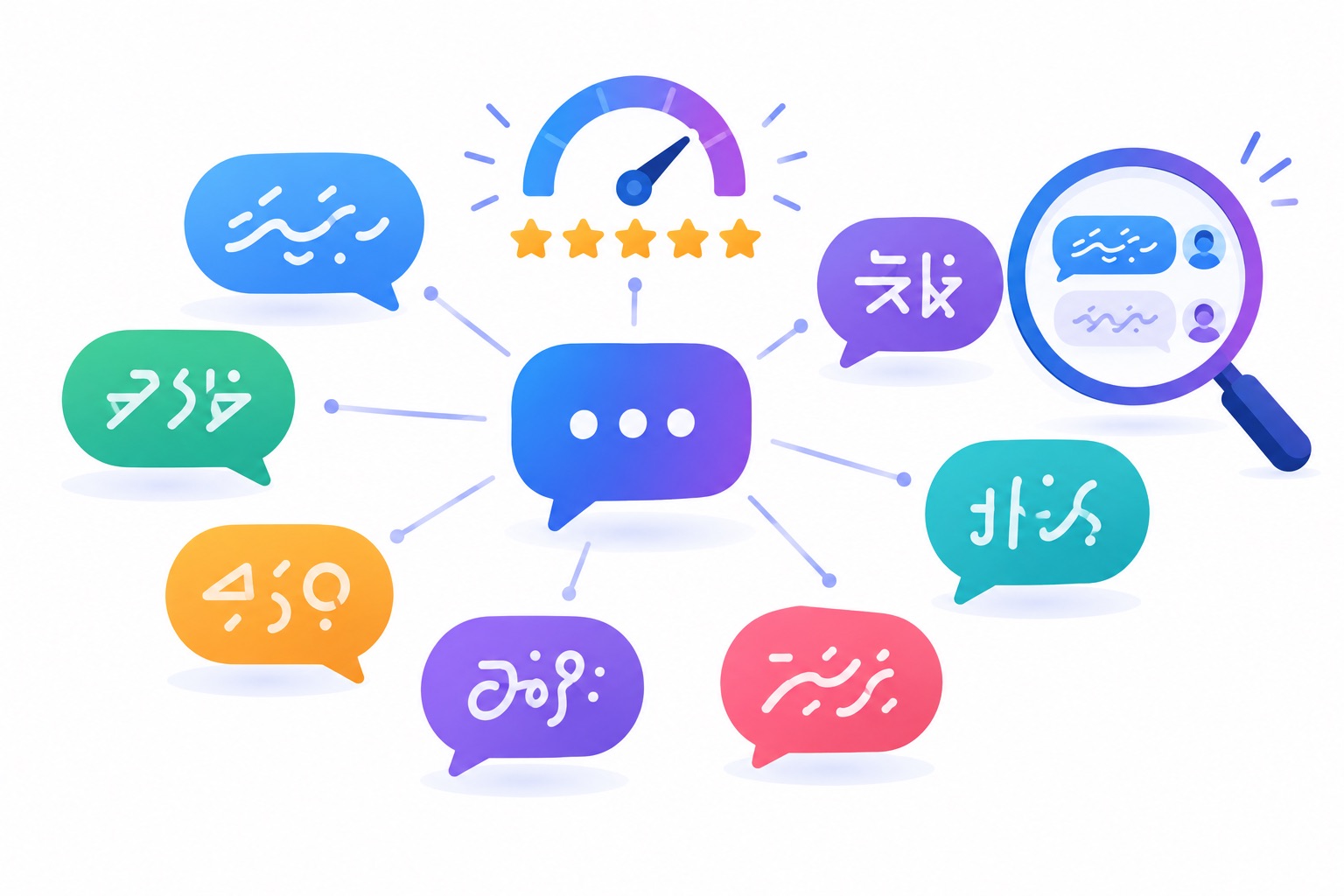
Four Key Points in Multilingual Quality
- Pick the multilingual stack deliberately: models, translation mechanisms, and terminology management set the ceiling of quality.
- Localize beyond words: the culture and expression habits behind each language shape how answers land.
- Evaluate per language: measurable multilingual quality standards make drift visible.
- Keep business consistent: the same business question must yield the same answer across languages.
The Overall Design
I would work on three layers—technical adaptation, expression localization, quality evaluation—plus fallback.
Layer 1: Multilingual technical solution
- Model layer: prefer base models with strong multilingual capability; fine-tune for markets where minor-language coverage is weak.
- Translation mechanism: internally, understanding and reasoning may run in one core language, but replies are generated in the user's target language; build a multilingual glossary for business terms, product names, and policy keywords—never machine-translate professional terms, because mistranslating amounts or deadlines is a business incident.
- Knowledge layer: maintain core policy knowledge per language through localization, not machine translation—policy wording directly affects user rights.
Layer 2: Expression habit adaptation
- Establish independent reply templates and tone guides per language: German-speaking users prefer formal and precise; some Southeast Asian markets prefer warm and concise.
- Respect local culture and holiday contexts; run localized review of sensitive expressions.
- Format time, currency, and size units per local conventions—a wrong date format can make a user miss the return window.
Layer 3: Quality evaluation system
Build independent evaluation sets per language and measure four dimensions:
- Comprehension accuracy: are intent and entities recognized correctly?
- Translation quality: terminology accuracy and naturalness (manual sampling plus automatic scoring).
- Business consistency: does the same question get the same answer in different languages—verified by cross-language consistency regression sets, the most easily missed piece.
- User-side metrics: satisfaction, repeat contact rate, and transfer rate per language.
Feed badcases from low-scoring languages back into annotation and optimization; assign native-speaker quality inspection for key markets.
Layer 4: Fallback mechanisms
- On low confidence or weak minor-language capability, transfer to a human or re-confirm in a language the user prefers.
- Display uncertain key information (amounts, deadlines) as structured data—a card showing "30 days" carries far less ambiguity than the phrase buried in a sentence.
Practice in Bytedesk
The open-source Bytedesk customer service system (GitHub, website https://www.weiyuai.cn ) is designed for multilingual scenarios: the interface and message templates support internationalization; the knowledge base organizes content by language dimension, supporting per-language operations; conversation statistics slice by channel and scenario, providing the data basis for per-language quality monitoring; and the quality inspection module supports manual conversation sampling to implement native-speaker review.
Key Takeaways
- Multilingual is not localization: translation solves language; per-language rule maintenance solves business.
- Business terms must map through a glossary; never let the model translate them freely.
- Maintain core policy knowledge per language by humans; machine translation is an aid only.
- Run cross-language consistency regression tests to ensure one question, one answer.
- Present key information as structured cards to minimize language ambiguity.