A Globally Unified AI Customer Service Architecture: Standardized Foundation, Localized Configuration

A friend running cross-border e-commerce complained to me: separate support systems for the US and UK storefronts, different bot answers to the same "what is the return window?" question, weekly alignment meetings for the support director—and worse, every new market meant rebuilding the system from scratch, making expansion prohibitively expensive.
This is a problem every global support team eventually faces. This post is part of an experience-sharing series on "AI customer service product and engineering practice", drawn from hands-on practice at a global fast-fashion cross-border e-commerce platform. In this post I want to share a unified AI customer service product architecture that balances global standardization with localized service—how to split globally common business from country-specific business, how to layer knowledge and rules so each market serves currently valid answers, how to connect business systems so the bot can actually get things done, and how to sequence the rollout. This is the first architecture decision every support team going global has to make.
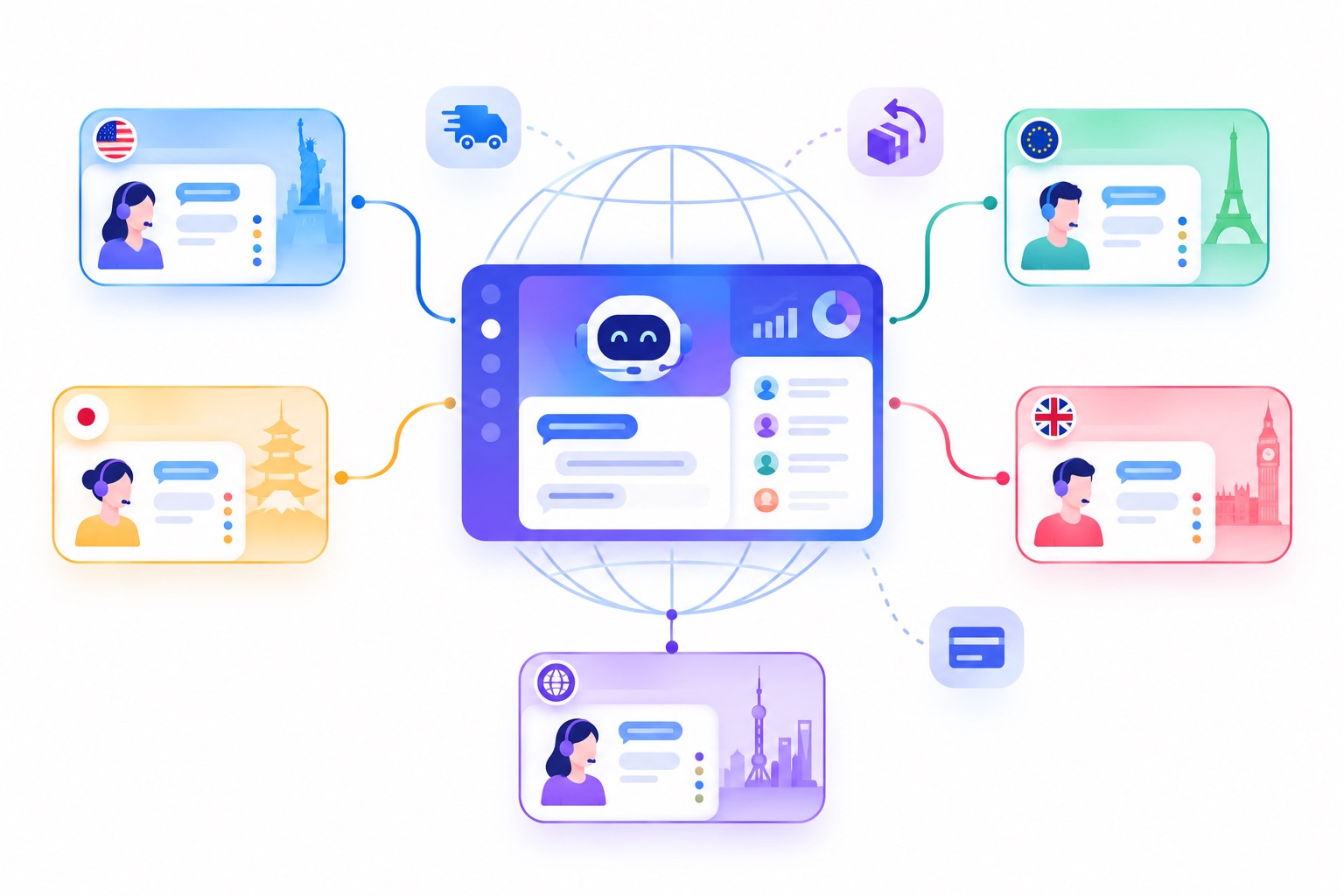
Six Key Points in Global Architecture Design
- Business differences come first: genuinely understanding differences across countries in language, logistics, payments, returns, and consumer service habits, instead of waving it off as "just add multi-language support".
- One foundation, not one system per country: the architecture must be one unified, reusable AI customer service foundation rather than a separate system per country.
- AI capabilities must interlock: multilingual intent recognition, LLMs, RAG retrieval, context management, and human handoff need to work together as one chain.
- Business systems must be connected: orders, payments, logistics, product, and after-sales systems integrate for real-time information access and closed-loop operations.
- Global standards, local rules: establish global data standards while supporting per-country rule configuration and knowledge versioning.
- Sequenced execution: priorities are sequenced and delivery driven through pilots, monitoring, and iteration.
The Overall Design
If I owned this system, I would not start by debating which LLM to use. I would first articulate the business problem, then lay out the architecture layer by layer. My overall principle: one unified global foundation, country-level configuration, AI-orchestrated dispatch.
Step 1: Decompose global versus local business differences
Split the business into two categories: globally common business (order status, tracking, product questions, account issues, refund progress—nearly identical across markets, reusable worldwide) and country-specific business (return windows, refund rules, carriers, payment methods, tax policies, local languages, service hours—must be localized). Then decompose along country, scenario, and user type to decide what to reuse and what to configure.
Without this groundwork, everything after is built on sand: a US user and a UK user asking about returns have identical intent, but the window, fees, and steps may differ completely. A single global FAQ easily produces "the bot answered correctly, but the answer does not apply to this user's market".
Step 2: Build a unified AI customer service foundation
- User access layer: one entry point for app, website, and chat, identifying market, language, and order context.
- AI interaction layer: intent recognition, entity extraction, multi-turn dialogue, context understanding, task decomposition.
- Knowledge and rules layer: RAG retrieval matched by country, language, scenario, and effective dates.
- Business service layer: integrations with order, payment, logistics, product, and after-sales systems for real-time queries and operations.
- Human collaboration layer: intelligent escalation for complex, abnormal, or high-risk cases with full context handover.
Differences collapse into the configuration layer—no country builds its own duplicated system.
Step 3: Globally unified, regionally independent knowledge and rules
Three knowledge layers: global common base (product basics, common flows, platform rules), country/regional base (local return policies, logistics rules, tax explanations), and scenario base (solutions for order exceptions, refund failures, and the like). Every item carries country code, language, scenario, effective/expiry dates, and version metadata; retrieval filters by market first, then fetches the currently effective rule—US and UK return policies must never share one answer.
Another key principle: critical rules like return windows and refund amounts must not be decided solely by an LLM—validate through a rules engine or the after-sales API. The LLM only understands the question, composes language, and explains outcomes.
Step 4: Connect business systems for closed-loop service
AI support must solve problems, not just answer them. Prioritize five integrations—order, logistics, payment, after-sales, product—exposed as unified APIs with standardized data structures so the AI invokes tools per intent. For state-mutating operations like refunds and cancellations, identity verification, permission checks, and result confirmation are mandatory; never execute purely on LLM-generated content.
Step 5: Multilingual service and data monitoring
For multilingual service: detect the user's language, preserve business terms verbatim, optimize replies for local expression, and fall back to humans on low-confidence or cross-lingual failures. The yardstick is not just translation accuracy but whether the user actually understood the solution.
For monitoring, track four metric families: AI capability (intent accuracy, knowledge hit rate, tool call success), business (bot resolution, first-contact resolution, transfer rate), experience (satisfaction, repeat contacts), and cost. Never read bot resolution rate alone—no transfer does not mean solved; a user returning days later is the proof. Correct it with repeat-contact and first-contact-resolution metrics, analyzed by country and scenario.
Rollout: pilot first, then expand
Start with high-volume, rule-clear scenarios (order status, tracking, refund progress) in one or two key markets; once the core loop works, expand to return requests, abnormal orders, and complex multilingual inquiries. Three end goals: cut the cost of per-country rebuilds, improve bot accuracy and efficiency, and keep the system extensible to new countries and scenarios.
Practice in Bytedesk
The open-source Bytedesk customer service system (GitHub, website https://www.weiyuai.cn ) mirrors this thinking: the multi-channel access layer unifies website and app entries; workgroups and routing assign agents by market, language, or business line; the knowledge base supports categories and tags for multi-market content; AI Agents support tool calling to integrate order and logistics systems; conversations transfer to humans with full context; the ticket module handles cross-team after-sales workflows; and conversation statistics plus quality inspection provide the data foundation for optimization.
Key Takeaways
- The core of global support is a unified foundation with localized configuration, not one system per country.
- Knowledge and rules carry country, language, scenario, effective dates, and version metadata; filter by market before retrieval.
- The LLM handles understanding and expression; business outcomes follow real systems and rule engines.
- Read bot resolution rate with first-contact resolution and repeat contacts to avoid the "no transfer means solved" trap.
- Pilot high-volume, rule-clear scenarios first, then expand.