Transfer Rate Down 20%, Costs Unchanged: Decomposing Agent Service Costs

Three months after the logistics agent launched, everyone at the operations review was waiting for one conclusion: transfer rate down 20%, so can we shrink the agent headcount? Finance's answer silenced the room—overall service cost barely moved. Where did the saved human effort go? Eaten by model tokens? By tool calls? Or did the remaining human cases simply get harder? If you cannot explain where the money went, the next round of optimization has nowhere to start.
This post is part of the "AI Customer Service Product and Engineering Practices" experience-sharing series, drawn from a practice review of an AI customer service product at a leading logistics company. In this post I want to share how to analyze the cost structure across token consumption, tool calls, model inference, human fallback, and task completion efficiency — and determine optimization priorities — when the human transfer rate drops 20% after an AI agent goes live but overall service cost does not improve. This is the gate an agent must pass to go from "works" to "economical".
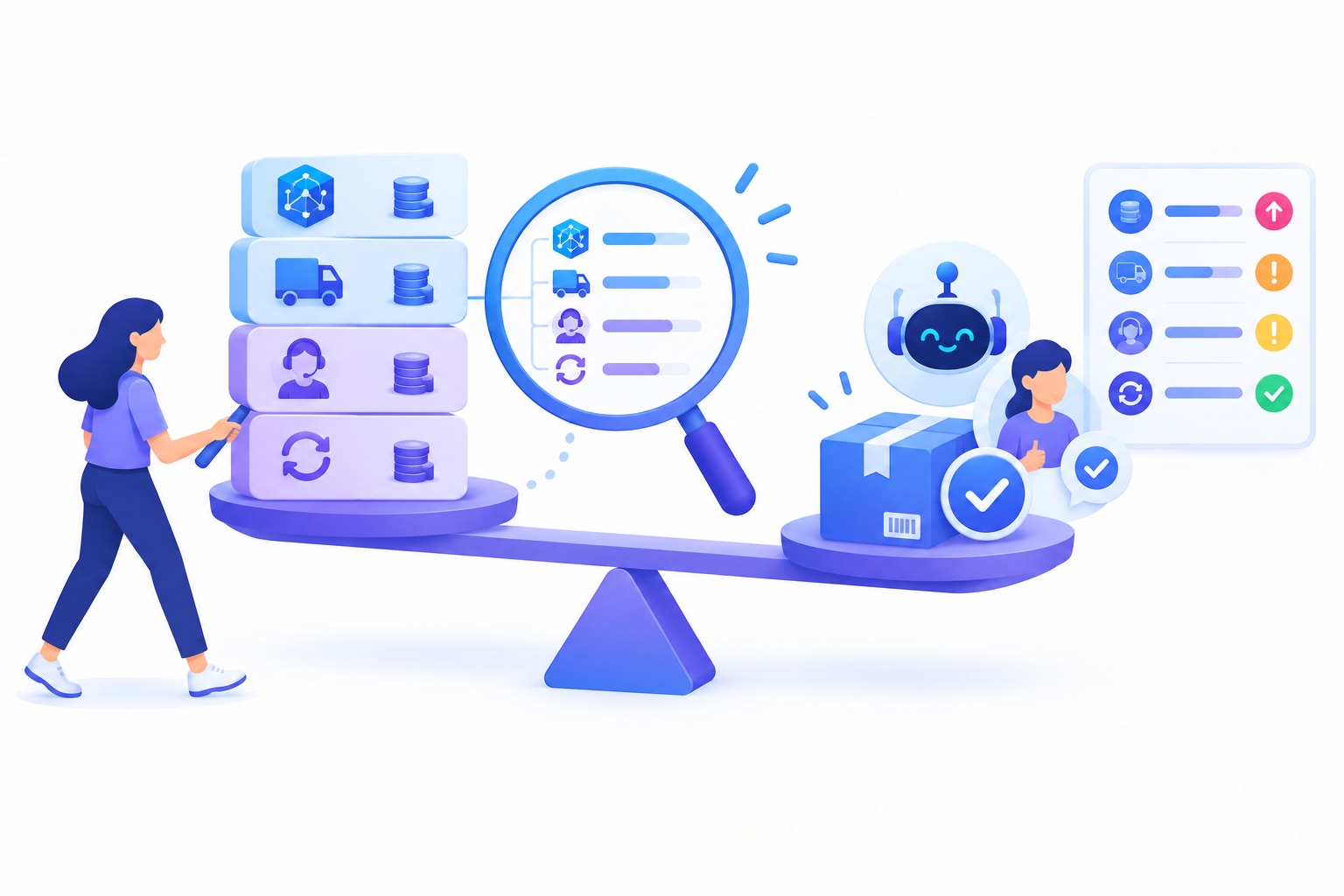
Five Key Design Points in Cost Decomposition
- Cost modeling: whether you can decompose per-service cost into model, tool, human, and operations components.
- Token and inference cost: context length, retries, model tiers, caching.
- Tool call cost: call counts, failed retries, cross-system fan-out, third-party fees.
- Human cost: with transfer rate down, whether per-case complexity and repeat contacts rose.
- Efficiency and ROI: task completion rate, first-contact resolution, optimization priority ranking.
The Overall Design
In this cost review, I would start by accepting one fact: transfer rate fell but cost did not, which means the savings were eaten somewhere else—and my job is to find that place. The overall approach in one sentence: build the four-block cost model first, then find the amplifiers, rank optimizations by ROI, and accept results on cost and resolution together.
Step 1: Build the four-block cost model
Cost per service = model inference + tool/system calls + human labor (transfers, rework) + operations (knowledge maintenance, labeling, evaluation). Allocate by scenario and task type, and see which block is growing. Track both the cost per contact and the total cost of taking one issue from first inquiry to final resolution—otherwise retries and repeat contacts scatter across different reports and quietly vanish.
Step 2: Check token and model-side amplifiers
- Is the context too long: whether history and knowledge injection leave room for compression;
- Whether multi-round failed retries cause repeated billing;
- Whether every request routes to the large model—can model routing screen simple questions through small models or rules first;
- What the cache hit rate looks like, and whether high-frequency Q&A is cached.
Step 3: Check tool and inference-side amplifiers
On the tool side, watch call counts and failure rates—retries and cross-system calls multiply cost, and third-party billed APIs deserve a separate line; consider whether tools can be merged or useless queries reduced. On the inference side, watch long reasoning chains, concurrency, and latency: high latency usually means high resource occupation, and repeated computation is hidden waste.
Step 4: The human side needs its own ledger
This is the most underestimated block: transfer rate fell 20%, but are the transferred cases more complex with longer handling time? Are users coming back more often? Automation absorbs easy inquiries first, leaving humans with hard cases whose per-case cost rises; leave this out and the whole model is distorted.
Step 5: Rank optimizations by ROI, accept on cost and outcome together
Optimization is not doing everything, but ranking by ROI: start with low-cost context compression, caching, and model routing; then tool consolidation and failure-rate governance; only consider switching models or changing architecture last. After each change, evaluate cost per service together with true resolution—never sacrifice resolution to save money; saving tokens while losing customers is negative optimization.
Practice in Bytedesk
In the open-source Bytedesk customer service system (GitHub, website https://www.weiyuai.cn ), the configurable multi-turn memory window provides a direct lever for controlling context size and compressing tokens; complete records of bot and human reception, plus tool invocation logs and ticket handling records, help inspect duplicate calls and human rework; conversation statistics slice volume and transfer rate by channel and scenario, offering clues on whether the remaining human cases are the hard ones. Ledgers such as token billing aggregation, infrastructure allocation, and labor-hour accounting need to be built on the business side following this post—shrinking the memory window requires regression on critical facts and resolution, and must not be counted directly as successful cost optimization.
Key Takeaways
- When transfer rate falls but cost does not, first build the four-block cost model: model inference, tool calls, human labor, operations—allocated by scenario and task to see which block grows.
- On the token side watch context length, failed retries, full routing to large models, and cache hit rate; on the tool side watch call counts, failed retries, third-party billing.
- Keep a separate human-side ledger: transferred cases getting more complex, handling time lengthening, repeat contacts increasing are the most underestimated cost items.
- Rank optimizations by ROI: compress context, cache, and route models first; then tool consolidation and failure-rate governance; switch models or architecture last.
- Accept on cost per service + true resolution together—sacrificing resolution to save money is negative optimization.