Unified Architecture for Platform-Level IM Customer Service: One Foundation, Many Business Lines

When a local-life services platform runs food delivery, in-store, hotel, and instant retail businesses at the same time, the customer service team often faces an awkward reality: every business line wants "its own customer service system," because refund rules, order structures, and scripts all differ. But if you really build one system per line, message channels get rebuilt repeatedly, knowledge bases fragment, and Agent capabilities cannot be reused—costs spiral out of control.
This is the first article in an experience-sharing series on "AI customer service product and engineering practice," drawn from hands-on practice as an AI Product Manager focused on IM intelligent customer service at a local-life services platform. In this post I want to share how to design a unified IM product architecture when supporting multiple business lines simultaneously—how to divide foundational messaging capabilities, business service capabilities, and Agent capabilities, and how to resolve differences in workflows, rules, and personalization across business lines.
At its core, this is the central competency of platform-level product work: build a platform for what is common, configure for what differs. A single-business service product only needs to work; a platform-level one must think through reuse.
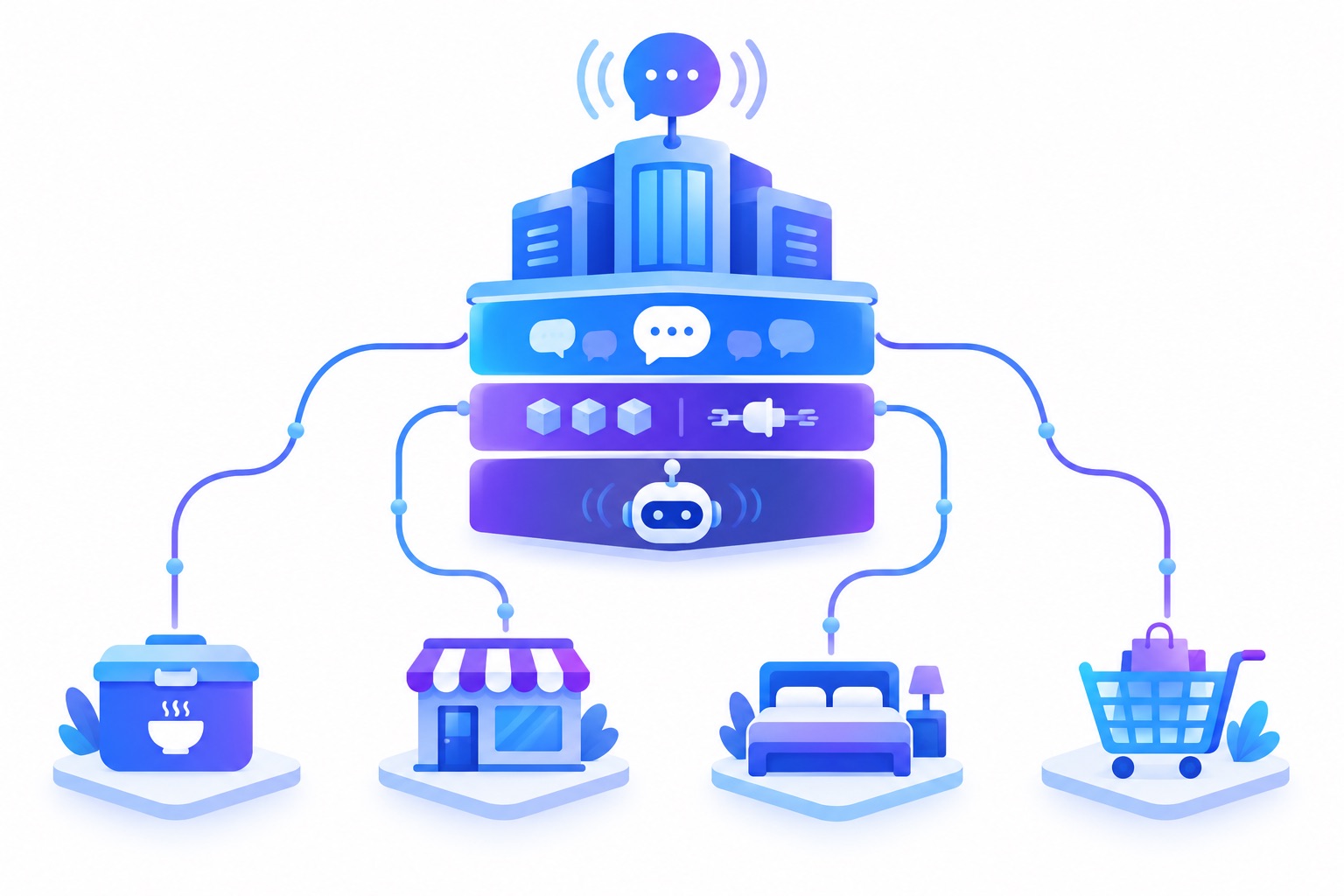
Five Key Points in Platform-Level Architecture
Architecture work like this is typically judged from five angles, and all five are worth designing for deliberately:
- Identify common vs. differentiated needs across business lines—this is the basis for layering.
- Properly split the three layers: IM foundation, business services, and Agent intelligence.
- Clarify the relationship between business rules, knowledge bases, tool calling, and the Agent—who calls whom, who configures whom.
- Keep a modular, configuration-driven, cross-business reuse mindset, instead of running a custom project per business line.
- Validate the platform's actual value with data metrics, proving platformization is not architecture for its own sake.
In one sentence: build common capabilities once, configure for differences, attach AI on demand, and verify business outcomes continuously.
Overall Approach
I recommend a four-step structure: business decomposition → layered architecture → difference configuration → validation.
Step 1: Decompose Commonalities and Differences
Analyze customer service conversations across delivery, in-store, hotel, and instant retail, then sort requirements into two piles.
Common needs include message send/receive, session management, order association, problem identification, human handoff, and service rating. Across every business line, the technical shape and product logic of these capabilities are nearly identical.
Differences concentrate in business rules and handling flows:
- Delivery cares about order chasing, missing items, and refunds;
- Hotels care about check-in policies, room types, and cancellations;
- In-store cares about voucher redemption and reservations;
- Instant retail cares about inventory, delivery, and after-sales.
The difference is not "whether to look up an order," but "how to decide whether a refund is allowed after the lookup." This insight determines the layering that follows.
Step 2: Design the Three-Layer Platform Architecture
Layer 1: IM foundation. Unified message send/receive, read receipts, session state, message reliability, human handoff, and permission management. Focus on no message loss, no duplication, no reordering, and no context loss after handoff—if the messaging channel is untrustworthy, everything above it is castles in the air.
Layer 2: business services. Through standard APIs, rule engines, and workflow orchestration, connect to order, refund, fulfillment, and inventory systems as unified interfaces, while letting each business plug in its own rules and workflows. Reuse the foundation; do not force-unify business rules.
Layer 3: Agent intelligence. Unified intent recognition, RAG knowledge retrieval, context management, task planning, tool calling, and result verification, so Agents from different businesses can compose capabilities per scenario instead of rebuilding from scratch.
Beyond the three layers, build a unified operations console supporting knowledge maintenance, workflow configuration, effect monitoring, and gray release. The hardest part of platformization is not technical reuse but business adoption—when operations teams can self-serve knowledge and workflows while R&D focuses on common capabilities, adoption forms a positive loop.
Step 3: Resolve Differences Through Configuration
Do not develop a separate service system per business line; abstract differences into business plugins, rule configurations, and workflows.
Take refunds: delivery and hotel can reuse the platform's intent recognition, identity verification, and order query, while refund rules, approval flows, and execution interfaces are configured per business. Delivery may need to check whether goods were delivered, missing, or defective; hotels need to check check-in status, cancellation policy, and refund conditions.
The full pipeline: user initiates a consultation → IM receives the message → business and intent identified → order context fetched → Agent decides the handling path → business tools invoked → execution result verified → user replied. Plain order queries can be fully automated; operations touching user rights require rule and permission checks first, plus user or human confirmation when necessary.Pay special attention to the Agent's execution boundary: low-risk tasks like order lookup or rule explanation can run automatically; operations like order cancellation or refund execution must combine business permissions, rule checks, and confirmation mechanisms—never rely on the model's own judgment alone.
Step 4: Establish Metrics and Validation
On the platform side, watch message success rate, response latency, system stability, and capability reuse; on the business side, watch effective resolution rate, task completion rate, human handoff rate, repeat consultation rate, satisfaction, and cost per service.
At rollout I would not cover all businesses at once—start with an MVP on high-frequency, relatively standardized scenarios like delivery order queries and hotel policy consultations, then validate through small pilots, gray release, and per-business reviews.
Watch for false signals: if a business's resolution rate rises while repeat consultations climb, that is not real optimization—go back to the conversations.
The whole idea in one sentence: unified foundation, configurable business layer, composable Agents on top, validated by data—scale reuse without sacrificing per-business experience.
Practice in Weiyu
This layered thinking maps closely onto Weiyu, the open-source AI customer service system (GitHub, website): core modules provide the IM messaging channel, session management, and multi-channel access as the "foundation layer"; skill-group routing, tickets, and ticket workflows play the "business services" orchestration role; the AI module offers knowledge base with RAG, AI Agent, and tool calling, supporting human-AI collaboration and handoff. The admin console covers knowledge maintenance, skill-group configuration, and session statistics with QC—exactly the "unified operations console." Multiple business teams can serve different lines on one foundation through configuration differences in skill groups and knowledge bases.
Takeaways
- The first step of platform architecture is decomposing common vs. different: commonalities become platform, differences become configuration.
- The three-layer split—IM foundation, business services, Agent intelligence—is the basic framework for multi-business reuse.
- The Agent's execution boundary must map to risk level: low risk runs automatically; high-risk operations add confirmation and approval.
- A configuration-driven console determines business adoption—the non-technical key to platform success.
- All platform work must ultimately be validated by data metrics; beware of rising resolution rates with degrading experience.