An Iteration System for AI Misunderstanding: Attribute First, Then Touch Knowledge, Workflow, or Model

When merchants complain that "the AI agent answers the wrong question," the team's first instinct is often to tweak prompts or swap models. But frontline experience repeatedly shows: more than half of "misunderstanding" cases are not model problems at all—the content is simply missing from the knowledge base, or it exists but cannot be retrieved. Pushing every problem to the model layer is the most expensive and least effective path in smart customer service iteration.
This is the eighth article in an experience-sharing series on "AI customer service product and engineering practice," drawn from hands-on practice as an AI Product Manager focused on IM intelligent customer service at a local-life services platform. In this post I want to share how to build an iteration system spanning problem attribution, knowledge governance, prompt optimization, and model evaluation when merchants report that the AI frequently fails to understand promotions, delivery restrictions, and after-sales policies—and how to decide when to optimize the knowledge base, the workflow, or the model itself.
The heart of it is data-driven iteration methodology—acting without attribution is prescribing medicine blindfolded.
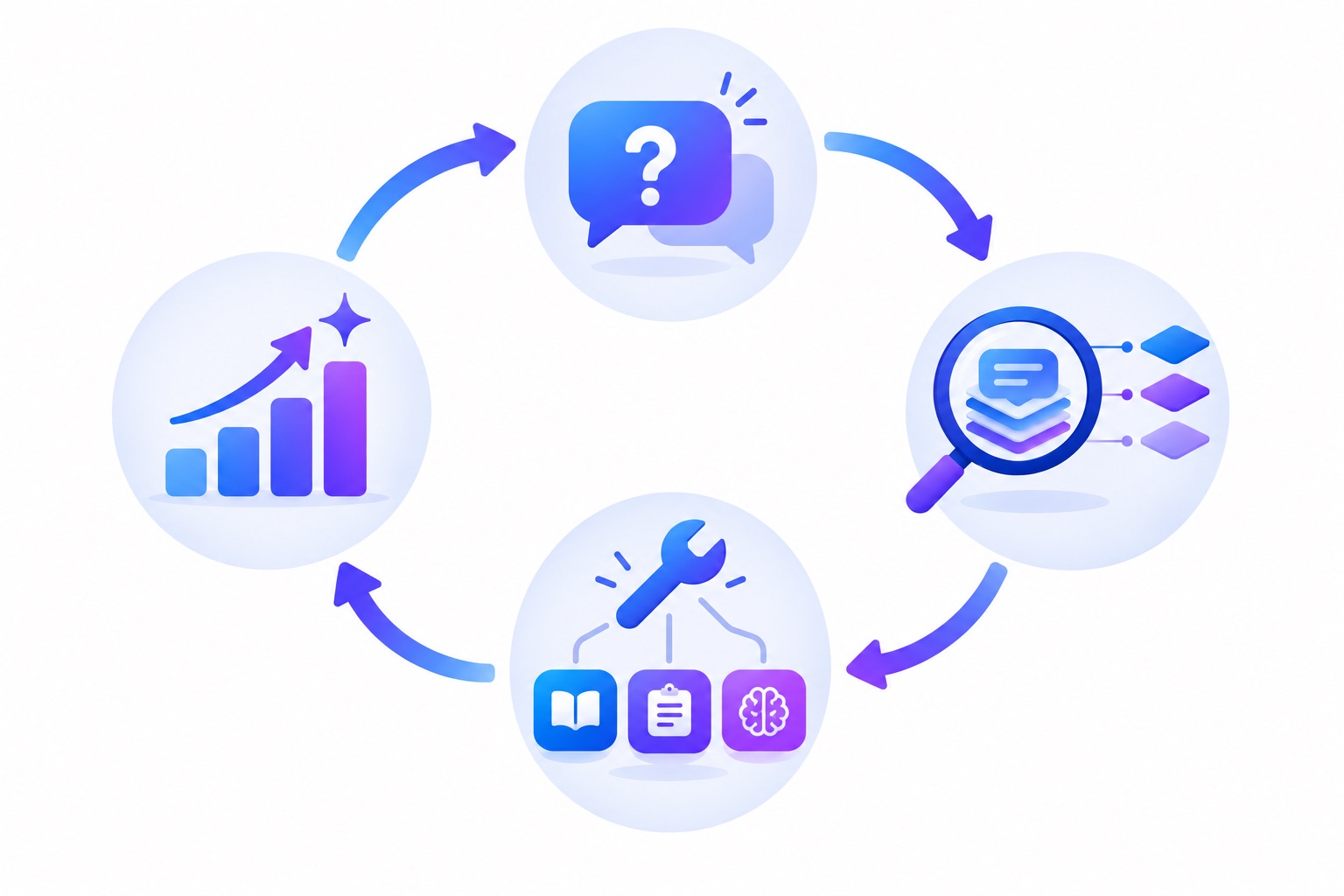
Three Key Points in the Iteration System
- Build a data-driven bad-case attribution method instead of acting on intuition when feedback arrives.
- Know the different fixes for knowledge-layer, workflow-layer, and model-layer problems—their costs and time-to-impact differ by an order of magnitude.
- Build a sustainable evaluation regression system so each optimization introduces no new problems.
Overall Approach
Step 1: Attribution — Classify Before Acting
I would not touch prompts upon receiving feedback. First, sample the failed conversations behind merchant reports and tag by root cause:
- Knowledge missing/stale: the content is absent from the knowledge base or outdated;
- Retrieval failure: the knowledge exists but was not retrieved (wording differences, indexing issues);
- Workflow defects: unreasonable flow design (missing clarification steps, missing order context);
- Model understanding/generation issues: knowledge was provided but the model misunderstood or answered off-topic.
Tally the share of each root cause to decide investment. In practice knowledge problems usually exceed half, so the iteration order is: knowledge first, then retrieval and workflow, model last.
Step 2: Layered Remediation
Knowledge governance (usually the largest share):
- Extract standard Q&A pairs from failed conversations and fill knowledge gaps;
- Build a merchant self-service knowledge maintenance portal with freshness requirements, giving volatile content like promotions a clear update mechanism with expiry reminders;
- This is the cheapest, fastest-acting move.
Retrieval optimization: synonym expansion, query rewriting, hybrid retrieval (vector + keyword) to lift hit rates.
Prompt/workflow optimization: add clarification follow-ups, enforce citing knowledge fragments, adjust answer structure.
Model optimization: the last resort—few-shot, fine-tuning, or switching models—because costs are high, outcomes uncertain, and cycles long.
Step 3: Evaluation Regression
Build layered evaluation sets: merchant high-frequency question set + bad-case regression set. Run evaluations each iteration, measuring intent accuracy, retrieval hit rate, and answer accuracy; optimizations must pass evaluation before gray release—otherwise you fix promotions while breaking after-sales, netting zero.
Validating the System
I would verify with changes in attribution shares: if knowledge-problem share declines month over month, governance is working; if model-problem share rises, the knowledge layer's dividends are exhausted and model investment finally becomes worthwhile.
Decision Principle
One sentence: missing knowledge—fill it first; unretrievable—tune retrieval first; bumpy flow—fix the workflow first; the model layer is the last resort—because knowledge and workflow optimizations are cheap, controllable, and explainable.
Practice in Weiyu
Weiyu, the open-source AI customer service system (GitHub, website), provides the supporting components for this iteration loop: the knowledge base module supports categories, tags, and full-text/vector retrieval, enabling knowledge gap-filling and retrieval tuning; the session QC module enables sampling and review of failed conversations—the data source for bad-case attribution; the AI module supports multi-model switching and prompt configuration, making the "model last" strategy cheap to execute; session statistics provide satisfaction and resolution trends to validate iteration effects.
Takeaways
- Attribute before acting: tag failed conversations across four classes—missing knowledge, retrieval failure, workflow defect, model problem.
- Iteration order: knowledge first, then retrieval and workflow, model last—cost and controllability dictate it.
- A merchant self-service maintenance portal gives volatile knowledge a clear update mechanism—the organizational guarantee of knowledge governance.
- Layer the evaluation sets (high-frequency + regression); optimizations pass evaluation before gray release.
- Validate the system by month-over-month attribution shifts, not a single accuracy number.