Priority Decisions Under Competing Demands: A Value Model Instead of the Loudest Voice

Every product manager faces this weekly: merchants want bulk replies, users complain the human-entry is buried, the algorithm team pitches a multi-Agent architecture—but R&D capacity covers only one. Most teams decide by "whoever shouts loudest" or "whoever ranks highest," and neither correlates with value.
This is the tenth article in an experience-sharing series on "AI customer service product and engineering practice," drawn from hands-on practice as an AI Product Manager focused on IM intelligent customer service at a local-life services platform. In this post I want to share how to build a demand value assessment model, set priorities, and validate product ROI when merchants request bulk-reply features, users request a quick human-support entry, and the algorithm team proposes a multi-Agent upgrade—but R&D can support only one direction.
There is no standard answer here, but there is a standard method—the assessment framework and decision mechanism are what really matters.
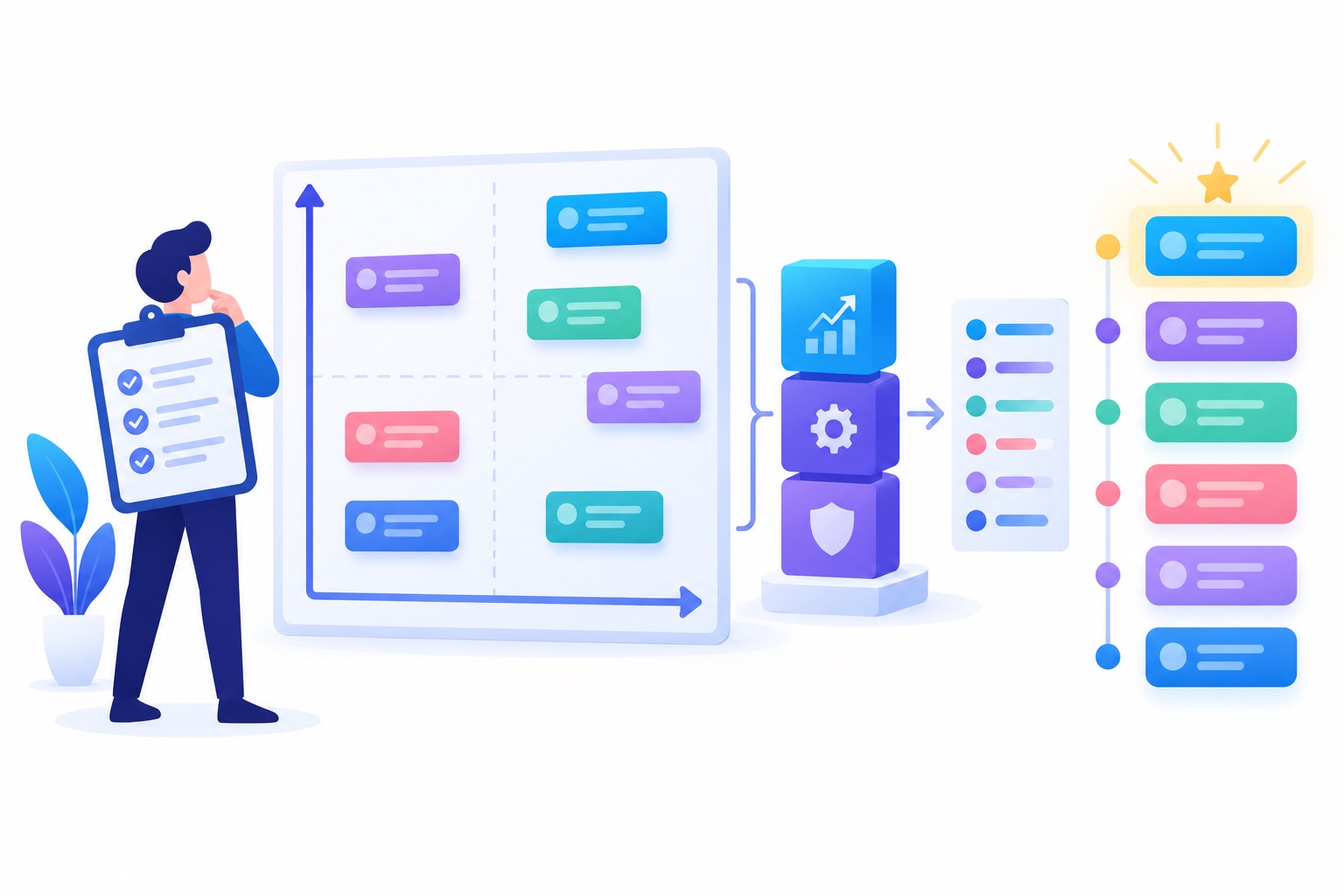
Three Key Points in Prioritization
- Build a structured value assessment framework, turning "I think it's important" into "the data says it's important."
- Understand the real value differences behind each stakeholder's ask—merchant efficiency, user experience triage, and algorithm capability are fundamentally different value types.
- Design ROI validation and retrospective mechanisms, making prioritization a sustainable process rather than a one-shot game.
Overall Approach
I would compare demands with a unified value model, not by whoever shouts loudest.
Step 1: Build the Five-Dimension Model
Score each demand (weighted as needed):
- User/merchant value: reach × pain intensity (look at request volume, complaints, NPS correlation);
- Business value: contribution to north-star metrics (resolution rate, satisfaction, cost);
- Strategic fit: alignment with the platform's current stage goals;
- Implementation cost and risk: R&D investment, launch risk, maintainability;
- Urgency: competitive or regulatory pressure.
Step 2: Analyze the Three Demands in Context
These three demands are fundamentally three types:
- Quick human entry is a "stop-the-bleeding" demand: it directly affects experience and public sentiment. Check the data first—if human-transfer requests are high and the entry is hard to find, breeding frustration, priority is high, because experience problems compound into reputation loss.
- Bulk replies are an "efficiency" demand: assess affected merchant count and order volume; if top merchants consume massive service resources, the value is considerable.
- Multi-Agent upgrade is a "capability" investment: high upside but long cycles and uncertainty, and it must match the current bottleneck—if even single-Agent resolution is below par, multi-Agent is premature optimization; downgrade it to research.
Step 3: Decide and Validate
The key: define the validation criteria for each demand at decision time, then check ROI with data after launch:
- Quick entry → watch human-transfer wait time and satisfaction;
- Bulk replies → watch merchant support efficiency and response time;
- Multi-Agent → watch complex-task resolution rate.
Demands that miss ROI expectations get stopped or adjusted promptly. Prioritization then becomes a sustainable mechanism rather than a one-shot game—the demand that lost this round returns next round with fresh data.
A Concrete Ranking Example
If data confirms that hard-to-find human entry is driving mass negative sentiment and bad reviews, my ranking: quick entry first (stop the bleeding), bulk replies second (certain efficiency gains), multi-Agent to research (wait until single-Agent dividends plateau). But the ranking must follow each demand's data, not the category labels themselves.
Practice in Weiyu
The feature evolution of Weiyu, the open-source AI customer service system (GitHub, website), embodies this trade-off: it first nailed "experience floor" capabilities—multi-channel access, skill-group routing, human handoff—then layered on "capability upgrades" like knowledge-base RAG and AI Agent tool calling, each step verifiable with metrics (handoff rate, session statistics, satisfaction). For a community product, assessment gains an extra dimension: issue volume and discussion heat from open-source users are a natural data source for "reach × pain intensity."
Takeaways
- Prioritize with the five-dimension model (value, business, strategy, cost, urgency)—not the loudest voice.
- Three demand types, three logics: stop-the-bleeding watches sentiment data; efficiency watches reach; capability watches bottleneck fit.
- Capability investments like multi-Agent are premature optimization while single-Agent lags—downgrade to research.
- Define validation criteria at decision time; verify ROI post-launch; cut losses promptly.
- The value of a prioritization mechanism is sustainability—today's losers return next round with new data.