Multi-Source Knowledge Governance: When Platform Rules, Merchant Promises, and Product Data Disagree, Whom Does the Bot Believe?

When a customer service bot answers wrongly, the root cause is often the knowledge, not the model. E-commerce knowledge sources are inherently plural: platform rules say seven-day no-reason returns, the merchant's product page promises thirty days; the spec sheet disagrees with the order system; an after-sales policy got a temporary revision during a big sale while the knowledge base still holds the old version. The user asks "can I return this?", the bot quotes stale, low-priority knowledge, and a complaint follows.
This post is part of an experience-sharing series for AI customer service product managers and developers, drawn from hands-on practice as an intelligent service product manager at a large general e-commerce platform. In this post I want to share how to design knowledge governance, priority arbitration, and dynamic updates that keep bot output accurate and consistent when platform rules, merchant promises, product information, order status, and after-sales policies conflict, expire, or disagree on scope.
The ceiling of a RAG system is never the model — it is knowledge governance, and that is exactly the debt most teams carry.
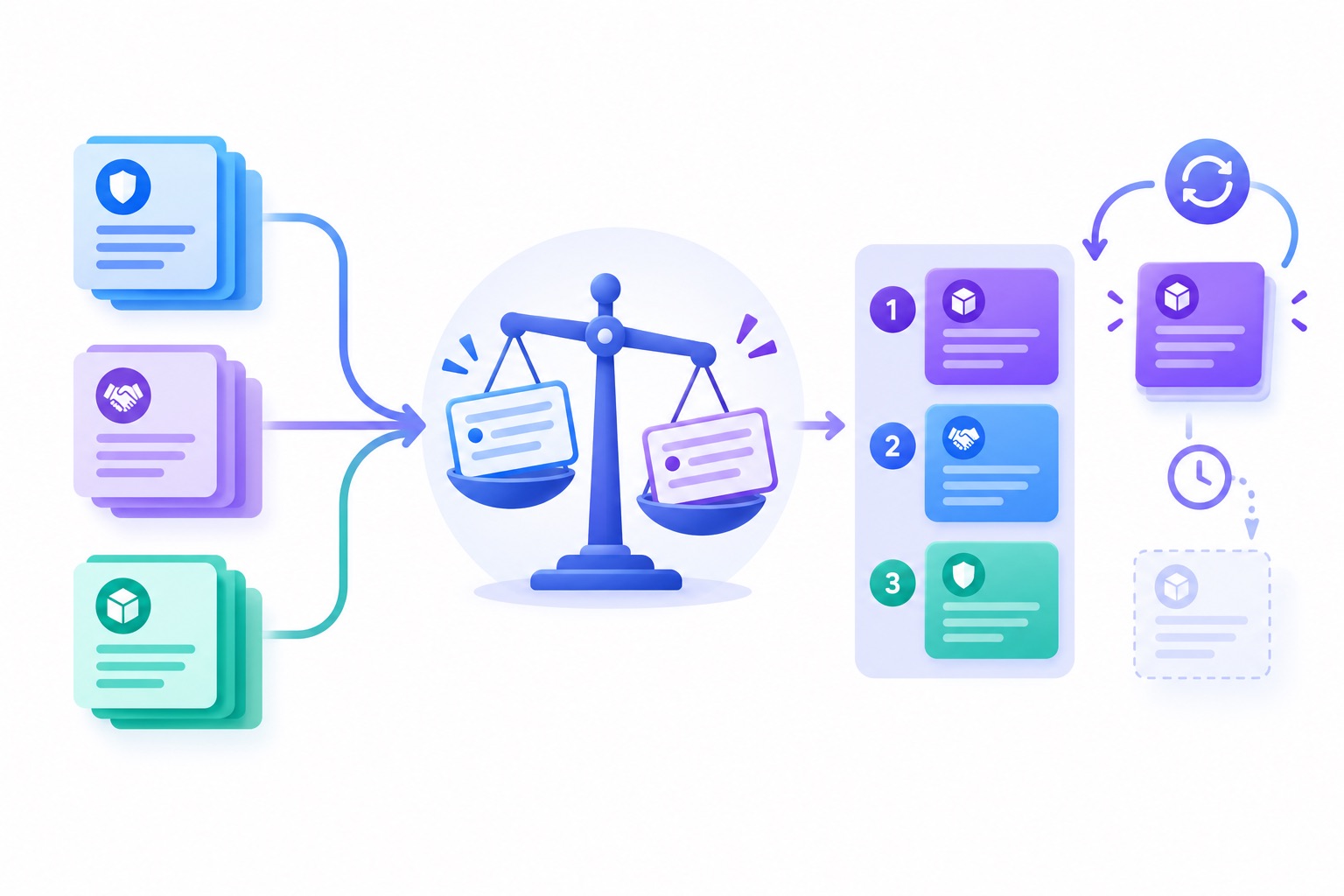
Three Key Points in Multi-Source Knowledge Governance
- Multi-source governance design: clear layering and arbitration rules for knowledge from different origins.
- Engineering rigor in conflict arbitration and freshness: at which layer conflicts get resolved, how expired content auto-retires — mechanisms, not manual heroics.
- Long-term operations mindset: treating the knowledge base as a product with a lifecycle, not a one-time construction project.
The Overall Design
Step 1: Knowledge layering and priority design
I would establish a clear priority order, from highest to lowest:
- Real-time business data (order status, logistics milestones) — sourced from system APIs, never cached stale;
- Laws, regulations, and mandatory platform rules (e.g., seven-day no-reason returns);
- Explicit merchant promises to users (product-page commitments, recorded agent promises) — merchant promises must not fall below the platform floor; on conflict, the one more favorable to the user wins, within platform rules;
- General after-sales policies and product knowledge.
Every knowledge item gets metadata tags: source, effective date, expiry date, applicable scope (category/store/order type), and priority. Retrieval filters and arbitrates by tags — knowledge outside scope should never be recalled at all.
Step 2: Conflict detection and arbitration
- Run consistency checks on ingestion and updates, plus periodic batch scans for semantically conflicting entries pushed to knowledge operators for human adjudication — catch conflicts at the source, before users hit them.
- When retrieval hits conflicting items, arbitrate by priority rules at the retrieval layer before generation, never let the model decide. This mechanically reduces hallucination: the material handed to the model is already clean and consistent.
- In generation, require the model to answer only from retrieved knowledge with cited sources; when uncertain, explicitly say "subject to human verification" — fabricating is forbidden. Better to admit ignorance than deliver a confident wrong answer.
Step 3: Dynamic update mechanisms
- Rule-type knowledge: integrate with the rules platform so rule changes automatically trigger knowledge updates and invalidation;
- Product-type knowledge: sync with the product system in real time, no static copies — otherwise the detail page changes and the knowledge base does not;
- Policy-type knowledge: set validity periods, auto-retire on expiry and remind operators to re-review; support knowledge version switching for special periods such as big-sale-specific return rules;
- Build a Bad Case → knowledge repair loop: wrong answers are auto-attributed to missing, expired, or conflicting knowledge, queued for knowledge operations, and regression-tested after repair before going live again.
Two insights worth stating out loud
Knowledge has a lifecycle: ingestion → activation → monitoring → expiry → archiving is full-process management, not one-time construction. Launch day is when operations begin.
Placing priority arbitration in the retrieval layer instead of the generation layer is the key engineering decision for consistency. Letting the LLM "weigh" conflicting knowledge hands the least error-tolerant step to the least deterministic component.
How This Maps to Bytedesk
Bytedesk, the open-source AI customer service system (GitHub, site), provides infrastructure for this governance approach: the knowledge base supports categories, tags, and multi-format imports, enabling structure by source and scope; the RAG retrieval chain supports filtering and ranking at the recall stage; FAQ and quick replies suit high-priority deterministic rules; and session quality inspection and statistics surface wrong-answer scenarios so Bad Cases flow back to knowledge operations for repair. Deeper governance capabilities — rules-platform integration, knowledge validity periods, and version switching — are areas Bytedesk keeps strengthening.
Key Takeaways
- Rank knowledge as real-time business data → laws/mandatory platform rules → explicit merchant promises → general policies and product knowledge, with metadata tags throughout.
- Arbitrate conflicts at the retrieval layer before generation; never hand the choice to the model, and generation must cite sources and never fabricate.
- Rule-triggered updates, real-time product sync, policy validity periods, and sale-season version switching keep knowledge moving with the business.
- The Bad Case attribution → repair → regression loop is the engine of long-term knowledge quality.
- Remember: a RAG system's ceiling is knowledge governance, not parameter count.