Turning Service Expertise into Executable SOPs: Extraction, Structuring, and Continuous Governance

For the same "my package hasn't moved for three days" inquiry, a top agent can tell from one sentence whether it is hub congestion or a suspected loss—reassure first, then chase the shipment, and she knows exactly when to escalate. Paste her call recordings straight into the knowledge base, though, and the bot just recites the SLA policy while the user grows angrier. Great agents carry tacit judgment, not documents—and turning that expertise into answer strategies an AI Agent can actually execute is where knowledge operations most often stumble.
This post is part of the "AI Customer Service Product and Engineering Practices" experience-sharing series, drawn from a practice review of an AI customer service product at a leading logistics company. In this post I want to share the SOP structuring, business rule extraction, decision flows, and exception branch handling mechanisms that turn the service expertise accumulated by the support team into executable answer strategies for an AI Agent. Without proper extraction, the Agent's ceiling is forever capped by what humans hand over.
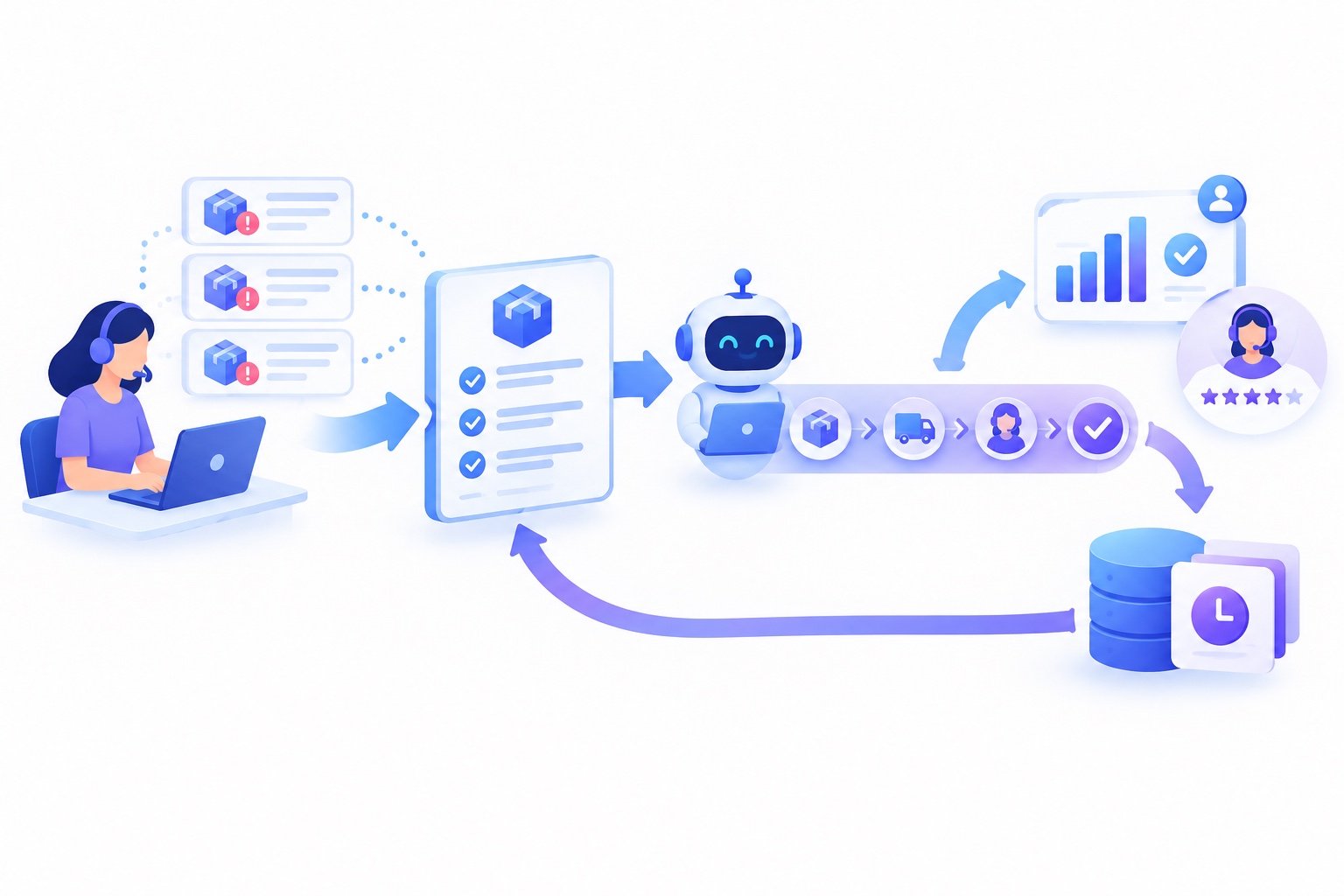
Five Key Design Points in Executable SOP Design
- Expertise extraction: making the tacit judgment of top agents explicit, turning it into executable, reusable rules and flows.
- Knowledge engineering: fundamentals of SOP structuring, business rule extraction, knowledge governance, and version management.
- Flow design: decision flows, exception branches, and fallback-to-human design must be complete.
- Agent implementation: how structured SOPs connect to RAG, rule engines, and workflows instead of staying at the document level.
- Operations loop mindset: excellent human cases keep flowing back and are validated through evaluation.
The Overall Design
In this effort, I would first be clear about one thing: what moves into the system is not recordings and scripts, but the reasoning behind why great agents act as they do. The overall approach in one sentence: extract first, then structure; hard-check explicit rules, use tacit expertise as judgment reference, fall back to humans on exceptions, and iterate through evaluation.
Step 1: Inventory the expertise and figure out what "great" means
Pull excellent recordings, high-scoring tickets, quality-inspection cases, and failure cases, group them by logistics inquiry, exception, and after-sales scenarios, and figure out what actually made the service great: precise judgment, complete actions, steady wording, or good emotional care. Failure cases matter too—they mark the boundary of where the expertise applies.
Step 2: Structure SOPs with a unified template
Give every SOP the same template: trigger conditions → pre-checks → execution steps → branch decisions → standard scripts → exception branches → escalation/human-handoff rules. What triggers it, what must be verified upfront, how many steps it runs, which branch to take under which condition, and when it must go to a human—each item must be an executable expression, not descriptive prose.
Step 3: Separate explicit rules from tacit expertise, and govern them apart
- Explicit rules: policies such as SLA standards, compensation terms, and authorization scopes go into a rule store for hard validation; every rule carries its source, applicable scope, and validity period, so an expired policy never keeps running.
- Tacit expertise: how to tell a genuinely abnormal shipment, or how to calm a user, becomes decision cues, features, and positive/negative examples for the Agent to reference—but examples never override official policy.
Step 4: Solidify the decision flow and make exception branches executable
Fix the main flow with decision trees or state machines: the Agent understands the user and plans steps, while the rule engine enforces hard constraints, with a clear division of labor. Exception branches cover four cases: missing information triggers a follow-up on essential fields only; rule conflicts defer to the latest policy and system data; API failures retry within bounds; beyond-authority cases go straight to humans with a service summary. Every branch needs an explicit state and an owner—not a vague "fallback on exception".
Step 5: Close the loop with evaluation
Turn excellent cases into an evaluation set; after launch, attribute bad cases to intent, knowledge, rules, flow, or wording, and feed the findings back into the SOPs and the evaluation set. Human expertise then becomes a continuously iterating asset rather than a one-time migration.
Practice in Bytedesk
The open-source Bytedesk customer service system (GitHub, website https://www.weiyuai.cn ) provides the foundations for this approach: the knowledge base supports categorized, tiered management of service strategies and decision cues for retrieval-based answering; the ticket module supports categories, priorities, owners, and configurable flows, turning cross-team service branches in SOPs into trackable tasks; tool definitions connect SOP steps to business actions; the quality-inspection module supports manual sampling of excellent cases and bad cases, feeding expertise inventory and evaluation sets. Structured SOP templates, policy versioning, and rule arbitration remain business-side extensions that need a clearly assigned owner—ticket flows and tool descriptions are not a full rule engine.
Key Takeaways
- What moves into the system is not scripts, but the reasoning behind why great agents act as they do.
- Structure SOPs with a unified template: triggers, pre-checks, steps, branch decisions, standard scripts, exception branches, escalation rules.
- Explicit rules go into a rule store for hard validation; tacit expertise becomes decision cues and examples—and examples never override official policy.
- Exception branches cover missing information, rule conflicts, API failures, and beyond-authority cases, all falling back to humans with a service summary.
- Excellent cases become evaluation sets and bad cases are continuously attributed, so expertise becomes an iterating asset rather than a one-time migration.