From Reactive to Proactive Service: Designing Event Detection, Outreach Strategy, and User Consent

The highest form of customer service is not answering fast — it is solving the problem before the user speaks. A parcel stuck for three days, a rejected refund, a sudden price drop: the system knows about these events earlier than the user does. Waiting for an angry inquiry means the service has already lost half the game; pushing notifications recklessly turns "proactive service" into "proactive spam".
This post is part of an experience-sharing series for AI customer service product managers and developers, drawn from hands-on practice as an intelligent service product manager at a large general e-commerce platform. In this post I want to share how to upgrade AI customer service from reactive to proactive — detecting order delays, logistics exceptions, and refund-progress changes early and reaching out to users — with an event detection, service triggering, user consent, and follow-up interaction design that avoids useless interruptions and improves the experience.
Reactive service is a contest of efficiency; proactive service is a contest of restraint. That restraint is exactly the hard part.
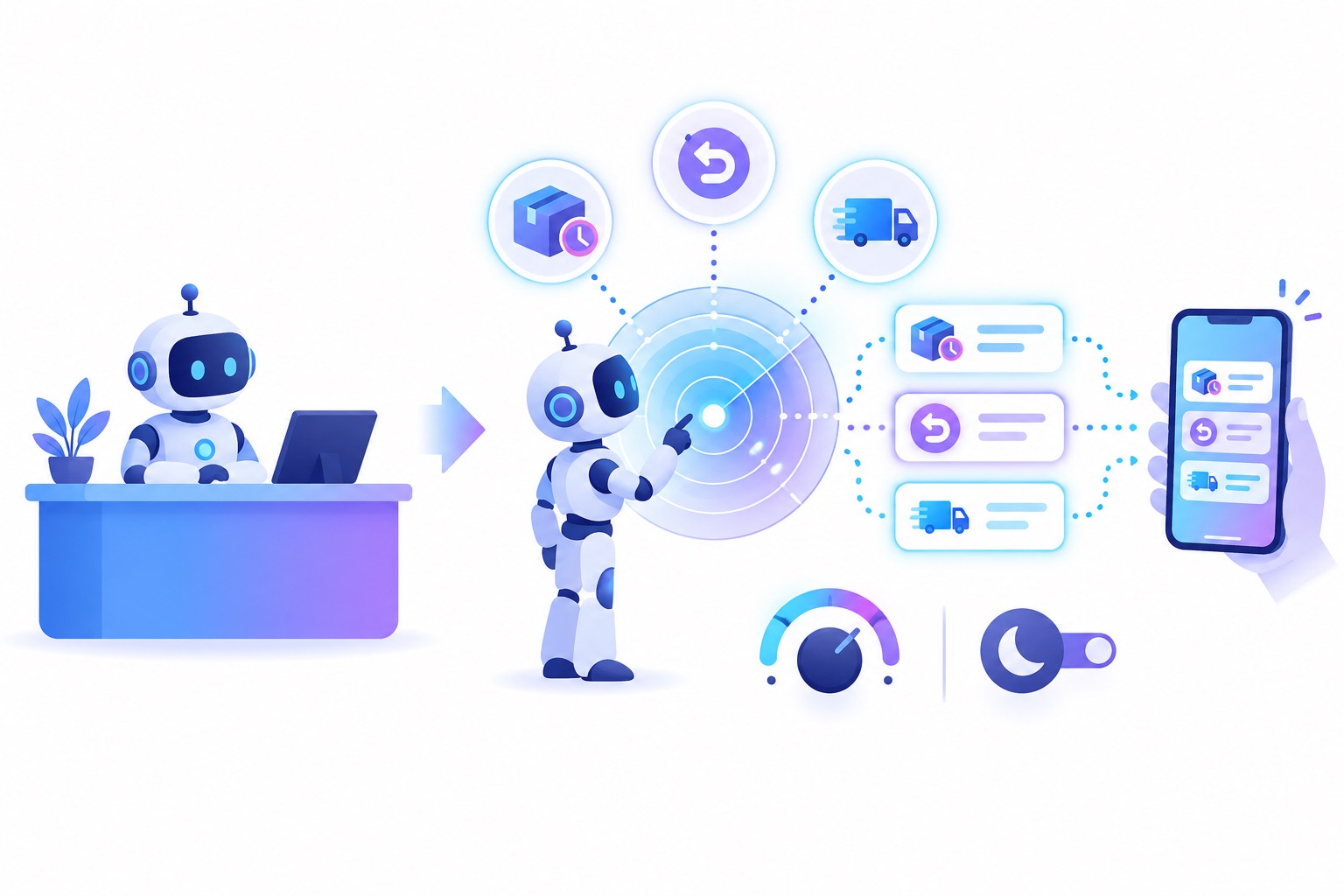
Three Key Points in Proactive Service Design
- Proactive service product design: decomposing "proactive" into a full chain of events, triggers, outreach, interaction, and closed loop.
- Balance between frequency control and experience: frequency caps, quiet hours, and downgrade paths must exist — not "push whenever possible".
- Consent and compliance awareness: notification consent and act-on-behalf consent managed separately, with users keeping a choice.
The Overall Design
Step 1: Event detection
- Connect to event streams from order, logistics, and refund systems, and define a serviceable event catalog: logistics not updating past a timeout, delivery delay beyond a threshold, refund rejected, refund received, price drop, delivery-signing anomalies, and so on.
- For each event type, define trigger conditions, severity, and expected impact (amount involved, time sensitivity), separating "must inform" from "nice to mention". Not every event deserves an interruption — classify before reaching out.
Step 2: Service triggering strategy
- After an event fires, first run a service-value judgment: can the bot offer a solving action (urge delivery, one-click reshipment, change address)? Reach out only when there is value; broadcast-only messages with no action get demoted.
- Tier the outreach channels: critical events (e.g., refund anomalies) use strong channels (push/SMS); ordinary events appear passively as cards in in-app messages or the order page.
- Frequency control and quiet hours: a daily cap on proactive outreach per user, each event per order reaches out only once, events the user already asked about are not repeated, and nighttime is silent. Frequency control is the seatbelt of proactive service — without it, even a great event catalog becomes a disaster.
Step 3: User consent
- On first use, explicitly tell users which types of proactive service they will receive, with per-type subscribe/unsubscribe.
- Acting on the user's behalf (auto-applying an extension, auto-changing the address) requires separate consent and is off by default; actions inside an outreach message still need a user tap to confirm. Consent to receive notifications is not consent to act — the two must be managed separately. That is the compliance floor and the trust floor.
Step 4: Follow-up interaction and the effect loop
- Proactive messages must be actionable: tapping one opens a conversation with the full event context, where the bot proposes a solution immediately — the user never re-describes anything. Making users repeat themselves after tapping in sells the value of proactive service at a discount.
- Watch four metrics: click-through rate, resolution rate, unsubscribe rate, and interruption-complaint rate of proactive service; iterate the event catalog and frequency thresholds with them, and retire low-value outreach decisively.
One-line principle
The core of proactive service is "actionable, solvable, non-intrusive" — a notification without a solving action is spam. Before designing any outreach scenario, ask: what can the user do after receiving this message? If the answer is "nothing", the message should not be sent.
How This Maps to Bytedesk
Bytedesk, the open-source AI customer service system (GitHub, site), already ships building blocks for proactive service: multi-channel access (web, in-app embeds, and more) enables tiered outreach; conversation and context management ensures the bot greets tapping users with full background; the AI Agent and tool calls can integrate business systems for order events and solving actions; tickets support event-driven processing; and session statistics and quality inspection provide the measurement basis for clicks, resolution, and complaints. Event-stream integration and a frequency-control engine are deeper customizations that can be built progressively on Bytedesk's open integration capabilities.
Key Takeaways
- Start with event classification: trigger conditions, severity, expected impact — separate "must inform" from "nice to mention".
- Reach out only with value: events with solving actions first; pure broadcasts demoted to passive display.
- Frequency caps + quiet hours + one outreach per event are the seatbelt of experience.
- Layer notification consent and act-on-behalf consent; delegation is off by default and confirmed case by case.
- Proactive messages must carry context and be directly actionable, and the event catalog keeps iterating on click rate, resolution rate, unsubscribe rate, and complaint rate.