Peak Season Surge: Traffic Shaping, Scheduling, and Degradation for Customer Service

Right after midnight on Black Friday, inbound conversations spike to five times the daily volume, human queues exceed an hour, bot APIs start timing out, and users complain in reviews that "support is unreachable". For many e-commerce teams this is a realistic picture of the biggest sales night: the peak of revenue often becomes the trough of support reputation.
This post is part of an experience-sharing series on "AI customer service product and engineering practice", drawn from hands-on practice at a global fast-fashion cross-border e-commerce platform. In this post I want to share a peak-protection solution for the consultation surge during major promotions and concentrated new-product launches: how to shape the system architecture and bot concurrency, prioritize requests, schedule human agents, and design service degradation so the system stays stable and the experience intact.
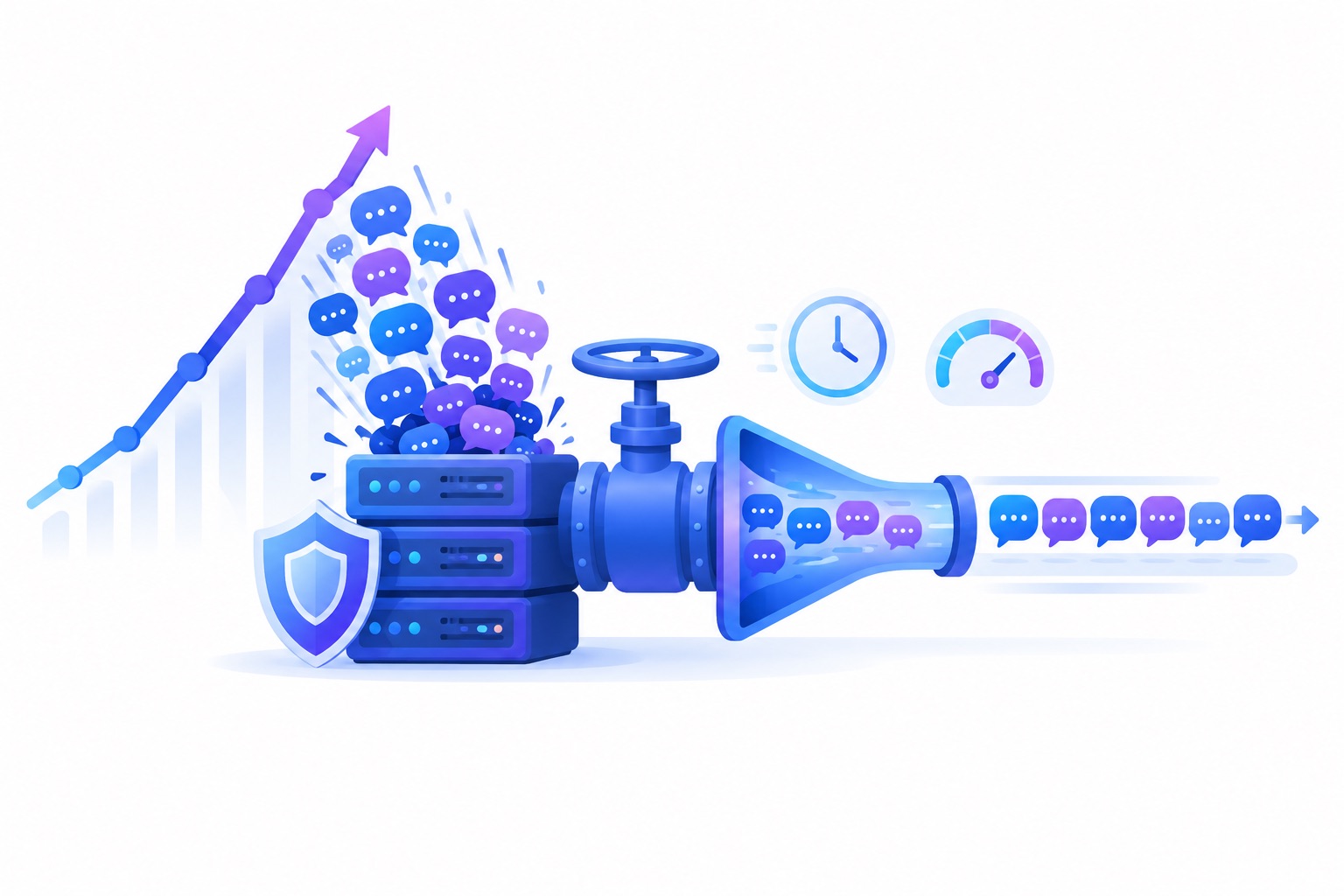
Four Key Points in Peak Protection Design
- Architecture absorbs the spike: peak shaving, elastic scaling, caching, and asynchronization carry the load.
- Scarce resources are prioritized: urgent is separated from routine, and scarce capacity goes to high-value scenarios.
- Scheduling stays elastic: bot-human cooperation and shift planning flex with the queue.
- Degradation is pre-designed: fallback plans for extreme cases protect the core experience.
The Overall Design
I would structure the design across "pre-event—during-event—post-event", with one goal: the system must not collapse, and scarce resources must go to the users and problems that matter most.
Pre-event: capacity planning and preparation
- Peak forecasting and load testing: predict the consultation peak from historical promo data—promo volume typically runs 3 to 5 times daily volume—and complete load testing and capacity assessment in advance, instead of adding machines on the fly.
- Elastic scaling: design bot services as stateless for horizontal scaling; pre-scale downstream dependencies such as knowledge retrieval and vector databases with rate limits, so support traffic never drags down business systems.
- Promo-specific knowledge packs: prepare activity rules, discount explanations, delivery-time announcements, and hot-product FAQs in advance so high-frequency questions have standard answers—no improvising on promo night.
During: dispatch on four levels
1. Peak shaving at the architecture level
- Apply request queuing and rate limiting (token bucket or leaky bucket) at the access layer; excess requests join a queue instead of failing outright.
- Cache answers to high-frequency questions—order status, delivery announcements—to reduce pressure on backend systems.
- Asynchronize non-real-time requests such as batch queries and review callbacks.
2. Request prioritization
- By problem type: transaction-impacting issues like payment failures, delivery exceptions, and refund disputes get priority; product questions and activity rules are handled by bots.
- By user value: high-value and repeat customers get priority access to humans.
- Show transparent estimated wait times while queuing and offer self-service options to reduce abandonment.
3. Elastic scheduling of human agents
- Schedule denser shifts ahead of the promo and enable cross-team support and outsourced seats.
- Set dynamic routing thresholds: when human queues exceed the threshold, bots take on more scenarios and extend self-service scope.
- Force bots to handle simple questions first; only unsolved ones transfer to humans, reducing agent pressure.
4. Service degradation
I would predefine three degradation levels, each with explicit triggers and automatic recovery, avoiding improvised human decisions:
- Level 1: shorten bot replies and disable non-core features such as satisfaction pop-ups.
- Level 2: switch non-urgent issues to delayed replies or message mode with a promised follow-up time.
- Level 3: in extreme cases, keep only core channels such as payment exceptions and safety issues; route everything else to self-service pages and announcement FAQs.
Post-event: review and consolidation
After the promo, review monitoring data—peak concurrency, queue duration, transfer rate, abandonment rate—locate bottlenecks, and consolidate the findings into the capacity plan for the next event. The plan is not a one-off document but a capability asset that iterates with every promo.
Practice in Bytedesk
Relevant capabilities already available in the open-source Bytedesk customer service system (GitHub, website https://www.weiyuai.cn ) include: bot-first reception with human queue routing that can expand bot coverage during peaks; workgroup routing that directs high-priority payment or logistics issues to dedicated agent groups; a multi-channel access layer managing inbound traffic; and conversation statistics covering queue duration and transfer rate, which serve as the basis for capacity assessment and post-event review.
Key Takeaways
- Promo volume typically runs 3-5x daily; capacity planning and load testing must happen beforehand.
- The peak-shaving trio: queue and limit at the access layer, cache high-frequency answers, asynchronize non-real-time requests.
- Prioritize along two dimensions—problem type and user value—giving resources to transaction-impacting issues first.
- Degradation policies come with preset triggers and automatic recovery, executed in levels, not decided on the spot.
- Post-event reviews consolidate capacity plans so every promo becomes a rehearsal for the next.