From Answering Questions to Completing Tasks: Designing Autonomy Boundaries for Logistics Agents

"My package hasn't moved for three days—chase it for me; nobody's home Friday, reschedule to Saturday; and if it can't be found, I want to file a claim." This is an ordinary logistics inquiry, yet it contains three classes of requests with completely different risk: a query, a modification, and a negotiation. A Q&A bot can only handle the first; for AI to truly get things done, it must autonomously invoke business systems—and how much autonomy to grant is precisely the core product design problem.
This post is part of the "AI Customer Service Product and Engineering Practices" experience-sharing series, drawn from a practice review of an AI customer service product at a leading logistics company. In this post I want to share how to decompose core scenarios such as logistics inquiries, exception handling, and after-sales negotiation when upgrading traditional intelligent support to a fully managed AI Agent service, and how to determine the boundaries between AI autonomous execution and human intervention. This is the key design problem any logistics support agentification cannot avoid.
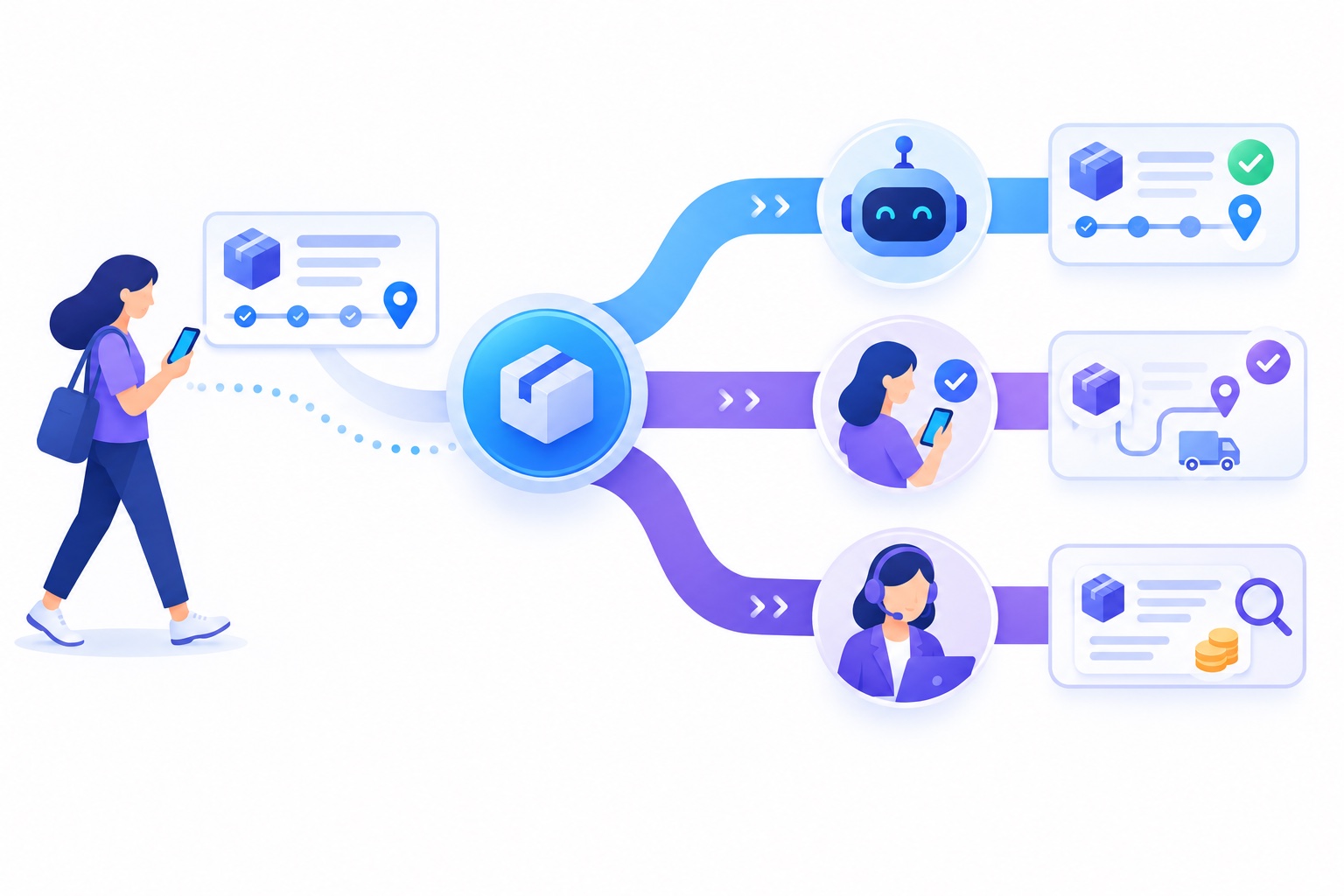
Five Key Design Points for Autonomy Boundaries
- Business decomposition: splitting logistics support into information queries, standard operations, and complex negotiation, and recognizing the risk differences across scenarios.
- Agent product design: the difference between task-oriented agents and Q&A bots, and the closed loop of intent recognition, task planning, tool calls, and outcome verification.
- Human-AI collaboration and permissions: drawing execution boundaries along four dimensions—business risk, execution authority, rule certainty, and reversibility.
- Technical understanding: how RAG, Function Calling, workflow orchestration, state management, and human takeover work together.
- Operations and metrics mindset: using true resolution rate as the core metric rather than auto-reply rate or reply volume.
The Overall Design
In this effort, I would first be clear about one thing: the problem is not whether the bot can answer questions, but whether AI can truly get things done for the user. So instead of debating which model to integrate, I would first clarify the business scenarios and risks. The overall approach in one sentence: decompose scenarios by risk, draw boundaries in three tiers, keep execution in a closed loop, and validate with data.
Step 1: Upgrade the goal from "answering" to "getting it done"
The goal of full managed service is completing tasks for users, with the true resolution rate—not the auto-reply rate—as the core metric. No matter how many replies are sent, if the package is still stuck at the transfer hub, the value to the user is zero. A wrong goal amplifies every subsequent automation error.
Step 2: Decompose three scenario classes by risk
- Logistics inquiries: tracking, delivery estimates, fee explanations—standardized, low-risk, and suitable as the first fully managed pilot.
- Logistics exceptions: delays, stalled tracking, failed delivery—these involve real business operations; the Agent must first check live status, diagnose the exception, create a ticket, and track the outcome.
- After-sales negotiation: lost packages, damage, compensation—involving money and liability, these must not simply pursue automation; they need stricter permission management and human review.
Step 3: Four dimensions, three boundary tiers
Using business risk, execution authority, rule certainty, and reversibility, split operations into three tiers: low-risk operations like tracking queries and rule explanations are executed directly by AI; medium-risk operations like address or delivery-time changes require identity and order-state checks plus explicit user confirmation; high-risk operations like above-limit claims and liability disputes are handled by AI collecting information, organizing evidence, and proposing recommendations, with humans making the final call. The boundary is drawn by risk and authorization, not by model confidence.
Step 4: Make execution a closed loop
Recognize intent → query business data → assess risk level → plan execution steps → call business tools → verify the outcome → report to the user. Technically, RAG retrieves the rules, Function Calling invokes the logistics and order systems, and a workflow engine manages task state; on timeout or abnormal results, the system must retry safely and be able to hand off to humans—with a service summary of the dialogue, verified information, and completed operations, so the user never re-explains.
Step 5: Validate with data before scaling
First run offline evaluation on historical cases, then pilot with limited traffic in low-risk scenarios, compared against the existing support process. Watch the true resolution rate as the core metric, along with automated task completion, human transfer rate, repeat contact rate, satisfaction, erroneous execution rate, and cost per service—expand coverage only after meeting the bar.
Practice in Bytedesk
The open-source Bytedesk customer service system (GitHub, website https://www.weiyuai.cn ) provides the infrastructure for this approach: tool management configures external capabilities such as logistics queries and delivery changes for robots and agents, enabling "getting things done"; the ticket module links conversations, assigns owners, and tracks handling status, fitting the cross-team tasks in exception scenarios; transferring to humans carries the full conversation context, and with a service summary agents need not re-collect information. The three-tier autonomy boundary, user double confirmation, and outcome verification are then implemented in the logistics adapter layer following this post—start with read-only queries, then enable confirmation-based operations, and always keep high-risk actions with humans.
Key Takeaways
- Full managed service does not mean replacing all human agents, but letting AI independently complete tasks with clear rules and controllable risk, while humans focus on complex judgment and special negotiation.
- Use the four dimensions—business risk, execution authority, rule certainty, reversibility—to split operations into: AI executes directly, execute after user confirmation, and AI prepares with humans deciding.
- Execution must be a closed loop: recognize, query, assess, plan, call, verify, report—missing any link turns "getting things done" into "gambling".
- Human handoff should attach a service summary (dialogue, verified information, completed operations) so users never re-explain—especially critical in fully managed service.
- The core metric is the true resolution rate: offline evaluation first, then limited pilots, and expansion only after meeting the bar.