Snap-to-Resolve: Landing Multimodal LLMs in AI Customer Service

There is a category of support conversation that is always painful: "The thing I bought arrived broken." Broken? Where? How? Which product? The agent asks round after round while the user digs through emails for the order number and types things like "there's a crack along the edge." Five rounds later, the ticket barely has enough information.
In fact, the user already had the answer in their pocket all along—one photo beats five rounds of interrogation. That is exactly what multimodal LLMs are for: compressing the user's evidence burden and description burden into a single image.
This is the fifth article in an experience-sharing series, "AI Customer Service Product and Engineering Practice," drawn from hands-on practice as an AI customer service product manager at a global short-video social platform. In this post I want to share which existing pain points image/video understanding can solve in customer service now that multimodal LLMs are widely available, and the implementation path of a concrete feature—for example, a user sending a product photo to consult after-sales.
Four Key Points in Multimodal Feature Design
- Insight into the pain point: name precisely that multimodality solves "users cannot describe the problem clearly"—the biggest friction in support—rather than vaguely praising "multimodal is powerful."
- End-to-end implementation design: from image understanding to information completion, from decision to fallback, keep the pipeline complete. Talking only about model capability without engineering closure leads nowhere.
- Compliance and risk awareness: for features involving compensation, define the LLM's boundary explicitly and prevent fraud. These are two red lines e-commerce scenarios cannot avoid.
- Metric definition: measure whether the feature works with explicit effectiveness and guardrail metrics.
The Overall Design
1. The Three Pain Points Multimodality Solves
- The description gap: users struggle to describe product issues in words (model, part, damage location)—especially older users and minor-language users, where text distortion is severe. Multimodality lets "send a photo" replace "explain clearly."
- Evidence ping-pong: after-sales requires photo evidence (damage, size mismatch); the traditional flow is a loop of "submit ticket → wait for review → be asked for more photos." Multimodality understands in real time and decides on the spot, turning evidence from asynchronous to synchronous.
- Inefficient guidance: purely textual instructions ("tap the third option in settings") often lose users. The reverse works: the user sends a screenshot, and support locates the page and the problem from the image—a completely different guidance efficiency.
2. Feature Design: "Snap-to-Resolve After-Sales"
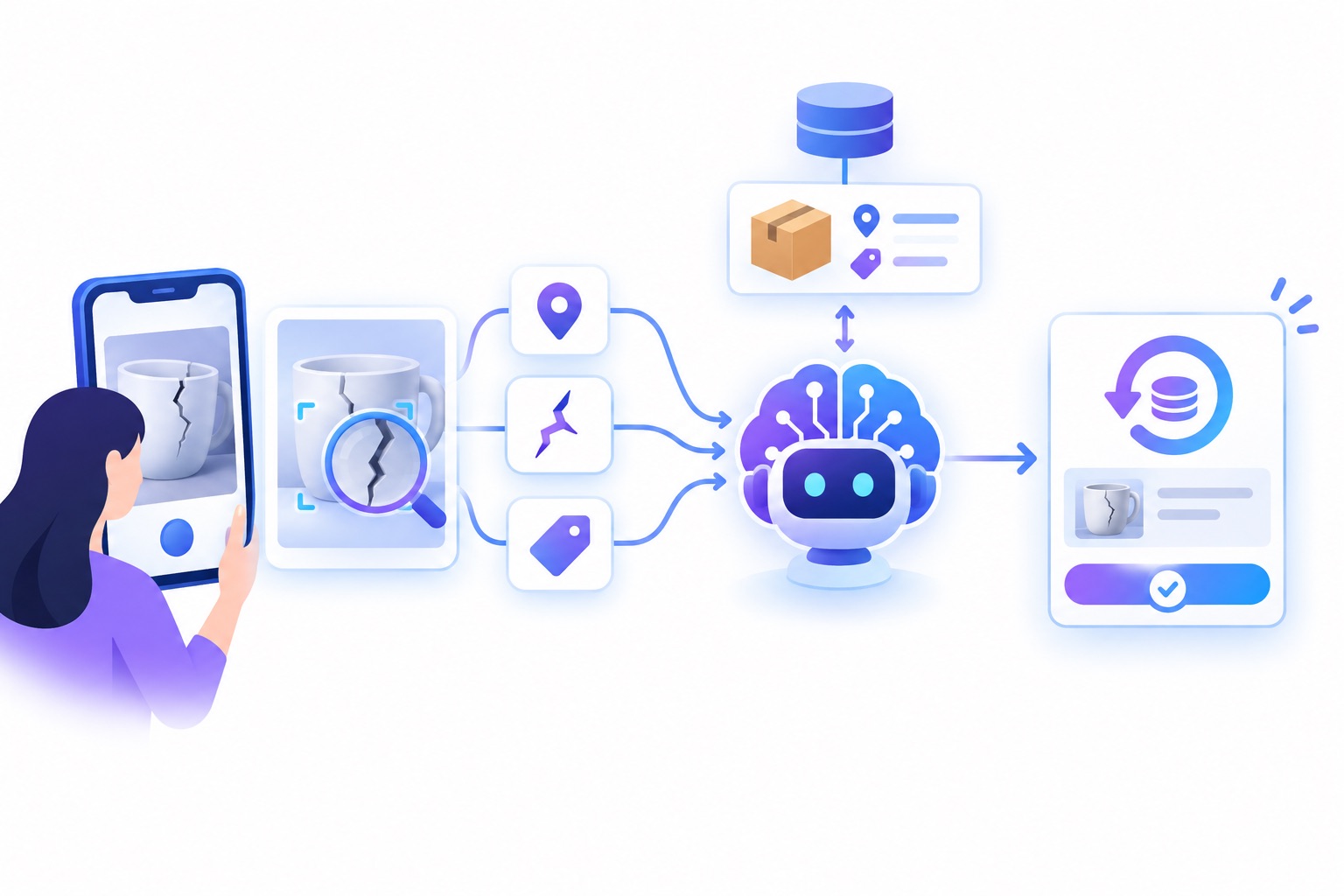
User flow: the purchased item arrives damaged; the user takes a photo, adds one line ("it's shattered, what now"), and sends it to support.
Implementation path (a five-step pipeline):
- Image understanding: the multimodal LLM extracts structured information—product category, damage type (broken/color mismatch/missing part), severity—and compares against the product image in the order database to confirm it is the same item, guarding against wrong photos and fraud.
- Information completion: image information plus order context (order number, logistics record) are jointly reasoned; ask only for what is truly missing ("Could you also photograph the outer box? We need it for the carrier claim") instead of making the user fill out a full form.
- Policy decision engine: damage severity + product value + user historical credit score → match the after-sales policy (direct refund / reshipment / shipping-only compensation). Key design: the rule engine makes the call; the LLM only extracts information and never decides compensation—that is the compliance red line.
- Solution output: generate an after-sales ticket with photo evidence and route it automatically; give the user a clear expectation ("Your compensation has been issued and will arrive within 24 hours").
- Fallback pipeline: low image-recognition confidence (blurry, occluded) → guide a retake with sample images; suspected fraud (photo mismatched with the order, or a reverse-image search hitting a fraud history database) → silently transfer to manual review without tipping off.
3. Key Metrics
- Effectiveness: image intent-recognition accuracy, after-sales information-completion rounds (target: from an average of 5 rounds to within 2), end-to-end handling time, and self-service resolution rate for the scenario.
- Guardrail: fraud-recall rate, while keeping the false-rejection rate low—anti-fraud must not become a reason to hurt legitimate users.
4. One Design Philosophy
The value of multimodality is not showing off. The landing principle in one sentence: LLMs do perception, rules do decisions, and fraud/compliance pipelines must have deterministic fallbacks.
How This Maps to Bytedesk
The open-source AI customer service system Bytedesk (GitHub, website) already has the skeleton to carry such features: conversations support image and other message types; multi-channel access lets users send photos from any entry point; the ticket system supports attachments, carrying "after-sales tickets with photo evidence"; AI Agent with tool calling makes the orchestration "query order → compare → create ticket" feasible; the knowledge base with RAG underpins after-sales policy Q&A; and human-AI collaboration covers transfers when image confidence is low. A vertical feature like "snap-to-resolve" can be built step by step along the five-step pipeline on this skeleton.
Key Takeaways
- The three pain points multimodality solves: the description gap, evidence ping-pong, and inefficient guidance—all essentially "lowering the user's expression cost."
- The five-step snap-to-resolve pipeline: image understanding → information completion → policy decision → solution output → fallback.
- Compliance red line: the LLM does perception and extraction only; compensation decisions go to the rule engine.
- Anti-fraud must hold two lines at once: high fraud recall, and a low false-rejection rate.
- The measure of multimodal value is simple: whether the user's evidence burden has been compressed into one photo.