A Unified Task Distribution System for Smart Customer Service: The Rule-Engine, Single-Agent, Multi-Agent, and Human Funnel

Who should handle a customer service task? The question sounds simple, but it determines the cost structure and experience ceiling of the entire smart customer service system. Route everything to the rule engine and flexibility suffers; everything to Agents and risk/cost spiral; everything to humans and wait times explode. The real answer is always a combination—and designing that combination is the task distribution system.
This is the fourth article in an experience-sharing series on "AI customer service product and engineering practice," drawn from hands-on practice as an AI Product Manager focused on IM intelligent customer service at a local-life services platform. In this post I want to share how to define the collaboration strategy among rule engines, single Agents, multi-Agent systems, and human agents by combining user intent, problem complexity, business risk, and handling cost, given large differences in task complexity across business scenarios.
This is classic "platform PM" territory: the task is not how to build a feature, but how to optimally allocate resources across multiple processing roles.
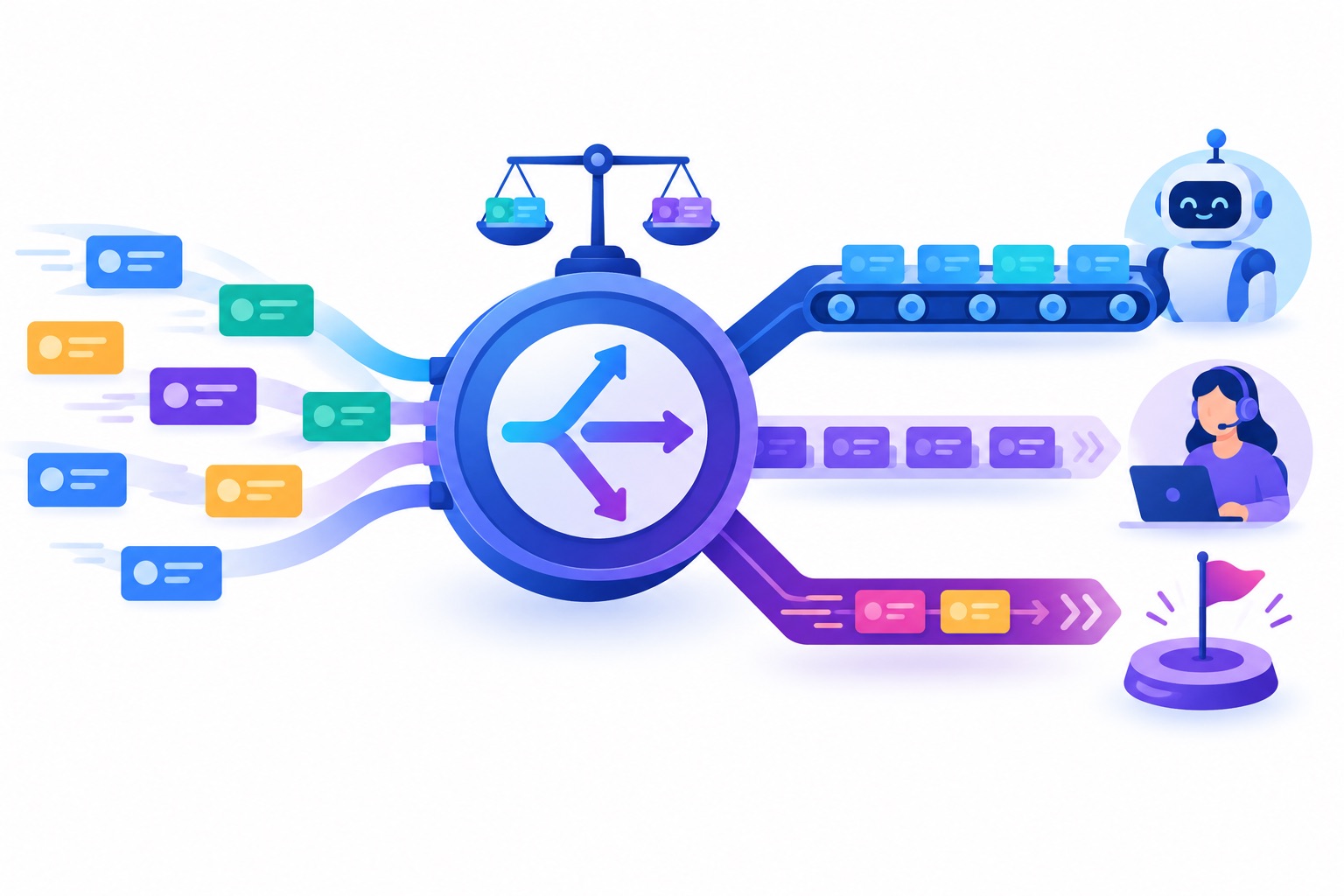
Three Key Points in Distribution-System Design
- Build a multi-dimensional task assessment model (intent, complexity, risk, cost) instead of deciding on a single dimension.
- Understand the capability boundaries and cost structures of each role—rule engines are cheapest, humans most expensive, each irreplaceable in its niche.
- Design dynamic routing and escalation so tasks can change hands mid-flight, not be assigned once and forever.
Overall Approach
My distribution logic is essentially a funnel of "determinism first, increasing cost."
Step 1: Build the Assessment Dimensions
Tag every incoming consultation on four axes:
- Intent type: query, transaction, complaint, consultation;
- Complexity: solvable in one turn, or multi-turn multi-system collaboration;
- Risk level: anything touching money, safety, or PR is high-risk;
- User value and emotion: high-value users and emotionally charged sessions escalate first.
These four tags decide which funnel layer the task enters.
Step 2: Design the Four-Layer Collaboration Strategy
1. Rule engine. Handles standard, high-frequency, clearly specified tasks that need no semantic understanding—fixed flows like "check delivery status" or "change address." Lowest cost, highest determinism; the funnel's first layer.
2. Single Agent. Handles routine tasks requiring semantic understanding and single tool calls, such as order queries or policy explanations. It understands non-standard phrasing like "why hasn't my food arrived" and then invokes the query tool.
3. Multi-Agent. Handles complex cross-system, multi-step tasks—e.g., refund + order-chasing + compensation coordination—with an orchestrating Agent decomposing tasks and aggregating results.
4. Human agents. Take high-risk, high-emotion sessions, Agent consecutive failures, or user-requested human service. The key: handoff must carry complete context plus AI-suggested next steps so the takeover is seamless and the user never repeats themselves.
Step 3: Dynamic Routing and Escalation
Distribution is not one-shot. When an Agent hits low confidence, consecutive failures, or negative user emotion mid-execution, escalate to the next layer in real time—do not let users bounce within the wrong layer repeating their request.
Conversely, standard cases handled by humans should flow back: distilled into rules or training data to continuously shrink the human share. This is the distribution system's self-evolution—the cases humans handle today become rule-engine or Agent capabilities tomorrow.
Also set cost constraints: avoid multi-Agent churn within one session and control cost per service, preventing "spinning in the Agent layer to look smart."
Validating the System
I would use four metric groups: share handled per layer, inter-layer transfer count, cost per service, and misrouting rate. Layer shares reflect funnel health, transfer counts reflect escalation smoothness, and misrouting rate maps directly to experience damage.
Practice in Weiyu
Weiyu, the open-source AI customer service system (GitHub, website), ships the infrastructure for this collaboration: skill-group routing assigns sessions by business type and agent skill; AI bots take sessions first, configurable by channel and time window; when a bot cannot handle a session it transfers seamlessly to a human agent with full conversation context; the agent workbench also offers AI-assisted replies so humans work faster with AI at their side. The session statistics module tracks per-layer shares and human-handoff rates, providing the data basis for continuously tuning routing policies.
Takeaways
- The essence of distribution is a "determinism first, increasing cost" funnel: rule engine → single Agent → multi-Agent → human.
- Four assessment tags (intent, complexity, risk, emotion) decide the entry layer.
- Escalation must be real-time: low confidence, consecutive failures, negative emotion escalate immediately—users never repeat themselves.
- Quality human-handled cases must flow back into rules and eval sets—the only path to sustainably shrinking human share.
- Validate system health with per-layer shares, transfer counts, cost per service, and misrouting rate.