Designing Core AI Customer Service Features with LLMs for Global Multilingual Users

An Indonesian user has just typed "paket" (package) into the support chat, and the system already floats three suggestions above the keyboard—"track my parcel," "shipping fee question," "change delivery address." One tap takes them straight to the answer, with no need to spell out the full question. Run the same feature in the Middle East, though, and the tone of voice, forms of address, and even the boundaries of what may be discussed all need a different rule set.
This is the daily reality of global AI customer service: one shared model foundation serving users whose languages, cultures, and expression habits differ completely. Product managers building this category all face the same core task: designing core features such as question prediction and dialogue guidance on top of LLMs for global multilingual users, while balancing language habits and cultural differences across regions.
This is the first article in an experience-sharing series, "AI Customer Service Product and Engineering Practice." The material comes from hands-on practice as an AI customer service product manager at a global short-video social platform, where the work was technically dense and the topics linked tightly together—from feature design all the way to metrics, incidents, and endgame thinking. In this post I want to share how to design LLM-based core features such as question prediction and dialogue guidance for global multilingual users, and how to balance language habits and cultural differences across regions.
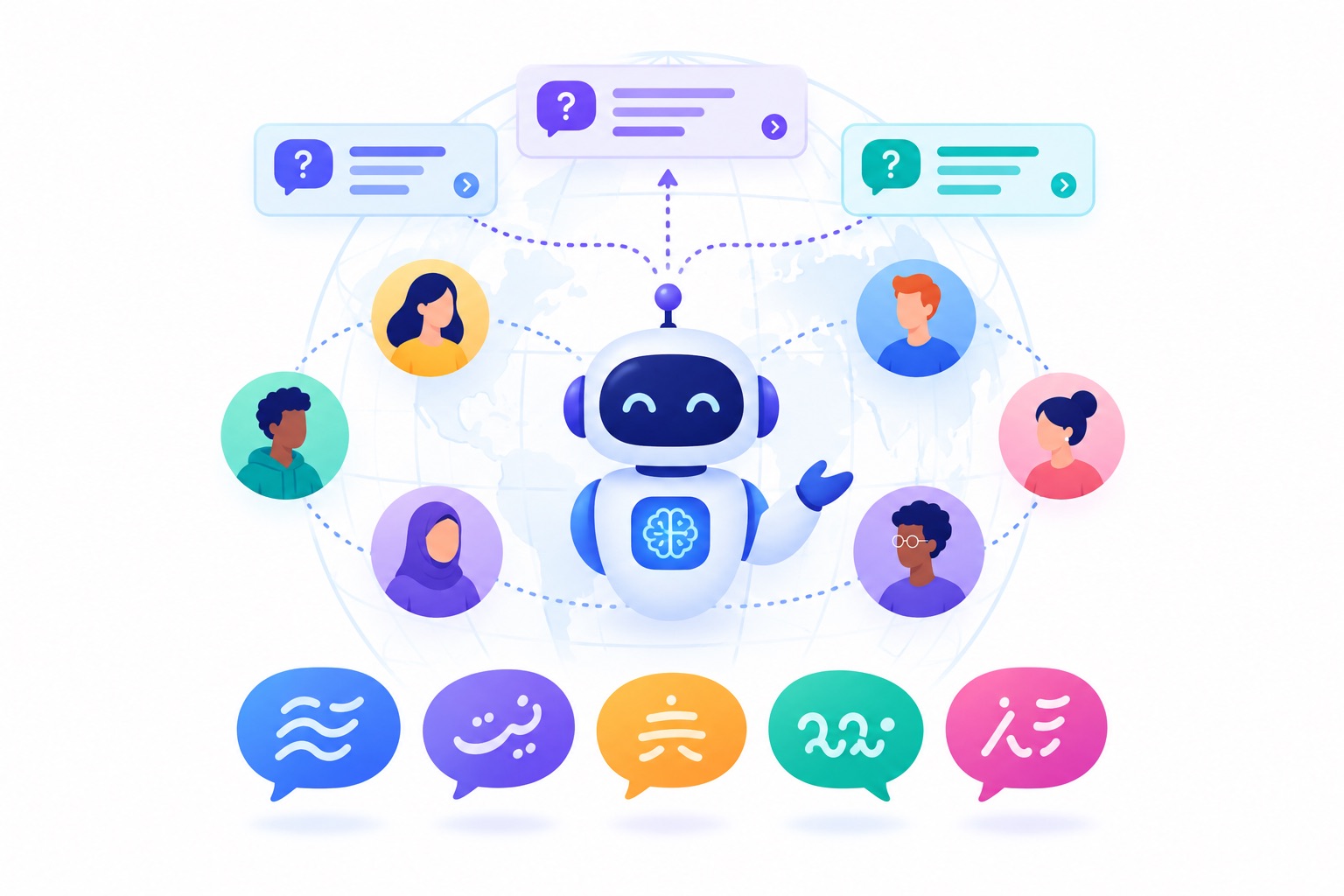
Five Key Points in Global Multilingual Feature Design
Looking back at this piece of work, five design points mattered most:
- Ability to ground LLM technology in a real scenario: translating model capabilities such as intent recognition, context understanding, and multi-turn dialogue into concrete support features like question prediction and dialogue guidance, with a clear technical path—rather than stopping at "just plug in an LLM."
- Cross-cultural product design and localization strategy: expression styles, semantic ambiguity, and cultural taboos all affect the support experience, so the balancing strategy has to be systematic rather than "add multilingual translation and done."
- User insight and scenario-based needs analysis: feature details should follow the differing core demands of users in different regions (for example, Southeast Asian users care most about logistics, while European and American users care most about privacy).
- Co-optimizing technology and experience: preserve response efficiency and accuracy while localization builds user trust—through culturally compliant phrasing and region-specific interaction habits.
- Structured case-level execution: use concrete regional cases to turn feature design plus cultural balancing into an operable loop, instead of talking in abstractions.
In one sentence: this work rewards teams who understand technical boundaries, respect the unglamorous work of localization, and can still land on concrete cases.
The Overall Design
My overall framework: state the core tension → design core features (the technical foundation) → cross-cultural balancing strategy (language layer + culture layer) → make it concrete with cases → close the value loop.
1. Start by Naming the Core Tension
The essential tension of global AI customer service is that the "general intelligence" of an LLM must cooperate with "fine-grained local experience." Feature design must serve two goals at once: technology-driven efficiency (less typing, shorter resolution paths) and the sense of safety that cultural adaptation provides (making users feel "this agent understands me"). Drop either one and the product fails—efficiency without localization loses trust; localization without efficiency doesn't scale economically.
2. The LLM Foundation Behind Core Features
Take question prediction and dialogue guidance as examples.
Question prediction: intent anticipation based on "user input + regional features"
The technical logic is a multilingual LLM foundation plus fine-tuning on region-specific dialogue data and RAG augmentation with a local knowledge base, predicting intent in real time as the user types. Three key points:
- Input side: as the user types the first word or phrase, the model combines that region's high-frequency questions (for example, an Indonesian user typing "paket" gets "logistics tracking" predicted first), conversation history, and device/network context (low-bandwidth regions get terser suggestions) to generate the three most likely questions—one tap leads straight to a solution.
- Disambiguation: ambiguity is the top killer of prediction. The same word can mean wildly different things across languages. The approach is a regional stop-word library plus a semantic disambiguation model that uses context to infer what the user actually means.
- Measurement: prediction tap-through rate and post-prediction self-service resolution rate, verifying that prediction genuinely reduces typing effort.
Dialogue guidance: dynamically generating "culturally adapted" scripts
The technical logic is controllable LLM generation layered with a "cultural rule engine" and a "regional script template library." The goal is for the machine to speak like a human—and specifically like a local human. Three layers:
- Base layer: a standardized dialogue logic chain (clarify the problem → deliver the solution → confirm satisfaction), keeping service flow consistent.
- Adaptation layer: region-specific instruction tuning to adjust tone and forms of address (for example, formal honorifics in certain markets, avoiding direct questions about private matters), plus a taboo-word filter to keep scripts compliant.
- Personalization layer: let users choose their own conversation style—some markets prefer a concise/detailed toggle, others an emoji-on/plain-text toggle—handing part of "cultural adaptation" back to the user.
3. Two Layers of Cross-Cultural Balancing
Language layer: from "can understand" to "understands the details"
- Multilingual and dialect support: cover core-market languages via the LLM's multilingual pretraining; improve low-resource languages (such as Vietnamese and Thai) through low-resource fine-tuning; for regional mixed usage (such as Indian English or Tagalog-English code-switching in the Philippines), connect local user dialogue corpora through RAG to strengthen slang comprehension—when a Filipino user says "sana all" (roughly, "I wish everyone could have this"), the model should recognize envy or a plea for help.
- Semantic ambiguity handling: maintain a regional ambiguity library. The same English word can denote entirely different things in North America versus parts of the Middle East; combine it with user history (did they browse electronics pages?) to auto-disambiguate.
Culture layer: from "not offensive" to "genuinely warm"
- Taboo rule engine: plug into cultural databases (religious taboos, etiquette norms) and run rule checks before generation. A typical example: when a user asks why their account was suspended, avoid accusatory phrasing like "you violated the rules"; say "our system detected unusual activity on the account—let's look together at how to restore it" instead. Same fact, completely different feeling.
- Values adaptation: different markets are sensitive to different things. In markets that prize privacy autonomy, offer explicit choice buttons ("Share order information? Agree / Decline"); in markets that prize communal relationships, add empathetic phrasing such as "We understand this affects your shopping experience; we've flagged it to the local team for urgent handling."
The supporting mechanism is a triple verification of "localized data + rule engine + user feedback": local data provides understanding, the rule engine prevents boundary crossings, and user feedback drives continuous correction.
4. Make It Concrete with Cases
I would pick two or three representative markets. For example: Southeast Asia, focusing on localized keywords for logistics question prediction (high-frequency words, slang, code-switching); the Middle East, focusing on taboo filtering and address conventions; Europe and America, focusing on privacy-consent interactions and concise-style options. Each case lands on "what do users in this region ask most, what do they find offensive, and what did our features therefore do differently."
5. Close the Value Loop
The end goal is for users worldwide to feel the warmth of a "dedicated local agent" while the LLM delivers scale efficiency, forming a positive loop of "technology → experience → retention." One-line summary: technology drives efficiency; culture drives trust.
How This Maps to Bytedesk
Much of this thinking already has counterparts in the open-source AI customer service system Bytedesk (GitHub, website): multi-channel access unifies users from web, app, and social entry points across regions; skill-group routing sends users of different languages and topics to the right bot or human team; the knowledge base with RAG supports organizing corpora by business domain, laying the groundwork for "local knowledge augmentation"; and human-AI collaboration with agent transfer provides the backstop beyond cultural rules. Input-assist in the style of question prediction can be built incrementally on the existing dialogue pipeline with intent recognition. Bytedesk is open source—the capability boundary of each step above can be verified directly in the code.
Key Takeaways
- The core tension of global AI customer service is coordinating general intelligence with fine-grained local experience; features must serve both efficiency and trust.
- Question prediction hinges on regional high-frequency questions + real-time intent anticipation + semantic disambiguation; dialogue guidance hinges on a standardized logic chain + regional script adaptation.
- Cross-cultural balancing has two layers: the language layer aims to "understand the details" (slang, dialects, ambiguity); the culture layer aims to be "genuinely warm" (taboo avoidance, values adaptation).
- Use localized data + rule engine + user feedback triple verification to keep adaptation quality sustainable.
- When landing the work, expanding two or three typical regional cases best demonstrates depth of scenario understanding.