Fixed Workflow, Single Agent, or Multi-Agent: Architecture Choices for Customer Service Systems

With the Agent hype of recent years, many teams starting an AI customer service project want to spin up a Multi-Agent orchestration right away, as if agent count equaled technical sophistication. But the real constraints of customer service point the other way: high traffic, low fault tolerance, cost sensitivity. If looking up a tracking number requires five agents holding a meeting, that is not intelligence — that is burning money.
This is the fourth post in an experience-sharing series for AI customer service product managers and developers, drawn from hands-on practice as an AI product manager at a Southeast Asian cross-border e-commerce platform. In this post I want to share how to decide between a fixed workflow, a single agent, and a Multi-Agent architecture in customer service scenarios, and how to draw module boundaries and control system complexity when intent recognition, knowledge retrieval, order lookup, and after-sales processing are all involved.
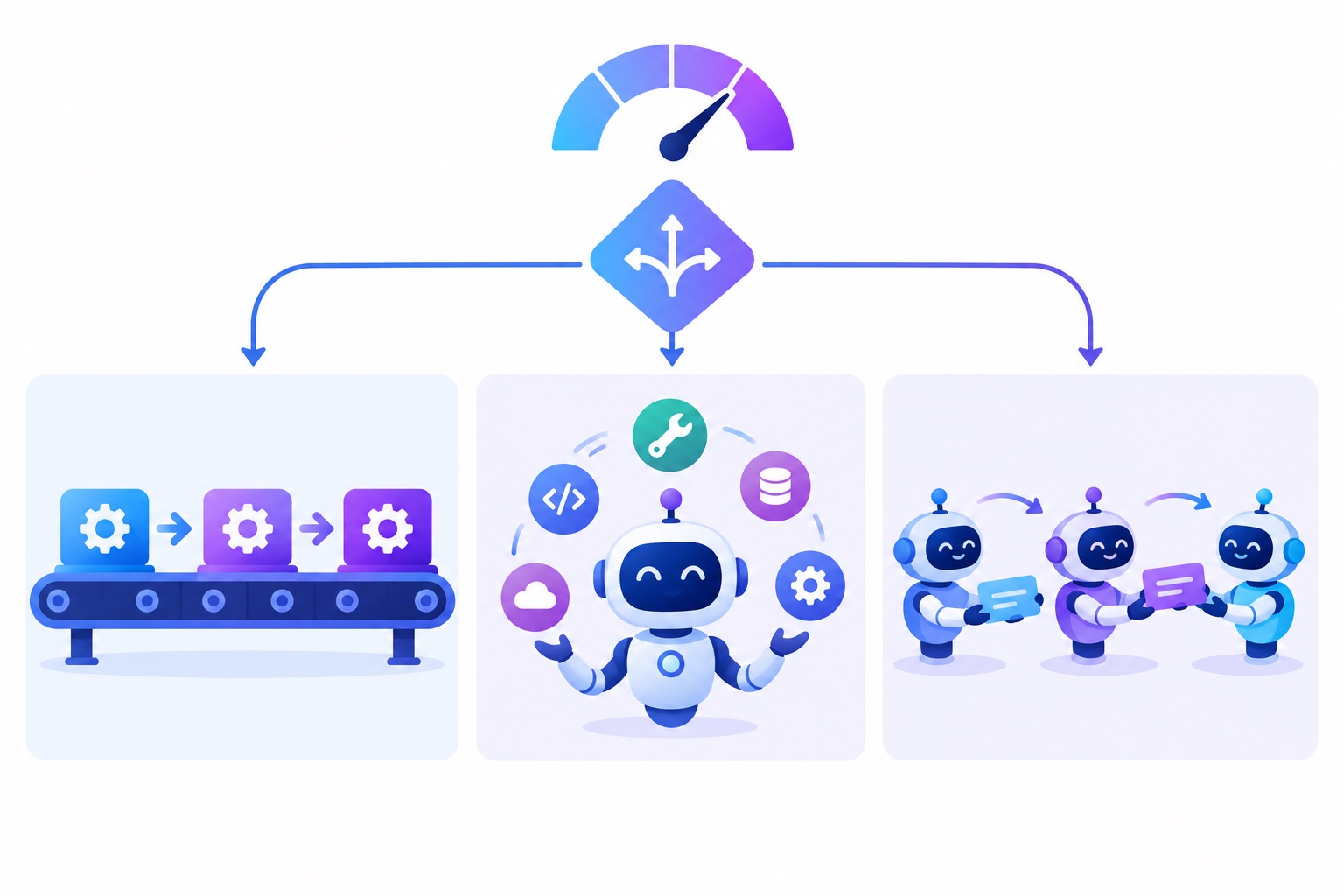
Three Key Points in Architecture Selection
- Trade-off thinking in architecture selection: balancing "determinism" against "flexibility" instead of chasing whatever is new.
- Modular design and complexity control: unclear boundaries mean every subsequent iteration pays interest on the debt.
- Cost and maintainability awareness: have the latency, token costs, and debugging difficulty of Multi-Agent been seriously weighed?
The Overall Design
1. Selection criteria: task determinism, flow length, and cost of failure
Each architecture has a clear fit:
- Fixed workflow: highly deterministic flows with fixed steps and high failure cost — standard queries like "look up logistics → return tracking status," and compliance-sensitive flows like refund approval. Controllable, testable, cheap.
- Single agent: diverse task types completable in one turn where the model must choose tools autonomously, such as general inquiries (maybe knowledge base, maybe order lookup). One tool-calling agent plus intent routing covers most traffic.
- Multi-Agent: introduce only when subtasks differ greatly in domain, each needs independent context and dedicated tool sets, and a single agent's context grows so long that performance degrades — for example, after-sales handling involving rule judgment, multi-system operations, and multi-turn negotiation. The cost is significantly higher latency, spend, and debugging complexity; use it sparingly in customer service.
2. Rollout strategy: progressive, data-driven upgrades
My practical advice is a progressive three-step path: fixed workflows absorb high-frequency standard queries (the bulk of traffic) → a single agent handles long-tail composite questions → only complex scenarios like after-sales disputes enable sub-agents or go straight to humans.
Launch with the simplest architecture, then use failure rate and handoff rate data to decide whether to upgrade. Do not pay in v1 for complexity you only imagined.
3. Module boundaries
Regardless of architecture, I would cut the boundaries like this:
- Intent recognition and routing layer: classifies the question and decides workflow vs. RAG vs. agent;
- Knowledge service layer: RAG retrieval and knowledge base management, iterating and evaluating independently;
- Business data layer: order and logistics APIs wrapped as standard tools, decoupled from the model;
- Dialogue management layer: multi-turn state, context memory, clarification strategies;
- Security and audit layer: permission checks and high-risk operation confirmation, cutting across all modules.
Single responsibility per layer is what enables independent testing and rollback.
4. Principles for controlling complexity
- Modules communicate through explicit interfaces; every layer can be evaluated and rolled back independently;
- Fewer agents, not more — adding an agent requires data proving its benefit;
- End-to-end tracing keeps problems locatable — being able to say which layer failed is itself the litmus test of architecture quality.
How This Maps to Weiyu
The architecture of the Weiyu open-source customer service system (GitHub: https://github.com/bytedesk/bytedesk , website: https://www.weiyuai.cn ) aligns closely with this design: the routing layer schedules traffic by channel, skill group, and agent assignment rules; standard high-frequency requests are served by FAQs, quick replies, and fixed flows; the AI Agent (with tool calling) handles inquiries needing flexible answers; complex or high-risk scenarios hand off seamlessly to human agents working in the console; conversation statistics and QA reports continuously output per-layer effectiveness data, informing "should we upgrade the architecture?" This progressive combination — deterministic flows as the base, agents for the long tail, humans as the safety net — is the most stable shape for a customer service system.
Key Takeaways
- Choose along three dimensions: task determinism, flow length, cost of failure — not technical novelty.
- Fixed workflows for high frequency, single agent for the long tail, Multi-Agent sparingly is the default combo for customer service.
- Clear module boundaries (routing / knowledge / business tools / dialogue management / security audit) are the precondition for independent evaluation and rollback.
- Let data drive upgrades: if failure rate and handoff rate are not degrading, do not add architectural complexity.
- End-to-end tracing is the last line of defense when complexity runs away.