The Multimodal Understanding Pipeline: Teaching the Bot to Read Logistics Screenshots, Defect Photos, and Voice Evidence

"My parcel has been stuck for three days — here's a screenshot." "The product has a broken corner — photo attached." "Please take my voice message; my elderly parent can't type." User help requests are naturally multimodal, yet most service bots only accept text. A user sends a logistics screenshot and the bot replies "please describe your problem" — the experience collapses on the spot.
This post is part of an experience-sharing series for AI customer service product managers and developers, drawn from hands-on practice as an intelligent service product manager at a large general e-commerce platform. In this post I want to share how to design the multimodal understanding pipeline — combining OCR, image recognition, and speech recognition with product, order, and after-sales data — for users who describe problems via images, screenshots, or voice such as logistics screenshots, product defect photos, or after-sales evidence, improving recognition and resolution of complex issues.
The key insight: the value of multimodal is not "recognizing it", but "the recognition matching the business data".
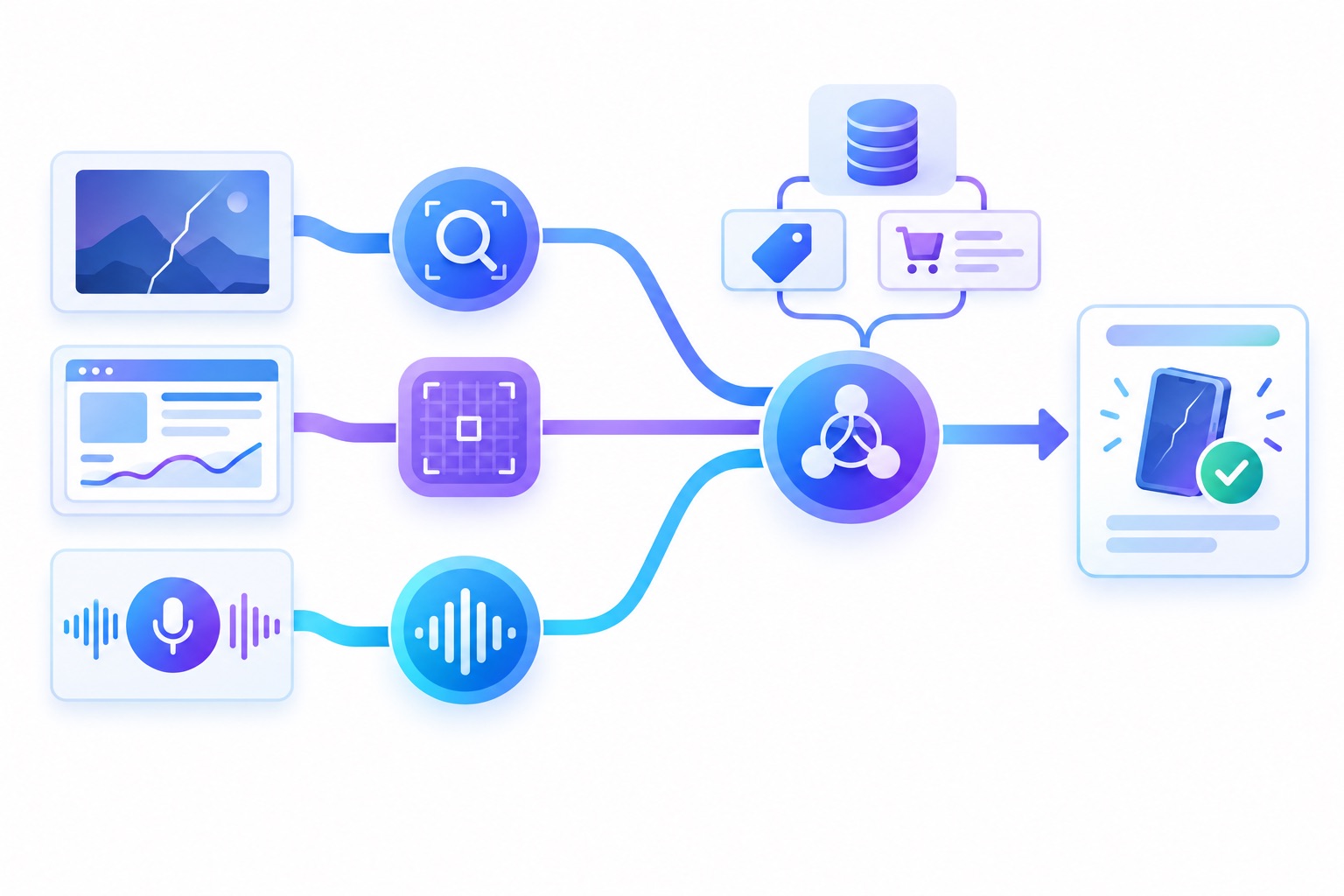
Two Key Points in the Multimodal Understanding Pipeline
- Product-level integration of multimodal tech: organizing OCR, image recognition, ASR, and multimodal LLMs into one reliable pipeline, instead of listing buzzwords.
- Cross-validation awareness: how recognized tracking numbers, defects, and evidence get compared against order and after-sales data before driving automation.
The Overall Design
Step 1: The multimodal understanding pipeline
- A unified entry receives images/voice and first performs classification routing: logistics screenshots, product photos, evidence photos, and voice messages each enter their own recognition pipeline — never force one pipeline to swallow every input.
- OCR extracts text (tracking numbers, timestamps, merchant promise copy); image recognition classifies defect types (damage, color difference, missing pieces); ASR transcribes voice while keeping the original for user confirmation.
- Prefer multimodal LLMs for holistic understanding (image content description + key information extraction), with traditional OCR/ASR as supplements and cross-checks — two legs walking; neither alone is reliable.
Step 2: Combining with business data (the heart of the chain)
- Recognized tracking numbers auto-link to orders, and screenshot content is compared with real logistics trajectories; defect photos are linked to the ordered product and after-sales history; evidence text is compared with the merchant page's promises.
- Cross-validation logic: recognition consistent with business data → enter the corresponding service flow directly (e.g., auto-initiate a defect return); inconsistent or unconfirmable → clarify with the user or request more material. A picture alone can never prove truth; cross-validation is what enables automation.
Step 3: Experience and trust design
- Echo the recognition result: "I see you uploaded a logistics screenshot — tracking number XXX, showing no update for 3 days" — let the user confirm before executing. Echoing is the cheapest place to correct errors.
- Show voice transcriptions as text so users can verify, especially for those who cannot type easily.
Step 4: Metrics and iteration
Watch three metrics: recognition accuracy, auto-resolution rate after recognition, and correction turns caused by recognition errors; recycle Bad Cases to improve recognition models and validation rules. Recognition errors are not scary; executing on a wrong recognition is.
Two points that must be stated
Core view: the value of multimodal lies not in "recognizing it" but in "the recognition matching business data". However accurate the vision model, without order-data cross-validation it stays at "describing the image" and never reaches "processing the business".
Compliance red line for evidence materials: retention purpose limits, user consent, and privacy masking. After-sales evidence may contain ID cards and addresses — collecting it means owning the responsibility.
How This Maps to Bytedesk
Bytedesk, the open-source AI customer service system (GitHub, site), already supports multi-channel image and file messaging, providing the channel foundation for multimodal entry; the AI module supports vision- and speech-capable LLMs for image understanding and information extraction; the knowledge base and tickets carry the post-recognition processing flows; and on human transfer, images and recognition context sync to the agent with the conversation. Cross-validation against order/after-sales systems is a business-side customization extendable on Bytedesk's open AI Agent tool-call mechanism.
Key Takeaways
- Route by type first, then recognize: screenshots, photos, evidence, and voice each get their own pipeline.
- Multimodal LLM as primary, traditional OCR/ASR as secondary, mutually supplementing and cross-checking.
- Recognition results must be cross-validated against order, logistics, and after-sales data — match enables automation, mismatch triggers clarification.
- Echo recognition results for user confirmation; display voice transcriptions; correct before executing.
- Track recognition accuracy and correction turns, and hold the compliance red line on evidence: consent, masking, purpose-limited retention.