A Unified Workbench for Merchant Support, Human Agents, and AI: Three Parties, One Conversation

Local-life platforms have a customer service peculiarity: more than one party may handle a session—the merchant's own support staff, the platform's agents, and an AI Agent, potentially all serving the same user at overlapping times. Without a unified workbench, users repeat themselves at every seam; "I already said that, why do I have to say it again" is a high-frequency phrase in negative reviews.
This is the ninth article in an experience-sharing series on "AI customer service product and engineering practice," drawn from hands-on practice as an AI Product Manager focused on IM intelligent customer service at a local-life services platform. In this post I want to share how to design session assignment, intelligent reply assistance, historical context sync, and human takeover when building a unified workbench that supports collaboration among merchant support, human agents, and AI Agents—cutting operational cost while raising handling efficiency.
The core tension: AI assisting humans and AI replacing humans are two entirely different product logics, and the unified workbench must support both.
Three Key Points in Workbench Design
- Design multi-party session assignment and routing, beyond a simplistic "bot first."
- Understand the difference between "AI assisting humans" and "AI replacing humans"—one boosts efficiency, the other diverts volume; the metrics differ completely.
- Guarantee seamless context handoff on takeover—zero repeated statements from the user is the experience floor.
Overall Approach
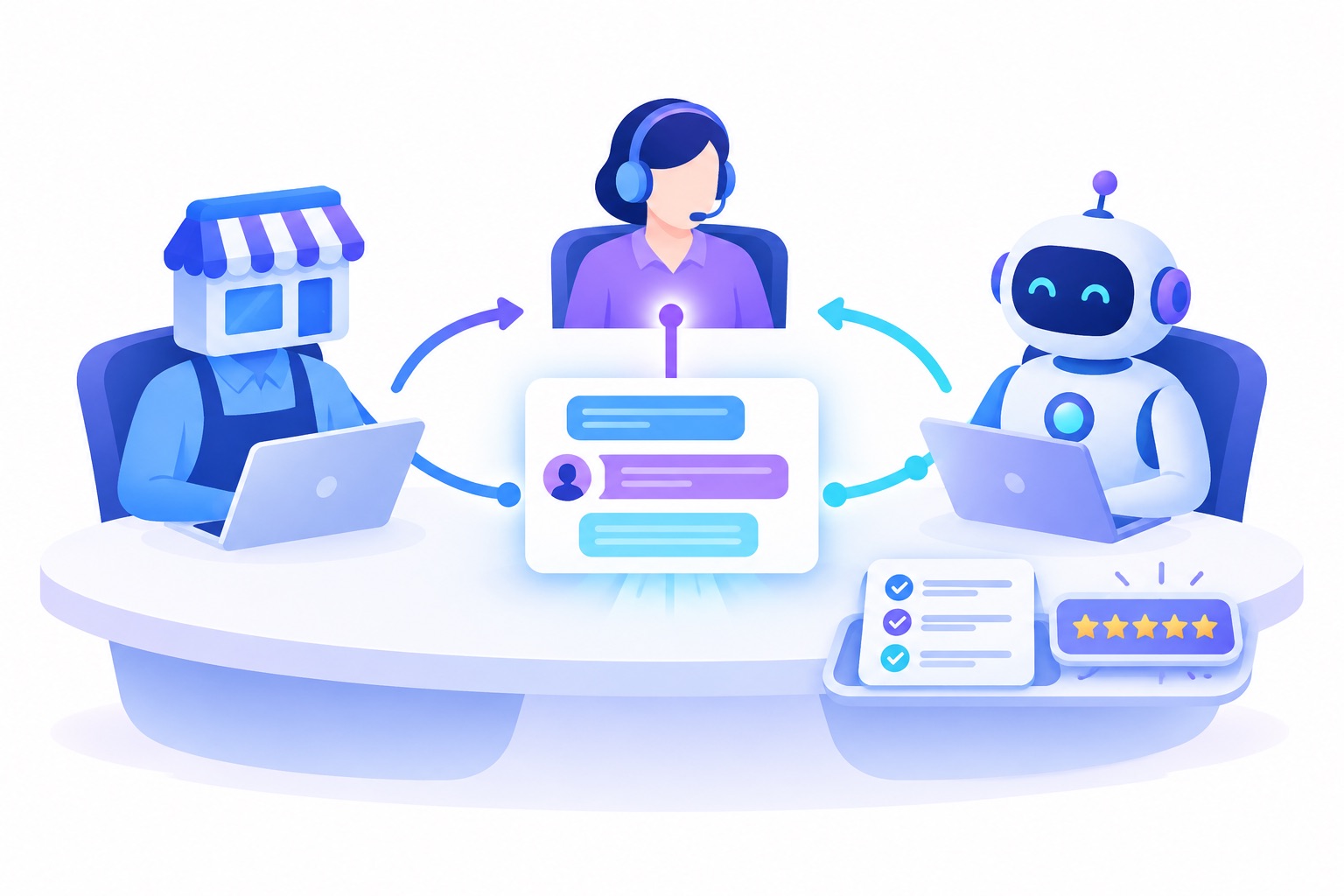
My design centers on "three parties sharing one conversation, with AI always at the side."
Step 1: Unified Session Model
All merchant-user conversations enter one workbench, with a "current serving party" state on each session (AI / merchant support / platform agent); all three share the same conversation context and order view. This is the foundation of all collaboration—if each party sees its own records, assistance and takeover are empty talk.
Step 2: Intelligent Assignment
Assign by "skill-group matching + load balancing + priority": route by business line and issue type to the right skill group, with VIP and high-risk sessions jumping the queue. The AI stays on standby within sessions; when humans are busy, AI takes over first and de-escalates—users never wait idle, which is the peak-hour experience floor.
Step 3: Intelligent Assistance (Copilot Mode)
While a human handles the session, the AI does four things beside them:
- Real-time reply suggestions the agent can adopt in one click and edit;
- Automatic summaries of user requests and order information;
- Similar historical ticket handling suggestions;
- Sensitive-phrase compliance checks.
The human only confirms and adjusts—transforming from "typist" to "reviewer," slashing typing cost.
Step 4: Seamless Takeover
When AI hands off to a human, four things must travel along: conversation summary, confirmed information, executed operations, and the AI's judgment with confidence. The human opens the session fully informed, and the user never repeats themselves—the experience floor and the very reason the unified workbench exists.
After takeover the AI shifts to silent assistance (still suggesting replies); conversely, the human can hand standardized parts back to the AI, forming elastic collaboration.
Step 5: Efficiency Metrics
Five metrics: average human handling time, AI adoption rate (share of suggested replies adopted), post-takeover user repetition rate, sessions per agent, and satisfaction.
If adoption keeps rising while repetition approaches zero, the collaboration works; if adoption is low, either suggestion quality is poor or agents distrust the AI—two very different problems with very different fixes.
Practice in Weiyu
The agent workbench of Weiyu, the open-source AI customer service system (GitHub, website), follows exactly this design: a unified session list supports collaborative service by AI bots, human agents, and merchant-side support; skill-group routing assigns sessions by business and skill with load balancing and priority; bot-to-human transfer carries the full conversation record so agents see complete context on open; sessions connect with tickets and the knowledge base so agents can consult while handling. The session statistics module provides handling time, volume per agent, and satisfaction—data for measuring collaboration effectiveness.
Takeaways
- The unified session model is the foundation: three parties share one context and order view.
- Assignment runs on "skill group + load + priority"; AI always backstops so users never wait idle.
- Copilot quartet: reply suggestions, auto summaries, similar-ticket hints, compliance checks—turning humans from typists into reviewers.
- Takeover carries summary, confirmed info, executed operations, and AI judgment—zero user repetition.
- Adoption rate and repetition rate are the core indicators of whether collaboration works.