Shipping Digital Humans and Voice Interaction: Which Scenarios Truly Deserve Them, and How to Evaluate ROI

Digital humans are the direction in AI customer service most easily derailed by "innovation for innovation's sake". The demo dazzles — a lifelike avatar smiles and answers questions on camera; the rollout embarrasses — the user asks about delivery status and must listen to thirty seconds of narration with no skip button. The tech is flashy, but the first principle of customer service is solving the user's problem at the lowest interaction cost, not showcasing technology.
This post is part of an experience-sharing series for AI customer service product managers and developers, drawn from hands-on practice as an intelligent service product manager at a large general e-commerce platform. In this post I want to share how to judge which scenarios truly fit when planning to introduce digital humans, voice interaction, and other multimodal service forms, and how to build the rollout plan across user experience, information-transfer efficiency, interaction latency, technical cost, and business value.
On the surface this is about multimodal knowledge; underneath it is about a product manager's restraint toward new forms — the refusal to build for building's sake is where sophistication lives.
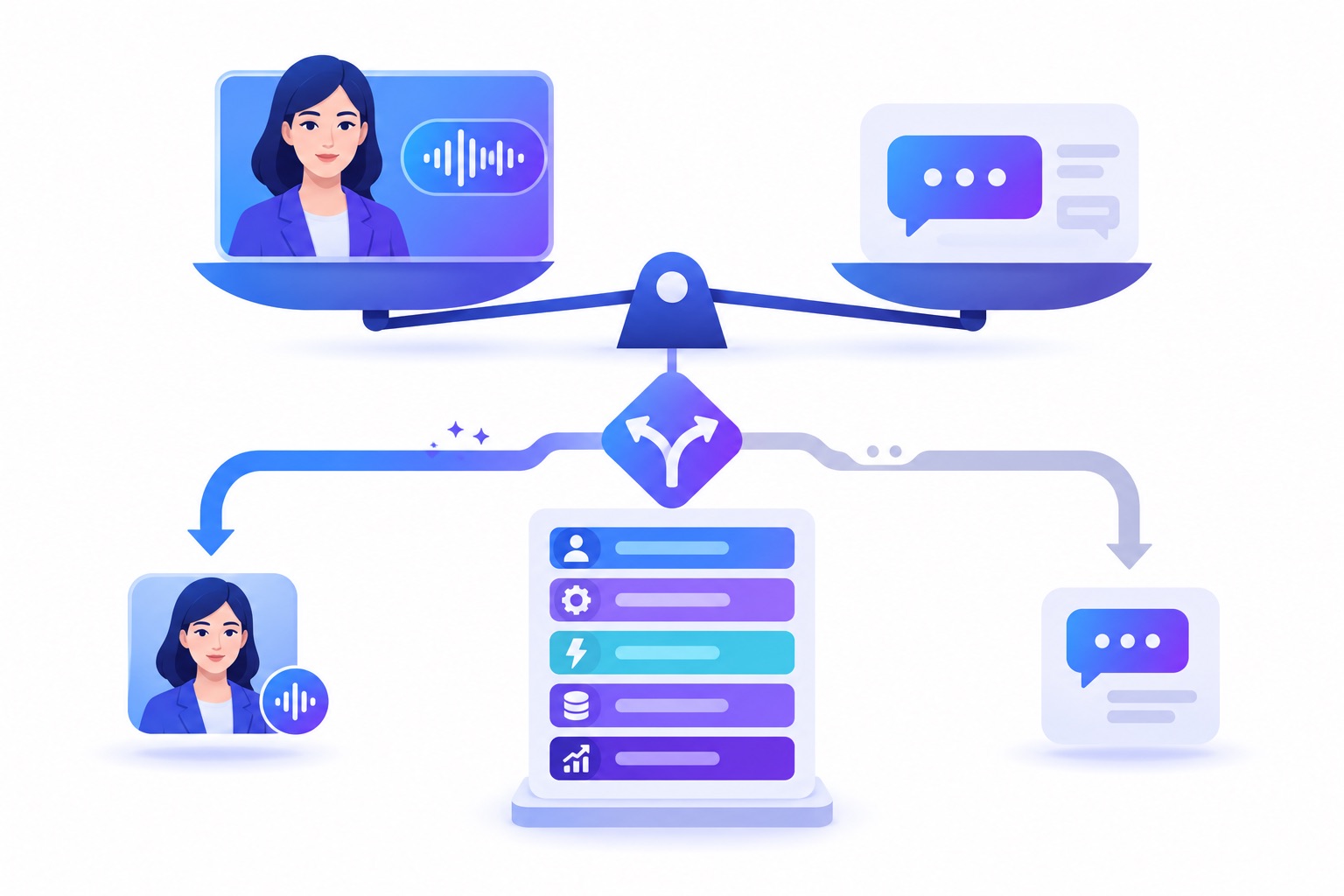
Two Key Points in Digital-Human Scenario Selection
- Calm judgment about new technology forms: resisting the "roll out everywhere" temptation and identifying genuinely fitting scenarios.
- Multi-dimensional ROI evaluation and rollout pacing: a scoring framework, a grayscale plan, and a stop-loss mechanism.
The Overall Design
Step 1: Scenario-fit judgment
Signals that suit digital humans/voice:
- Users whose hands are occupied and cannot type (e.g., consulting while receiving goods);
- High-emotion, high-dispute scenarios where a humanlike presence soothes (e.g., complex after-sales communication);
- Brand marketing and mega-sale events that need an "experience highlight".
Signals that do not:
- High-frequency, standardized queries (delivery status, refund progress) — text cards carry higher information density and efficiency;
- Scenarios requiring structured information display (order lists, refund progress) — voice is inherently inefficient at this.
Step 2: Five-dimension evaluation
- User experience: does the digital human genuinely raise trust and satisfaction (verifiable via user research), or is it a gimmick?
- Information-transfer efficiency: resolution time for the same question in voice/digital-human form versus text form;
- Interaction latency: voice pipelines demand far tighter response times than text — can the tech meet them?
- Technical cost: rendering, ASR/TTS, compute, and stability investment for the multimodal chain;
- Business value: measurable lift in resolution rate, satisfaction, or conversion.
Output: a scenario × five-dimension scoring matrix; greenlight only high-scoring scenarios. The evaluation exists not to prove the technology works, but to prove the experience is better and the cost is contained.
Step 3: Rollout plan
- MVP grayscale: pick one or two high-fit scenarios (e.g., after-sales soothing, sale-event shopping guidance) with small traffic, and support switching back to text at any time — an exit path is standard equipment for any new form.
- Core metrics: resolution rate, satisfaction, and completion rate in this form versus a text-form control group; plus cost per contact. Data without a control group proves nothing.
- Iteration strategy: expand only when results pass; fall back to text when they do not. The digital human is a capability for specific scenarios, not the default for everything.
Two positions worth stating
"Multimodal forms are an enhancement for specific scenarios, not a wholesale replacement" — text remains the most information-efficient form. A product manager who dares to say this during evaluation is more professional than one who writes digital humans into the annual roadmap. The restraint itself is the bonus point.
A downgrade path must exist by default: when the voice/digital-human pipeline fails, degrade imperceptibly to text to keep the service available. Multimodal is icing; availability is the cake — the latter always wins.
How This Maps to Bytedesk
Bytedesk, the open-source AI customer service system (GitHub, site), holds the same restraint: core capabilities are built around efficient text-based resolution, with multi-channel access supporting differentiated presentation across web, app, and other carriers; the AI module supports speech-capable LLMs to extend voice pipelines for specific scenarios (e.g., phone support); and human-bot collaboration guarantees a fallback in any form. Digital-human rendering is a front-end presentation enhancement that can be introduced per scenario via Bytedesk's open channel and front-end customization — never as the default form.
Key Takeaways
- Judge fit signals first: occupied hands, strong emotion, brand highlights fit; high-frequency standard queries and structured displays do not.
- Greenlight with a scenario × five-dimension matrix (experience, efficiency, latency, cost, value) — only high scorers ship.
- Every MVP needs a text control group and an instant switch-back path.
- Fall back to text when results miss: digital humans enhance specific scenarios, not replace everything.
- Imperceptible degradation to text is the floor design — availability always outranks form innovation.