Multi-Intent Recognition, Task Decomposition, and Dialogue State Tracking: Helping the Bot Finish Everything the User Asked

Real users rarely ask one thing at a time. "Where is my parcel? By the way, can I still use that coupon? And how much was refunded?" — three requests in one message, and the user keeps changing their mind as the conversation goes: "Actually, change the refund to a return." Bots typically break here in familiar ways: they answer the first intent and drop the other two, or after a few turns they forget where things stand and make the user repeat everything.
This post is part of an experience-sharing series for AI customer service product managers and developers, drawn from hands-on practice as an intelligent service product manager at a large general e-commerce platform. In this post I want to share how to design multi-intent recognition, task decomposition, context management, and dialogue state tracking so the bot understands accurately and completes the tasks continuously — for users who often express multiple related requests in natural language and keep supplementing or modifying them across turns.
This is the core hard problem of multi-turn products: understanding "what was said" and remembering "how far along we are" are two different jobs, and failing either one tanks the experience.
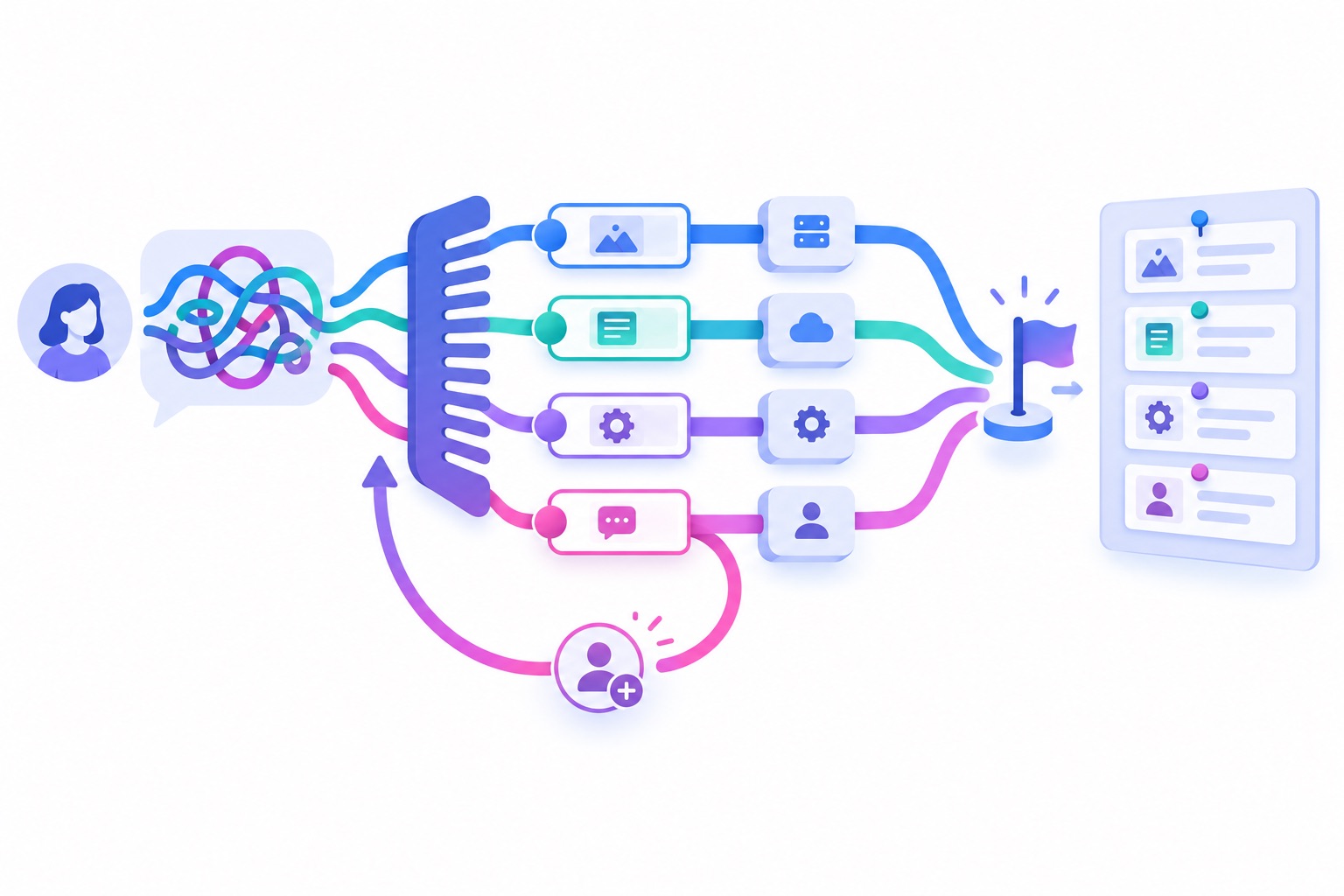
Three Key Points in Multi-Intent Task Handling
- Multi-intent methodology: turning mixed natural language into a structured, independently executable task list.
- Depth in dialogue state tracking and context engineering: session-, task-, and turn-level context treated as separate layers.
- Task continuity under changing needs: when users modify requirements or switch topics mid-way, the bot must resume without losing state.
The Overall Design
Four steps: intent parsing and task decomposition, three-layer context and state tracking, dialogue orchestration and task switching, then data validation.
Step 1: Multi-intent recognition and task decomposition
- At the entry point, use an LLM to parse user input and emit a structured intent list (e.g., check logistics + check coupon + check refund progress), with each intent carrying a confidence score and associated entities (order number, coupon ID).
- Decompose each intent into an independent service Task, mounted on a session-level task queue, with dependencies marked between tasks — for example, refund progress affects whether the coupon is returned.
- Actively clarify low-confidence intents instead of guessing and answering wrongly. One extra question beats several turns down the wrong path.
Step 2: Context management and state tracking
- Design three context layers: session-level (who the user is, which orders are involved), task-level (each task's progress and collected slots), turn-level (the raw text of recent turns). Each layer has its own purpose; do not pile everything into one ever-growing blob.
- Maintain a slot table per task — a refund task needs order number, reason, and method. When a slot is missing, ask only about the current task, never disturb the others.
- When the user changes requirements, have the LLM make an incremental update judgment: is this turn modifying an existing task's slots, adding a task, or closing one? Then sync the task queue instead of resetting everything.
Step 3: Dialogue orchestration and task switching
- For scheduling, finish light query tasks first and let heavy operational tasks (refund applications) advance step by step; when the user switches topics, suspend the current task while preserving state, and resume when they return rather than starting over.
- End each reply with a reminder of unfinished tasks: "You still have a refund-progress question pending — continue?" Let product mechanisms catch missed tasks instead of relying on the user's memory.
Step 4: Data validation
I track five metrics on this chain: multi-intent recognition accuracy, task completion rate, mid-task abandonment rate, context-recovery rate (whether the bot successfully picks the thread back up after a topic switch), and average turns per completed task. The first three measure understanding and execution; the last two directly reflect experience.
One architectural principle that matters most
The LLM understands "what the user said"; the task state machine records "how far things have gone" — keep them separate. Long conversations make LLMs forget and hallucinate; handing strong-state information like task progress to a deterministic state machine keeps the chain from breaking when the model wobbles.
Another common trap: critical business state (refund amount, coupon eligibility) must be read from the business system in real time every turn, never cached in dialogue context. A stale cache lets the bot make promises based on expired state — an incident-grade failure in anything touching money.
How This Maps to Bytedesk
Bytedesk, the open-source AI customer service system (GitHub, site), offers composable building blocks for this chain: the AI Agent handles intent understanding and structured output, combined with multi-turn dialogue and context management for task-level state; the knowledge base and RAG support light query tasks; skill-group routing and tickets push heavy operational tasks through deterministic workflows where progress stays visible; and human-bot collaboration ensures multi-task conversations can transfer to humans anytime with full context. Deeper multi-task orchestration is exactly where Bytedesk keeps investing in its AI Agent workflow direction.
Key Takeaways
- Emit a structured intent list with confidence and entities at the entry; clarify low-confidence intents rather than guessing.
- Manage three context layers separately; drive tasks with slot tables and ask only for what is missing.
- On requirement changes, make an incremental update judgment: modify slots, add a task, or close one — then sync the queue.
- Suspend tasks with state preserved on topic switches, and remind users of pending tasks at the end of each reply.
- The model understands, the state machine tracks progress, business systems own real-time state — each has its job, and only together do they survive long conversations.