Rapid Response and Long-Term Prevention for Major AI Customer Service Incidents

2 a.m. The alert fires: the AI customer service refund script is making bulk false promises—based on a contaminated knowledge base, the LLM has "promised" hundreds of users compensation plans that do not exist. Every minute now creates new financial risk and complaints. What do you do?
AI customer service incidents differ fundamentally from traditional software bugs: the system outputs errors fluently, confidently, and at scale. A single bad prompt can affect thousands of sessions within hours. That means incident response cannot start with "fixing"—it must start with "stopping the bleeding."
This is the sixth article in an experience-sharing series, "AI Customer Service Product and Engineering Practice," drawn from hands-on practice as an AI customer service product manager at a global short-video social platform. In this post I want to share how to respond quickly when AI customer service suffers a major incident—for example, LLM-generated wrong information causing user complaints—and how to build long-term prevention afterward.
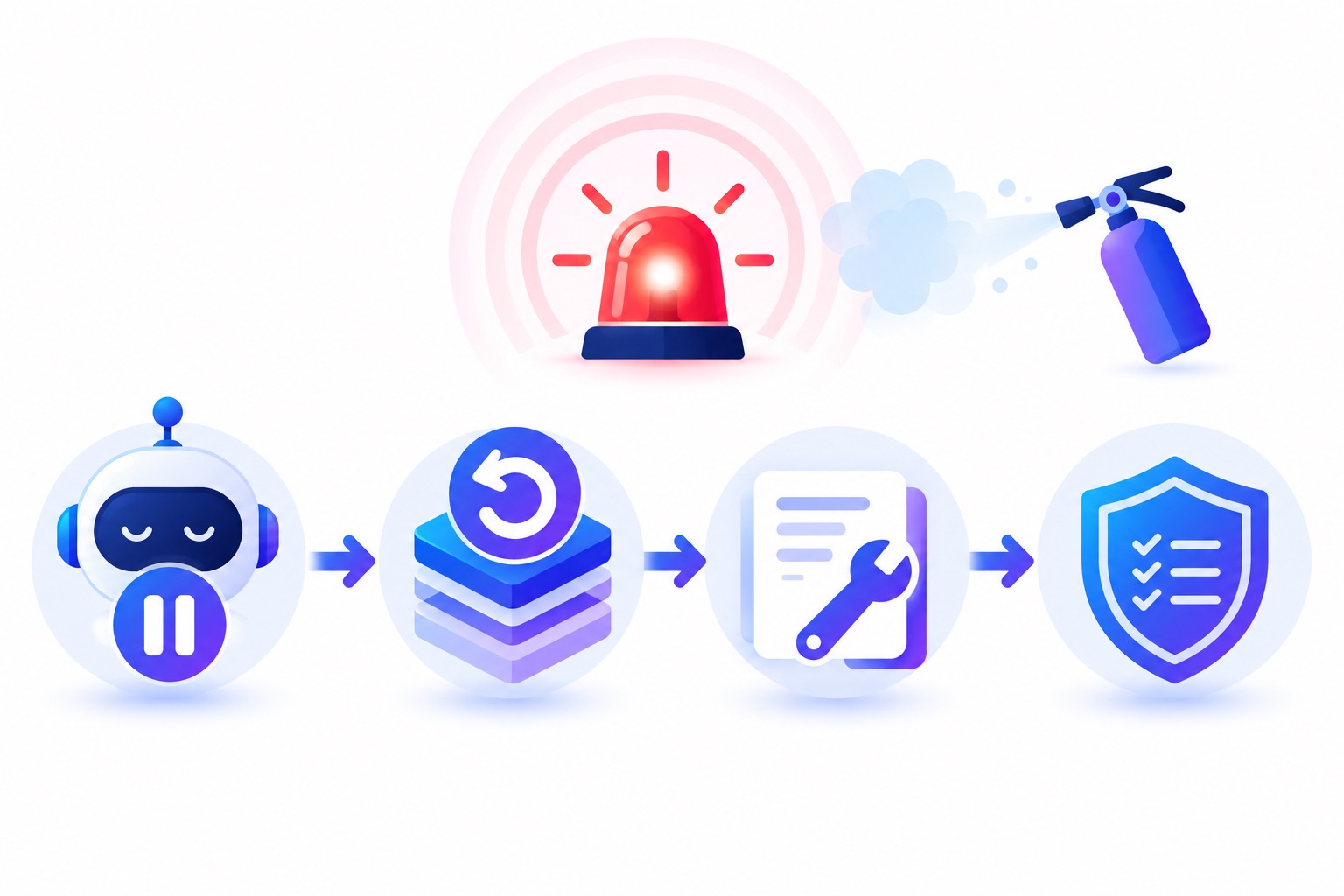
Four Key Points in Incident Response
- SOP-style crisis thinking: when an incident hits, follow an ordered sequence (stop the bleeding → root cause → recovery → prevention) instead of improvising in panic. What really matters is SRE-like discipline.
- Prioritization: bleeding stops before diagnosing—many people instinctively hunt for the root cause first, but no diagnosis matters while harm continues.
- Proactive accountability in communication: reach out to affected users proactively, rather than waiting for complaints to arrive.
- Systematic prevention: after the incident, turn every accident into reusable defenses, rather than just writing a postmortem report.
The Overall Design
1. Rapid Response: The Golden Hour, Bleeding First
Minutes 0–10: stop the bleeding. Confirm the blast radius—trigger conditions of the faulty script, number of affected users, and whether money or legal exposure is involved. Then circuit-break by severity: high-risk intents (refund promises, legal, medical) immediately downgrade to fixed knowledge-base scripts or direct human transfer. At this stage, do not aim to "fix"—aim only to "stop producing new harm."
Minutes 10–30: contain the existing damage. Use session logs to identify the full list of affected users and proactively reach out with correction and compensation: "The earlier information was wrong; the correct plan is X, with additional compensation Y." Proactive disclosure costs far less than waiting for escalated complaints—users can forgive a mistake, but rarely forgive a concealed one. Simultaneously brief the human support team on unified messaging and prepare a PR contingency plan.
Minutes 30–60: initial root-cause assessment. Classify the failure: prompt defect, knowledge-base contamination, model-version regression, or rule-engine loophole—and assign a fix owner.
2. Long-Term Prevention: Four Lines of Defense
- Launch defense: any change to the LLM output chain (prompt, model, knowledge base) must ship via canary release—start with 1% of traffic, watch accuracy and complaint rates, then ramp. High-risk scripts (financial promises, policy explanations) are forced into template + rule mode: the LLM only fills variables and never generates freely.
- Real-time defense: add guardrail filtering on the output side—sensitive-promise keyword detection and consistency checks against knowledge-base answers; on mismatch, intercept and downgrade. Set anomaly alerts on the monitoring dashboard (sudden moves in complaint rate, downvote rate, handoff rate).
- Retrospective defense: an automatic badcase reflux pipeline. Every incident's sessions are archived in full into a regression test set—every accident must become a test case, or the same failure will recur.
- Organizational defense: clear incident severity levels and a response SOP—who can trigger the circuit breaker, who communicates externally, who runs the postmortem. The postmortem delivers a fixed four-part output: timeline, root cause, recurrence-prevention actions, and owners. Ban vague "we'll be more careful next time" conclusions.
3. How to Present Past Experience (a STAR Framework Example)
When reviewing a past incident, structure it as Situation-Task-Action-Result (replace the numbers with your real story):
Situation: after launching a new intent model, refund scripts began making bulk false promises and complaints climbed fast. Task: as the owner, contain the impact and eliminate the root cause. Action: completed circuit-breaking within the first hour, identified all affected users, and delivered proactive compensation outreach the same day; afterward drove the adoption of "high-risk script templating plus canary release." Result: the complaint escalation rate stayed low, and this failure class never recurred.
The point of this framework is not pretty numbers—it is the operating order: bleeding stops before diagnosing; proactive outreach beats reactive response.
How This Maps to Bytedesk
Several capabilities in the open-source AI customer service system Bytedesk (GitHub, website) echo this system: human-AI collaboration with agent transfer is itself a natural circuit-breaker channel—when the bot misbehaves, traffic can switch to human handling immediately, stopping losses on the front line; the knowledge base supports versioned management and rapid correction, providing recovery for "knowledge-base contamination" incidents; session statistics and quality inspection can isolate abnormal time windows and support badcase review; and the ticket system carries compensation and follow-up processing. Canary release and guardrail filtering are deployment- and gateway-layer capabilities that can be built progressively along the four lines of defense on Bytedesk's open-source architecture.
Key Takeaways
- The special nature of AI customer service incidents: errors are output fluently, confidently, and at scale—so "stop the bleeding" must precede "locate the cause."
- The golden hour in three phases: 0–10 minutes tiered circuit-breaking, 10–30 minutes proactive outreach to affected users, 30–60 minutes initial root cause.
- Four lines of defense: launch canaries, real-time guardrails, retrospective test sets, organizational SOP—every incident must become a test case.
- Proactive disclosure always costs less than being exposed by complaints; users forgive mistakes, not concealment.
- When sharing crisis experience, use the STAR structure and emphasize the operating order, not the outcome numbers.