From Reactive to Proactive Service: Alerts, Interventions, and Frequency Control

The package has been delayed 48 hours and the user has not asked yet—wait for them to arrive furious and complain, or send a heads-up first: "your delivery is delayed, expected in the next day or two, here is a coupon"? The former saves one push; the latter saves a bad review, a complaint, and a human-handled conversation. That is the value of proactive service: deliver the information before the user realizes there is a problem.
This post is part of an experience-sharing series on "AI customer service product and engineering practice", drawn from hands-on practice at a global fast-fashion cross-border e-commerce platform. In this post I want to share how to move from reactive answering to proactive service: designing proactive alerts and service interventions from order status, tracking, refund progress, and anomaly events, controlling outreach frequency, and measuring the real impact on consultation volume, resolution efficiency, and user experience.
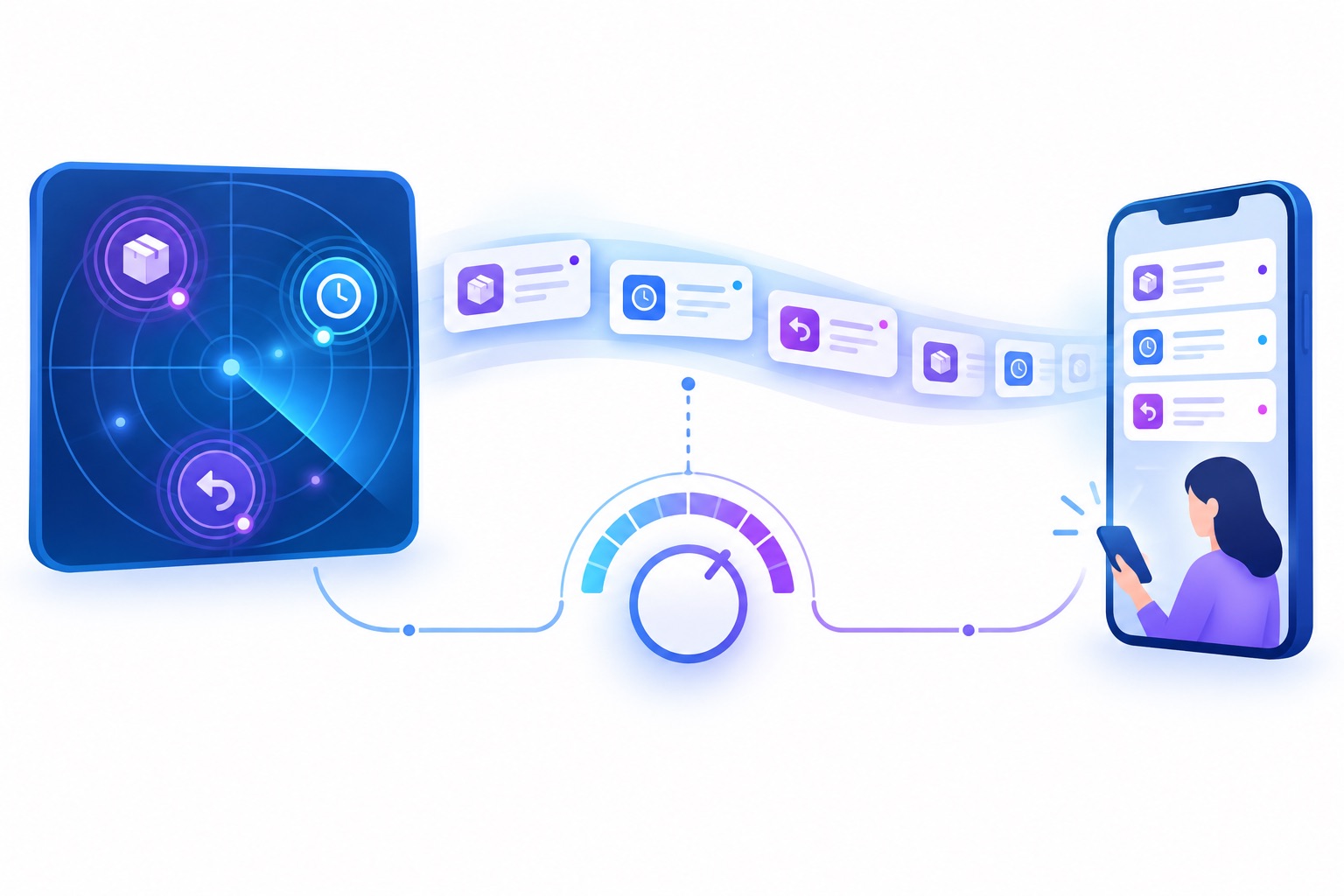
Four Key Points in Proactive Service Design
- Pick scenarios by value: high-value outreach moments come from real user journeys, not imagination.
- Control frequency and channels: anti-spam mechanisms, channel, and cadence management protect trust.
- Measure gains and side effects: scientific evaluation covers both directions.
- Mind the perception boundary: the line between proactive service and disturbance is thin.
The Overall Design
I would design across scenarios, mechanisms, frequency, and measurement—with "we speak first" replacing "users come ask".
Step 1: Identify proactive scenarios—event-driven only
I group high-value proactive alerts into four families:
- Logistics: shipping notices, package-at-locker notices, delay warnings—proactively informing before the user asks is far better and cuts consultation volume most directly.
- After-sales: refund-received notices, expiring return-label reminders.
- Anomalies: payment-failure alerts with resolution guidance, proactive outreach for order exceptions (out-of-stock, address issues).
- Value-added: exchange suggestions for wrong sizing, repurchase care.
Triggering principle: event-driven (fired by state changes), never scheduled mass sends; reach out only on journeys the user cares about.
Step 2: Intervention mechanism design
- Alert layering: informational alerts (shipped, refund received) need no reply; action-guiding alerts (payment failure, address anomaly) carry a one-tap resolution entry so the user solves it without entering support.
- Intervention loop: if the user does not act after the alert and the issue escalates, handle it automatically—severe logistics delay auto-triggers a compensation ticket instead of waiting for an angry user.
Step 3: Frequency control—rein in the disturbance
Once proactive service becomes spam, the loss of user trust far outweighs the experience gain. My hard rules:
- Frequency caps: per-user daily/weekly limits; merge similar events—multiple status changes of one package become one digest, not a barrage.
- Preference management: users can set receiving preferences (channels, type toggles); transactional messages cannot be turned off, marketing defaults to off.
- Channel strategy: choose app push, SMS, or email by urgency and preference; quiet hours—no non-urgent messages at night.
- Anti-fatigue: negative feedback (notification off, complaints) automatically lowers that user's outreach sensitivity.
Step 4: Measuring impact—validate hypotheses with experiments
- Core hypothesis: proactive service should reduce inbound consultations, shorten resolution time, and lift satisfaction.
- A/B validation: reminder group vs. no-reminder group, comparing inbound volume, resolution time for the same issue, and satisfaction.
- Guardrail metrics: post-outreach complaint rate, unsubscribe rate, notification-off rate—if reminders drive mass unsubscribes, the design over-reaches and loses more than it gains.
- Long-term metrics: notification open rate and in-notification resolution rate (the share solved via one tap)—the most direct evidence of real value.
The ideal outcome: after high-frequency alerts launch, logistics inbound volume drops visibly, satisfaction rises, and unsubscribe rates stay low—only then has proactive service truly created value.
Practice in Bytedesk
The open-source Bytedesk customer service system (GitHub, website https://www.weiyuai.cn ) supports visitor-facing proactive outreach through its conversation and messaging capabilities; multi-channel access enables differentiated push by channel; the ticket system carries follow-up handling triggered by alerts (such as compensation tickets); conversation statistics compare inbound volume and satisfaction before and after outreach, supporting impact measurement.
Key Takeaways
- Proactive service is event-driven only—no scheduled mass sends.
- Two alert tiers: informational without disturbance; action-guiding with one-tap resolution.
- Hard frequency rules: daily caps, event merging, quiet hours, auto-desensitization on negative feedback.
- Validate gains with A/B tests and watch the unsubscribe and complaint guardrails.
- Track notification open rate and one-tap resolution rate long-term—they are the real value of proactive service.