When Low-Resource Languages Fail: Designing Fallback and Human-Handoff for AI Customer Service

"The bot answered nonsense, so I asked for a human—and the first thing the agent said was: 'Could you describe your problem?'" This may be the most universal complaint about AI customer service worldwide. In multilingual settings the pain is amplified: low-resource languages have scarce data, LLM comprehension varies by language, wrong answers are more likely—and a handoff that makes the user re-explain everything from scratch pushes the bad experience over the top.
This is the third article in an experience-sharing series, "AI Customer Service Product and Engineering Practice," drawn from hands-on practice as an AI customer service product manager at a global short-video social platform. In this post I want to share how to design the fallback mechanism (such as the human-handoff strategy) in multilingual scenarios where LLM comprehension accuracy varies—for example, scarce resources for minor languages—so that user problems actually get solved, and which decision metrics to watch.
Four Key Points in Fallback Design
Fallback is essentially "safety-netting," and in my view four points decide whether it works:
- Grasp of what fallback really is: fallback is not simply "transfer to a human when stumped"—it is "when which signal appears, fall back at which cost." It is fundamentally a cost-versus-experience optimization problem. Being able to articulate this layer is the first watershed.
- Layered design and quantification: produce a layered degradation design (increasing cost per layer) and define measurable metrics for each layer's triggers and evaluation, rather than gut-feel "transfer when it fails."
- Multilingual special-handling awareness: minor languages need independent thresholds and monitoring, instead of being averaged into one English-dominated dashboard.
- Experience details: whether context is passed losslessly at handoff is something only people who have actually shipped global products tend to mention proactively.
The Overall Design
1. Design Principle: Layered Degradation, Increasing Cost
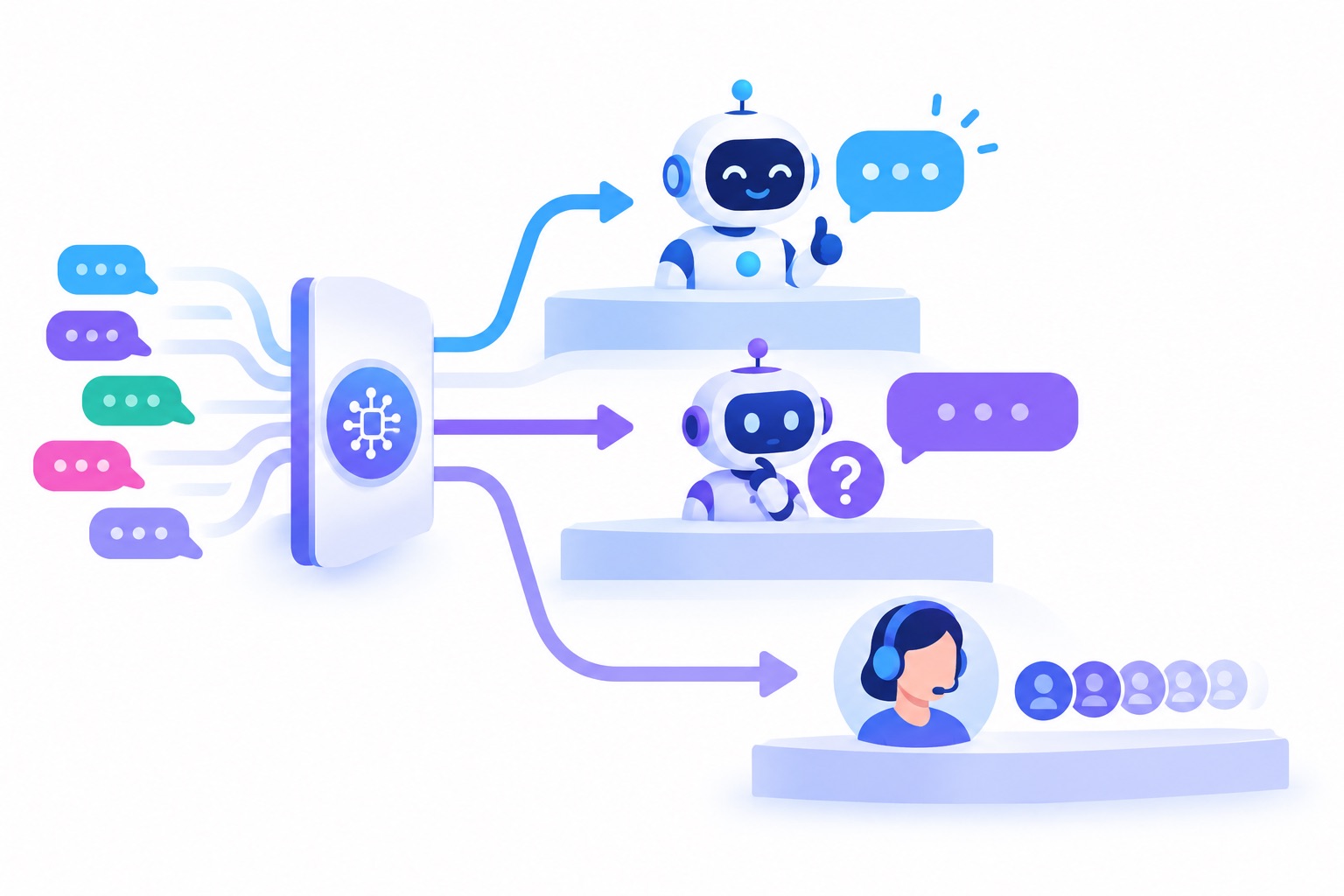
State the principle first: fallback is a process of layered degradation with increasing cost—try low-cost self-help first, then escalate layer by layer. There is exactly one hard constraint: never make the user re-describe their problem. The single worst experience in human handoff is making the user start over.
2. The Five-Layer Fallback Design
- L0 Model confidence self-check: the LLM outputs a confidence level or rationale alongside its answer. Low-confidence answers (say, intent-classification top-1 probability below threshold) are not shown; instead a clarifying script runs: "I understand your issue is X or Y—is that right?"
- L1 RAG fallback: on recognition failure, retrieve the local knowledge-base FAQ; if there is a hit, return the standard answer plus a "Did this solve your problem?" confirmation button.
- L2 Guided clarification (max 2 rounds): use option-based guidance to narrow the intent ("Is this a payment issue or a logistics issue?"). In minor-language scenarios, closed options are far safer than open-ended follow-ups—open questions only deepen misunderstanding.
- L3 Human handoff: when transferring, you must attach the full context summary—user language, problem summary, attempted solutions, emotional state; and the transfer script must set expectations: "We are connecting you to an agent who speaks your language; estimated wait is X minutes."
- L4 Asynchronous backstop: during hours when minor-language agent coverage is thin, convert to a ticket with a committed SLA response time, so the user is not left waiting indefinitely.
3. Key Decision Metrics
| Dimension | Metrics | Notes |
|---|---|---|
| Trigger accuracy | Intent confidence, LLM self-assessed confidence, clarification rounds | Core: transferring too early wastes labor; too late hurts experience |
| Resolution effectiveness | Self-service resolution rate, handoff rate, first-contact resolution after handoff | Low post-handoff resolution means context transfer failed |
| Experience cost | Re-description rate, clarification round distribution, transfer wait time, CSAT | More than 2 clarification rounds in one session should force escalation |
| Per-language health | Per-language recognition accuracy, resolution rate, handoff rate | Set separate thresholds for minor languages; never average them with English |
"First-contact resolution after handoff" is one of the signals I value most: if a user must re-explain their problem after reaching a human, the L3 context pipeline is broken and the fallback design has failed.
4. Multilingual Special Handling
- For low-resource languages, set more lenient auto-resolution thresholds and earlier human-fallback triggers—better to over-transfer than to answer wrongly. A wrong answer damages trust with minor-language users far more than a few extra minutes of wait.
- When agents are scarce, bridge with machine translation: user's language → internal translation → English-speaking agent → translate back, with a visible "translation-assisted" label to set expectations.
- Monitor "resolution-rate drops" by region and link it to the metrics system for root-cause analysis (the next article expands on this).
5. The Objective Function
The fallback objective function is: maximize global problem resolution while minimizing total cost (labor + experience). The path in three phrases: confidence-driven tiered escalation, lossless context transfer, independent per-language monitoring.
How This Maps to Bytedesk
The open-source AI customer service system Bytedesk (GitHub, website) carries this pipeline end to end: when the bot is out of its depth, a human handoff is one click away and carries the conversation context so the user never repeats themselves; skill-group routing assigns sessions to the right team by language or business line; outside covered hours, the ticket system takes over with progress tracking; the knowledge base with RAG powers the L1 content fallback; and session statistics provide resolution and handoff views by channel and time slot for setting independent thresholds per language market.
Key Takeaways
- Fallback in essence is "when which signal appears, fall back at which cost"—a joint optimization of cost and experience, not "transfer when it fails."
- Recommended five layers: confidence self-check → RAG fallback → guided clarification (max 2 rounds) → context-carrying human handoff → asynchronous ticket backstop.
- Iron rule: never make the user re-describe the problem; handoff must carry the full context summary.
- Minor languages need independent thresholds and earlier human-fallback triggers, with machine-translation bridging and explicit labeling when necessary.
- The single most telling metric is first-contact resolution after handoff—it tests whether the whole safety net is truly a closed loop.